## Comparative Analysis: 2D Gaussian Splatting Methods
### Overview
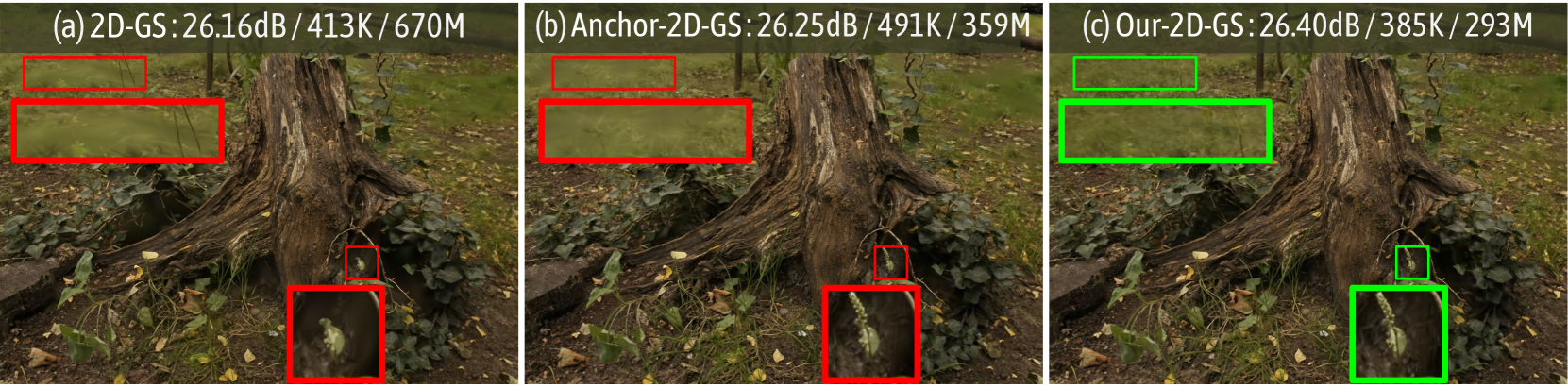
The image is a three-panel comparative visualization from a technical paper or report, evaluating the performance of different 2D Gaussian Splatting (2D-GS) algorithms. Each panel shows a rendered 3D scene of a tree stump in a forest setting, with specific regions highlighted to demonstrate rendering quality differences. The comparison focuses on three methods: a baseline, an anchor-based variant, and a proposed method ("Our-2D-GS").
### Components/Axes
The image is divided into three horizontally arranged panels, each with a title bar at the top containing the method name and performance metrics.
**Panel Titles & Metrics (Top of each panel):**
* **(a) Left Panel:** `2D-GS: 26.16dB / 413K / 670M`
* **(b) Center Panel:** `Anchor-2D-GS: 26.25dB / 491K / 359M`
* **(c) Right Panel:** `Our-2D-GS: 26.40dB / 385K / 293M`
**Metric Legend (Inferred from standard ML paper conventions):**
* `dB`: Peak Signal-to-Noise Ratio (PSNR), a measure of image quality (higher is better).
* `K`: Likely denotes the number of model parameters in thousands (e.g., 413K = 413,000 parameters).
* `M`: Likely denotes memory usage or computational cost in millions of operations or megabytes (lower is better).
**Visual Highlighting System:**
* **Red Boxes:** Used in panels (a) and (b) to indicate regions with visual artifacts, blurriness, or lower fidelity.
* **Green Boxes:** Used in panel (c) to indicate the same regions, now rendered with improved clarity and detail.
* **Box Placement:** Each panel has three highlighted regions:
1. **Top-left:** A rectangular area focusing on the grassy ground.
2. **Center-left:** A larger rectangular area focusing on the mid-ground grass and foliage.
3. **Bottom-right:** A square area focusing on a small, detailed plant or fungus growing on the tree stump.
### Detailed Analysis
**Panel (a) - 2D-GS (Baseline):**
* **Metrics:** PSNR = 26.16 dB, Parameters = 413K, Cost/Memory = 670M.
* **Visual Quality (Red Boxes):**
* **Top-left & Center-left:** The grass texture appears blurry and lacks high-frequency detail. Individual blades are not well-defined.
* **Bottom-right:** The small plant detail is very blurry and poorly resolved, appearing as an indistinct smudge.
**Panel (b) - Anchor-2D-GS:**
* **Metrics:** PSNR = 26.25 dB (slightly higher than baseline), Parameters = 491K (higher than baseline), Cost/Memory = 359M (significantly lower than baseline).
* **Visual Quality (Red Boxes):**
* **Top-left & Center-left:** Grass texture shows marginal improvement over (a) but remains generally blurry.
* **Bottom-right:** The plant detail is slightly more recognizable than in (a) but is still quite blurry and lacks sharp edges.
**Panel (c) - Our-2D-GS (Proposed Method):**
* **Metrics:** PSNR = 26.40 dB (highest of the three), Parameters = 385K (lowest of the three), Cost/Memory = 293M (lowest of the three).
* **Visual Quality (Green Boxes):**
* **Top-left & Center-left:** The grass texture is noticeably sharper. Individual blades and variations in the ground cover are more distinct.
* **Bottom-right:** The small plant detail is rendered with significantly higher clarity. Its structure and edges are well-defined compared to the blurry versions in (a) and (b).
### Key Observations
1. **Performance Trend:** The proposed method (`Our-2D-GS`) achieves the best balance of all metrics: highest image quality (PSNR), fewest parameters, and lowest computational/memory cost.
2. **Visual Fidelity:** There is a clear visual progression from blurry (a) to slightly less blurry (b) to sharp (c) in the highlighted regions, correlating with the increasing PSNR values.
3. **Efficiency Trade-off:** The `Anchor-2D-GS` method reduces cost (359M vs 670M) but increases parameter count (491K vs 413K) for a small quality gain. The proposed method improves upon both axes.
4. **Spatial Consistency:** The improvement is consistent across different types of detail—both the repetitive texture of grass and the unique, fine structure of the small plant are enhanced in panel (c).
### Interpretation
This image serves as a qualitative and quantitative validation of a new 2D Gaussian Splatting technique. The data suggests that the authors' method (`Our-2D-GS`) successfully addresses a key challenge in neural rendering: improving visual fidelity while simultaneously reducing model complexity and resource consumption.
The red-to-green box coding is a deliberate visual argument. It directs the viewer's attention to specific failure cases of prior methods (blurry textures and lost details) and demonstrates their resolution in the new approach. The accompanying metrics provide the empirical backbone, showing that the visual improvement is not due to simply using more resources; in fact, it's achieved with fewer.
The most significant finding is the decoupling of quality from resource cost. Typically, higher quality requires more parameters or computation. Here, the proposed method breaks that trend, achieving the best quality with the smallest footprint. This implies a more efficient underlying algorithm or representation, which is a substantial contribution to the field of real-time 3D rendering and computer vision. The comparison positions the new method as the new state-of-the-art among the three presented.