## Diagram: Cognitive Language Agent System Architecture
### Overview
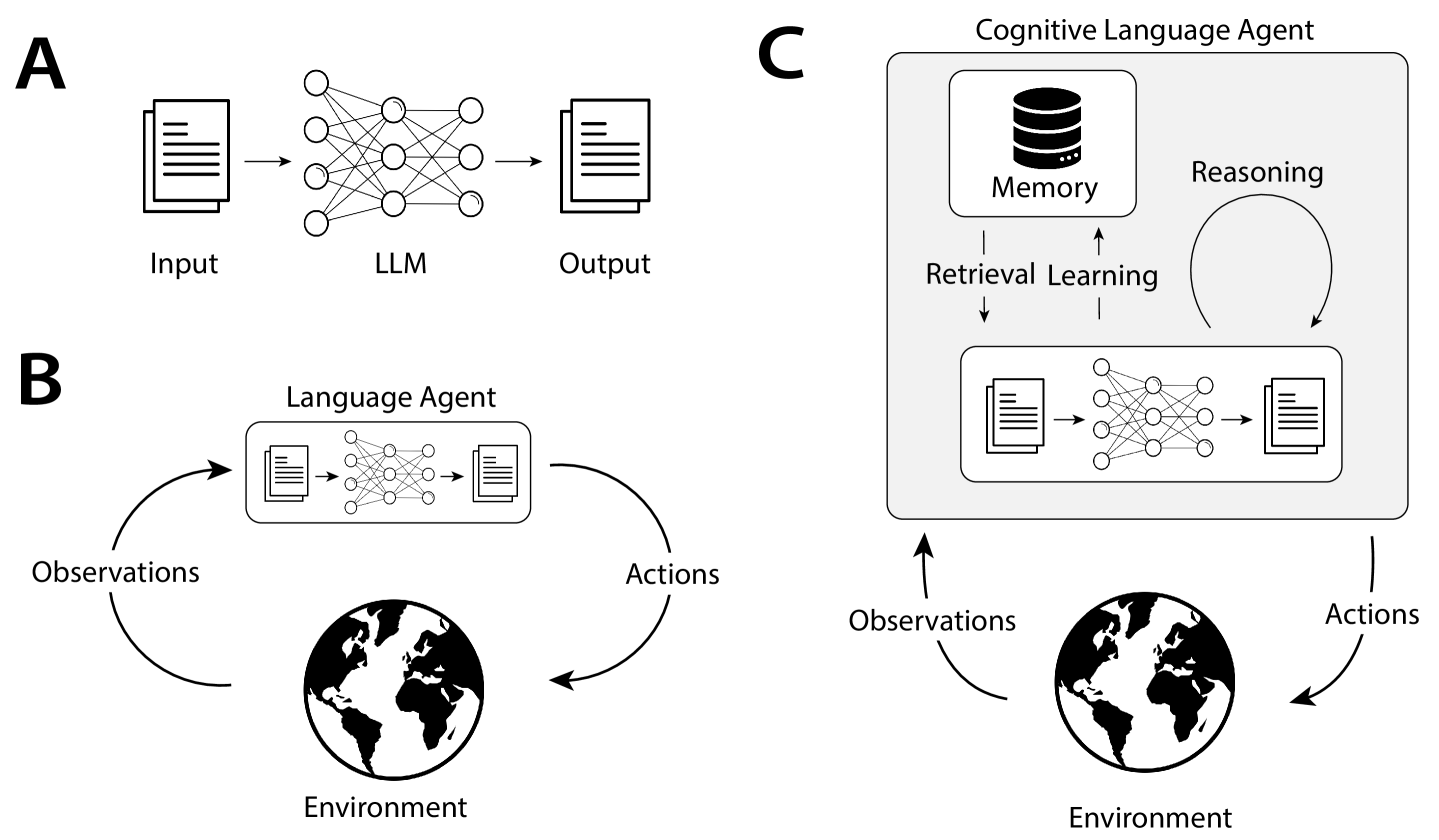
The image depicts a three-part system architecture for a cognitive language agent, illustrating input processing, environmental interaction, and memory-reasoning integration. Sections A, B, and C represent distinct components of the system.
### Components/Axes
#### Section A: Basic Language Model (LLM)
- **Input**: Text document icon (left)
- **LLM**: Neural network diagram (center)
- **Output**: Text document icon (right)
- **Flow**: Input → LLM → Output
#### Section B: Language Agent with Environment Interaction
- **Language Agent**: Neural network diagram (center)
- **Environment**: Globe icon (bottom)
- **Observations**: Curved arrow from Environment to Language Agent
- **Actions**: Curved arrow from Language Agent to Environment
- **Flow**: Observations → Language Agent → Actions → Environment → Observations
#### Section C: Cognitive Language Agent
- **Memory**: Stacked disk icon (top-left)
- **Retrieval Learning**: Arrow from Memory to Language Agent
- **Reasoning**: Circular arrow connecting Memory and Language Agent
- **Language Agent**: Neural network diagram (center)
- **Environment**: Globe icon (bottom)
- **Observations/Actions**: Arrows connecting Language Agent to Environment
- **Flow**: Memory → Retrieval Learning → Language Agent → Observations/Actions → Environment → Observations → Reasoning → Memory
### Detailed Analysis
1. **Section A**:
- Represents a standard language model pipeline.
- Input text is processed by the LLM to generate output text.
- No feedback loops or environmental interaction.
2. **Section B**:
- Introduces a **Language Agent** that interacts with an **Environment**.
- The agent receives **Observations** (e.g., sensory data) and produces **Actions** (e.g., responses).
- The Environment provides new Observations based on the Agent’s Actions, creating a closed-loop system.
3. **Section C**:
- Expands the Language Agent into a **Cognitive Language Agent** with **Memory** and **Reasoning**.
- **Memory** stores historical data, which is retrieved via **Retrieval Learning** to inform the Language Agent.
- **Reasoning** creates a feedback loop between Memory and the Language Agent, enabling adaptive decision-making.
- The Environment remains integral, but the agent now uses Memory to refine Observations and Actions.
### Key Observations
- **Hierarchical Complexity**:
- Section A → B → C shows increasing sophistication: from static LLM processing (A) to dynamic environmental interaction (B) to memory-augmented cognition (C).
- **Feedback Mechanisms**:
- Sections B and C emphasize closed-loop systems, where outputs (Actions) influence future inputs (Observations).
- **Memory Integration**:
- Section C introduces **Retrieval Learning** and **Reasoning**, enabling the agent to leverage past experiences for improved performance.
### Interpretation
This diagram illustrates the evolution of language agents from basic text processors (A) to autonomous, memory-aware systems (C). Key insights:
1. **Environmental Interaction**: Sections B and C highlight the importance of real-world feedback for adaptive learning.
2. **Memory as a Cognitive Enhancer**: Section C’s Memory component suggests that integrating historical data improves decision-making, akin to human episodic memory.
3. **Reasoning as a Feedback Loop**: The circular arrow between Memory and the Language Agent implies that reasoning is not a one-time process but an ongoing refinement mechanism.
The system’s design emphasizes **adaptability** (via environmental interaction) and **contextual awareness** (via memory and reasoning), positioning it as a step toward generalizable AI systems.