## Diagram: Language Agent Architectures
### Overview
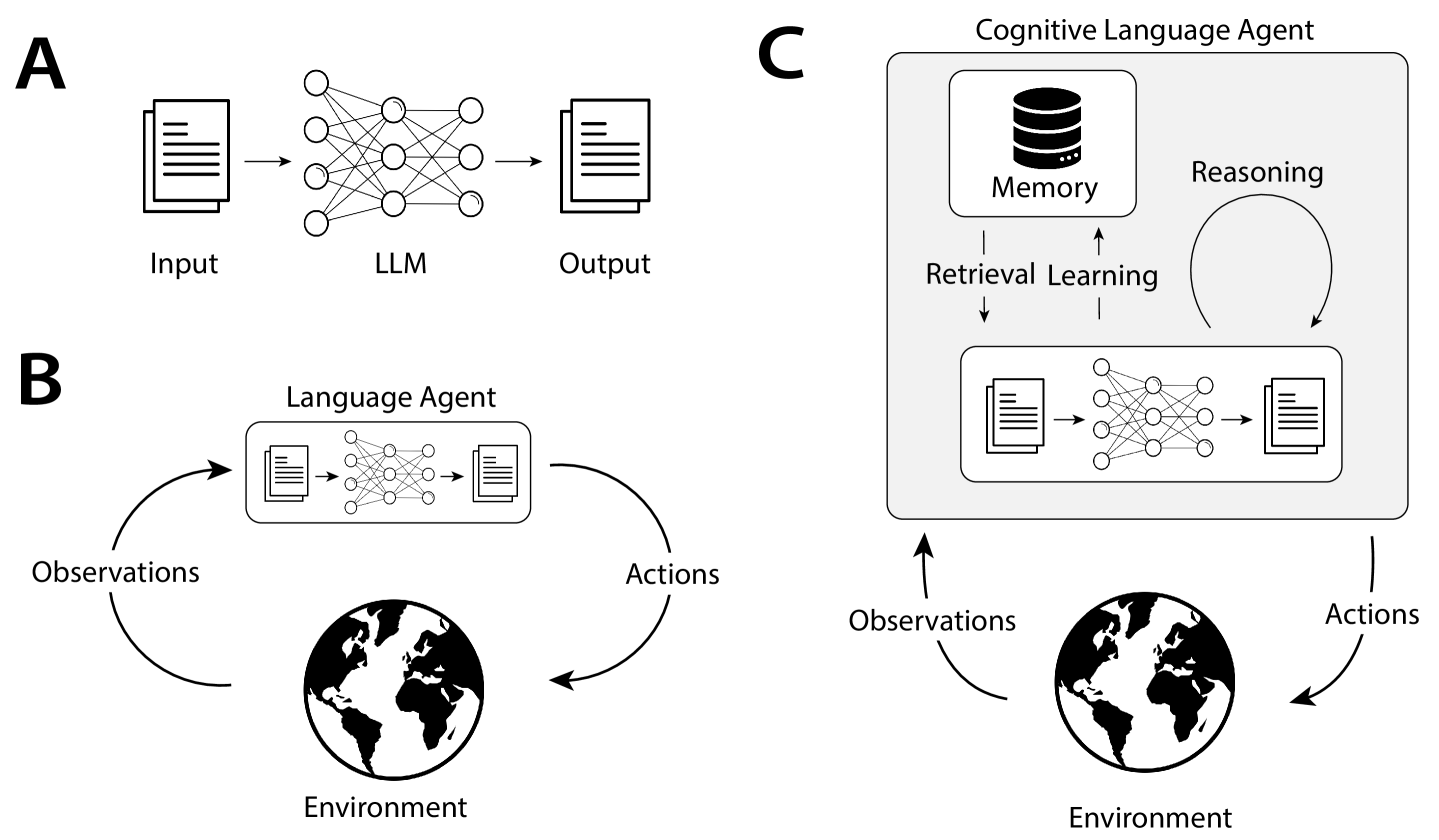
The image presents three diagrams (A, B, and C) illustrating different architectures for language agents. Diagram A shows a basic input-LLM-output structure. Diagram B depicts a language agent interacting with an environment through observations and actions. Diagram C illustrates a cognitive language agent with memory and reasoning capabilities, also interacting with an environment.
### Components/Axes
* **Diagram A:**
* **Input:** A document icon labeled "Input".
* **LLM:** A neural network diagram labeled "LLM".
* **Output:** A document icon labeled "Output".
* **Diagram B:**
* **Language Agent:** A rounded rectangle containing a document icon, a neural network diagram, and another document icon. Labeled "Language Agent".
* **Observations:** An arrow labeled "Observations" pointing from the environment to the language agent.
* **Actions:** An arrow labeled "Actions" pointing from the language agent to the environment.
* **Environment:** A globe icon labeled "Environment".
* **Diagram C:**
* **Cognitive Language Agent:** A large rounded rectangle containing a memory component, a reasoning loop, and a language processing component. Labeled "Cognitive Language Agent".
* **Memory:** A database icon labeled "Memory".
* **Retrieval Learning:** Arrows pointing between the memory and the language processing component, labeled "Retrieval Learning".
* **Reasoning:** A circular arrow labeled "Reasoning".
* **Language Processing Component:** A rounded rectangle containing a document icon, a neural network diagram, and another document icon.
* **Observations:** An arrow labeled "Observations" pointing from the environment to the cognitive language agent.
* **Actions:** An arrow labeled "Actions" pointing from the cognitive language agent to the environment.
* **Environment:** A globe icon labeled "Environment".
### Detailed Analysis or ### Content Details
* **Diagram A:** Shows a simple flow from Input -> LLM -> Output. The LLM is represented by a network of interconnected nodes.
* **Diagram B:** Illustrates a closed-loop system where the Language Agent receives "Observations" from the "Environment" and performs "Actions" that affect the "Environment".
* **Diagram C:** Expands on Diagram B by adding internal components to the Language Agent, specifically "Memory" and "Reasoning". The agent retrieves and learns from memory, and uses reasoning to inform its actions.
### Key Observations
* The diagrams progress from a basic LLM setup (A) to a more complex cognitive agent (C).
* Diagrams B and C emphasize the interaction between the agent and its environment.
* Diagram C highlights the internal cognitive processes of the agent.
### Interpretation
The diagrams illustrate the evolution of language agent architectures, moving from simple input-output models to more sophisticated agents capable of interacting with their environment and exhibiting cognitive functions like memory and reasoning. The progression suggests a trend towards creating more autonomous and intelligent language agents. The inclusion of "Memory" and "Reasoning" in Diagram C indicates an attempt to model more human-like cognitive processes within the agent. The "Retrieval Learning" loop suggests the agent can learn from past experiences, improving its performance over time.