## Diagram: Cognitive Language Agent Architecture
### Overview
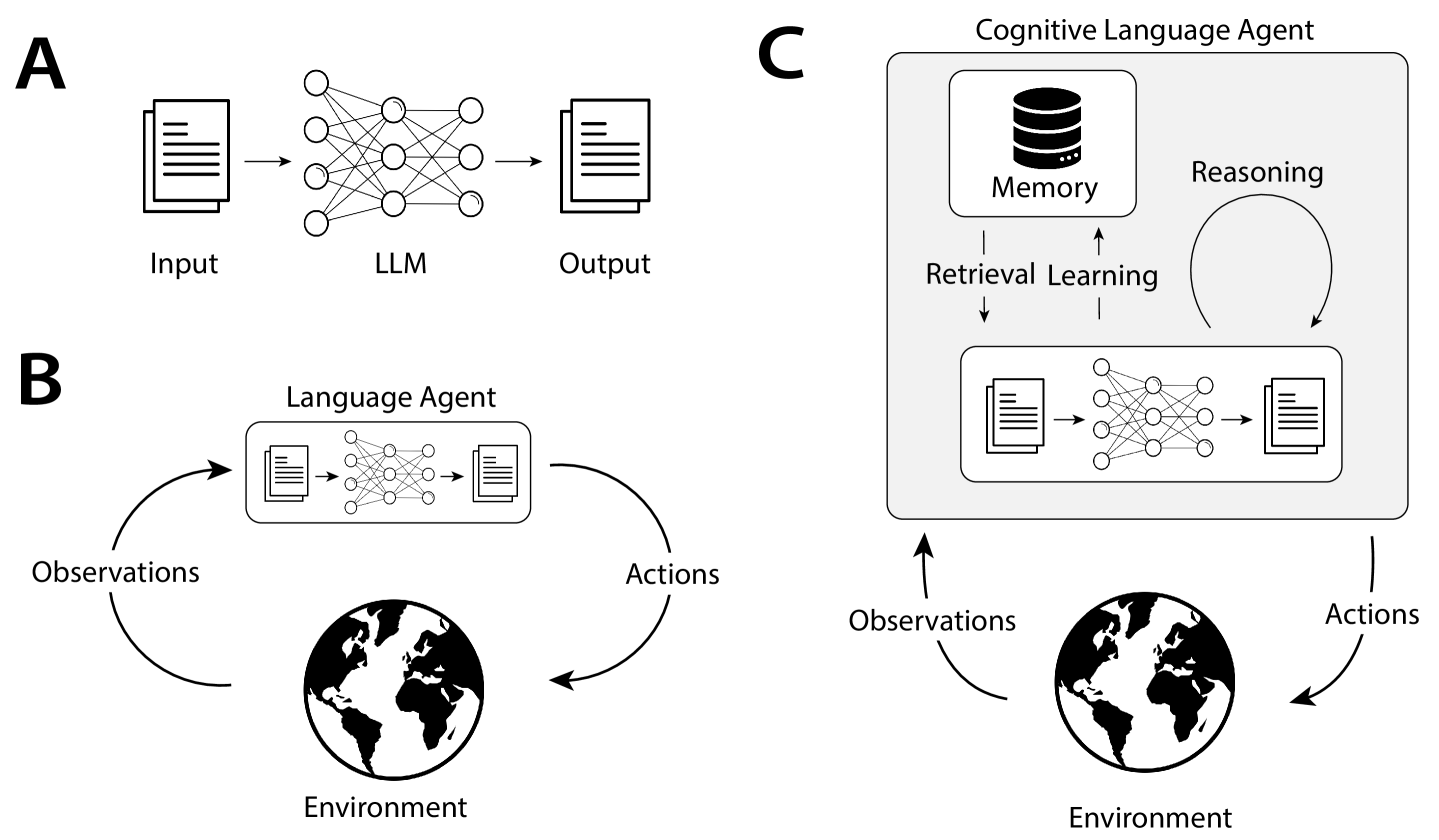
The image presents a series of diagrams (A, B, and C) illustrating the architecture of a Cognitive Language Agent. Diagram A shows a basic Large Language Model (LLM) process. Diagram B depicts a Language Agent interacting with an environment. Diagram C illustrates a more complex Cognitive Language Agent incorporating memory and reasoning. The diagrams use a consistent visual style with rounded rectangles representing processes, circles representing components, and arrows indicating flow.
### Components/Axes
The diagrams are labeled A, B, and C in the top-left corner. Each diagram contains the following components:
* **Input:** Represented by a document icon.
* **LLM:** Represented by a network of interconnected nodes.
* **Output:** Represented by a document icon.
* **Language Agent:** A box containing an LLM and associated processes.
* **Environment:** Represented by a globe.
* **Observations:** Represented by a speech bubble.
* **Actions:** Represented by a speech bubble.
* **Memory:** Represented by a cylinder.
* **Reasoning:** A curved arrow indicating a feedback loop.
* **Retrieval Learning:** An arrow connecting Memory and LLM.
### Detailed Analysis or Content Details
**Diagram A: Basic LLM Process**
* The diagram shows a linear flow from "Input" to "LLM" to "Output".
* The "Input" and "Output" are represented by document icons.
* The "LLM" is represented by a network of approximately 20 interconnected nodes.
* Arrows indicate a unidirectional flow of information.
**Diagram B: Language Agent Interaction**
* The "Language Agent" box contains an LLM (similar to Diagram A) and is connected to the "Environment" via "Observations" and "Actions".
* "Observations" are received from the "Environment" and fed into the "Language Agent".
* "Actions" are generated by the "Language Agent" and sent to the "Environment".
* The "Environment" is represented by a globe.
* The "Observations" and "Actions" are represented by speech bubbles.
* The flow is cyclical, with "Observations" leading to "Actions" which affect the "Environment", which then provides new "Observations".
**Diagram C: Cognitive Language Agent**
* This diagram builds upon Diagram B, adding "Memory" and "Reasoning" components.
* The "Cognitive Language Agent" box encompasses the LLM, "Memory", and "Reasoning".
* "Memory" is represented by a cylinder and is connected to the LLM via "Retrieval Learning".
* "Reasoning" is represented by a curved arrow, indicating a feedback loop from the LLM back to itself.
* The "Cognitive Language Agent" interacts with the "Environment" through "Observations" and "Actions", similar to Diagram B.
* The flow is more complex, with "Retrieval Learning" and "Reasoning" influencing the LLM's processing of "Observations" and generation of "Actions".
### Key Observations
* The diagrams demonstrate increasing complexity in agent architecture.
* Diagram A represents a simple LLM.
* Diagram B introduces the concept of an agent interacting with an environment.
* Diagram C adds cognitive capabilities (memory and reasoning) to the agent.
* The cyclical flow in Diagrams B and C highlights the agent's ability to learn and adapt based on its interactions with the environment.
* The "Retrieval Learning" component suggests that the agent can leverage past experiences (stored in "Memory") to improve its performance.
### Interpretation
The diagrams illustrate a progression in the development of intelligent agents. Diagram A represents a foundational LLM, capable of processing and generating text. Diagram B expands on this by placing the LLM within an agent that can perceive and act in an environment. This introduces the concept of embodied intelligence. Diagram C represents a significant advancement by incorporating cognitive capabilities such as memory and reasoning. This allows the agent to learn from its experiences, adapt to changing circumstances, and make more informed decisions.
The inclusion of "Retrieval Learning" suggests that the agent is not simply learning from scratch with each interaction, but rather building upon a knowledge base stored in "Memory". The "Reasoning" component indicates that the agent can engage in higher-level cognitive processes, such as planning and problem-solving.
The overall architecture depicted in Diagram C suggests a move towards more sophisticated and autonomous agents capable of performing complex tasks in real-world environments. The diagrams are conceptual and do not provide specific details about the implementation of these components, but they offer a valuable framework for understanding the key elements of a Cognitive Language Agent.