## Bar Chart: Accuracy of Prompting Methods for Mistake Detection
### Overview
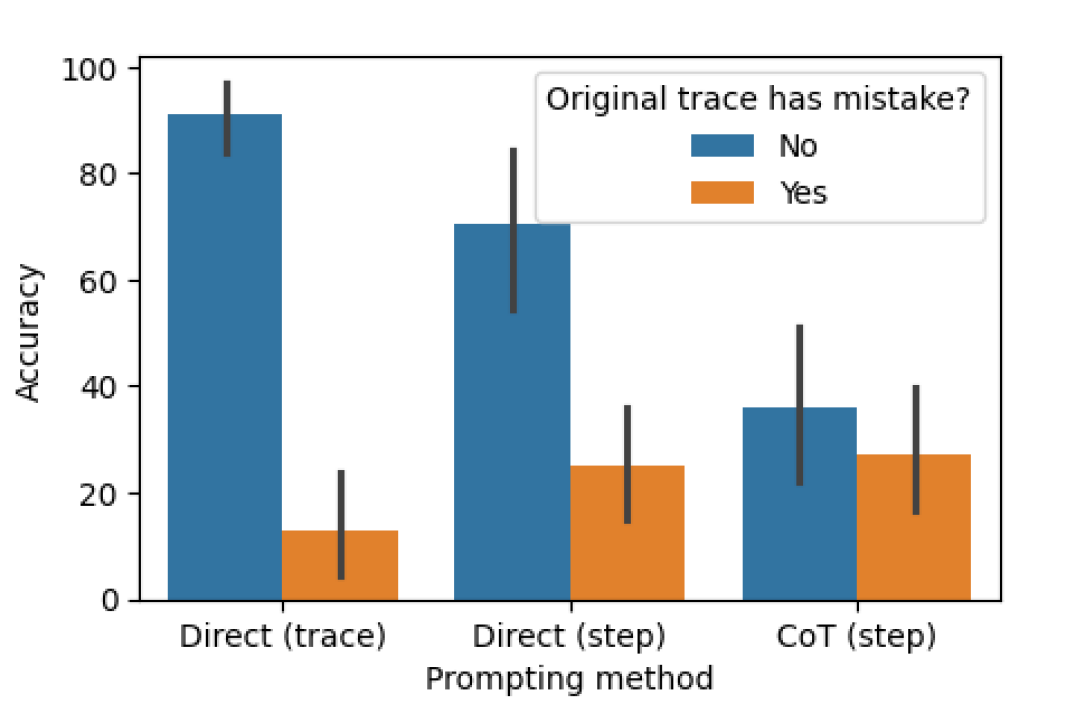
The chart compares the accuracy of three prompting methods ("Direct (trace)", "Direct (step)", and "CoT (step)") in detecting whether an original trace contains mistakes. Accuracy is measured on a 0-100 scale, with separate bars for cases where the original trace **has no mistake** (blue) and **has a mistake** (orange). Error bars indicate variability in measurements.
### Components/Axes
- **X-axis**: Prompting methods
- Categories: Direct (trace), Direct (step), CoT (step)
- **Y-axis**: Accuracy (0-100 scale)
- **Legend**:
- Blue = "No" (original trace has no mistake)
- Orange = "Yes" (original trace has a mistake)
- **Error Bars**: Vertical lines on each bar representing measurement uncertainty
### Detailed Analysis
1. **Direct (trace)**
- Blue ("No"): ~90 accuracy (error ±10)
- Orange ("Yes"): ~15 accuracy (error ±5)
2. **Direct (step)**
- Blue ("No"): ~70 accuracy (error ±15)
- Orange ("Yes"): ~25 accuracy (error ±10)
3. **CoT (step)**
- Blue ("No"): ~35 accuracy (error ±15)
- Orange ("Yes"): ~28 accuracy (error ±10)
### Key Observations
- **Trend 1**: Accuracy for "No" mistakes decreases significantly from Direct (trace) to CoT (step) (~90 → ~35).
- **Trend 2**: Accuracy for "Yes" mistakes increases slightly from Direct (trace) to CoT (step) (~15 → ~28).
- **Error Patterns**: Largest variability occurs in "No" mistake detection for Direct (step) and CoT (step).
### Interpretation
The data suggests a trade-off between overall accuracy and mistake detection capability:
- **Direct (trace)** excels at identifying correct traces but struggles with mistake detection.
- **CoT (step)** improves mistake detection but sacrifices overall accuracy, potentially due to increased complexity in reasoning steps.
- The error bars highlight reduced reliability in complex prompting methods, particularly for "No" mistake cases.
This pattern may reflect challenges in balancing precision and recall in trace analysis systems, where simpler methods prioritize correctness while advanced methods focus on error identification at the cost of general performance.