\n
## Bar Chart: Prompt Length vs. Average Success Rate
### Overview
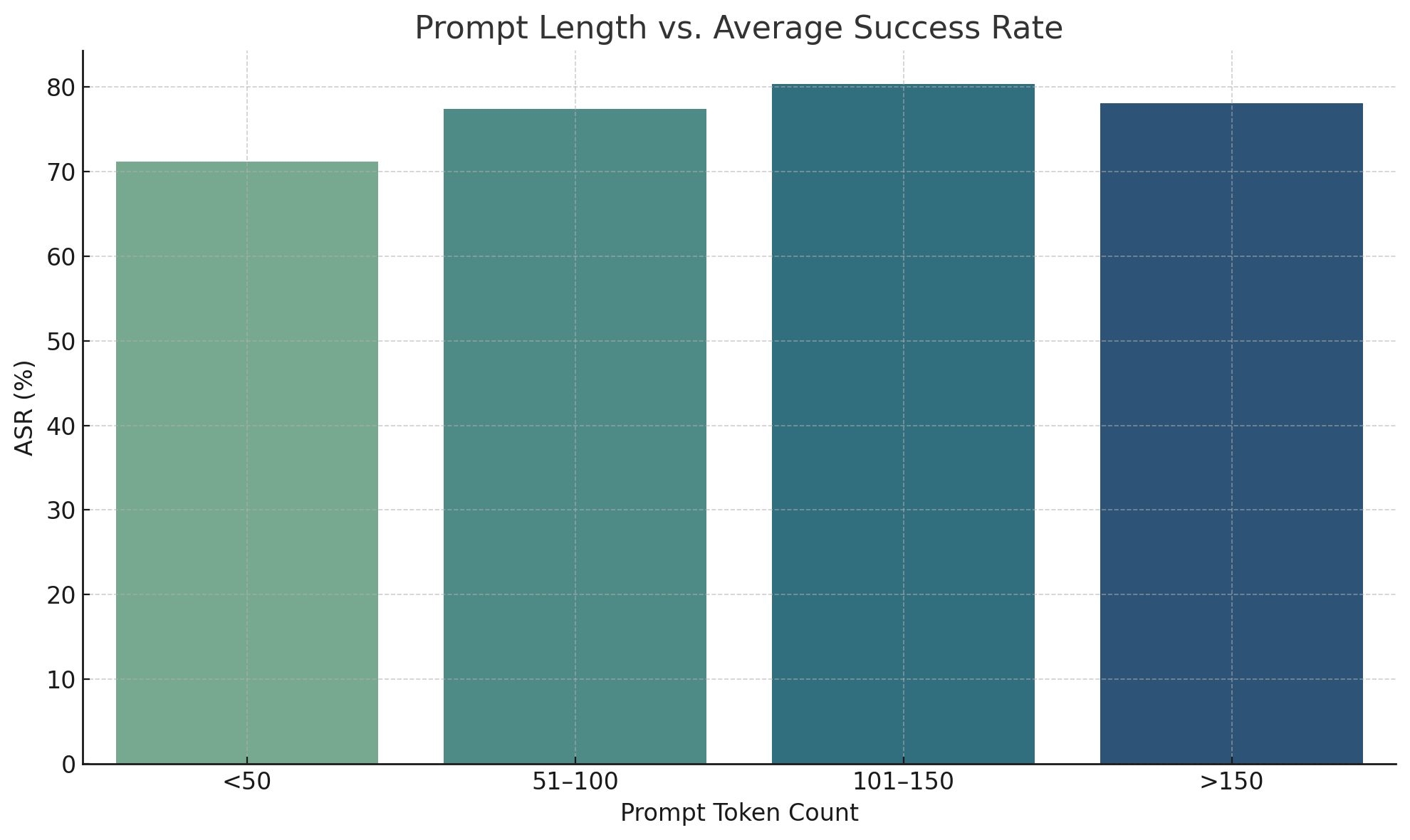
This is a vertical bar chart illustrating the relationship between the length of a prompt (measured in token count) and its average success rate (ASR). The chart suggests that success rate generally increases with prompt length up to a point, after which it may plateau or slightly decline.
### Components/Axes
* **Chart Title:** "Prompt Length vs. Average Success Rate" (centered at the top).
* **X-Axis (Horizontal):**
* **Label:** "Prompt Token Count" (centered below the axis).
* **Categories (from left to right):**
1. `<50`
2. `51-100`
3. `101-150`
4. `>150`
* **Y-Axis (Vertical):**
* **Label:** "ASR (%)" (rotated 90 degrees, positioned to the left of the axis).
* **Scale:** Linear scale from 0 to 80, with major tick marks and grid lines at intervals of 10 (0, 10, 20, 30, 40, 50, 60, 70, 80).
* **Data Series:** Four distinct bars, each representing a token count category. The bars are colored in a sequential palette, progressing from a light sage green to a dark slate blue.
* **Grid:** Light gray, dashed horizontal grid lines extend from each major y-axis tick mark across the chart area.
### Detailed Analysis
The chart displays four bars, each corresponding to a prompt token count range. The visual trend is an increase in bar height (success rate) from the first to the third category, followed by a slight decrease in the fourth.
1. **Bar 1 (Position: Far Left):**
* **Category:** `<50` tokens.
* **Color:** Light sage green.
* **Trend:** This is the shortest bar.
* **Approximate Value:** The top of the bar aligns just above the 70% grid line. Estimated ASR: **~71%**.
2. **Bar 2 (Position: Center-Left):**
* **Category:** `51-100` tokens.
* **Color:** Medium teal green.
* **Trend:** This bar is taller than the first.
* **Approximate Value:** The top of the bar is between the 70% and 80% grid lines, closer to 80%. Estimated ASR: **~77%**.
3. **Bar 3 (Position: Center-Right):**
* **Category:** `101-150` tokens.
* **Color:** Dark teal blue.
* **Trend:** This is the tallest bar in the chart.
* **Approximate Value:** The top of the bar appears to be exactly on or very slightly above the 80% grid line. Estimated ASR: **~80%**.
4. **Bar 4 (Position: Far Right):**
* **Category:** `>150` tokens.
* **Color:** Dark slate blue.
* **Trend:** This bar is slightly shorter than the third bar but taller than the second.
* **Approximate Value:** The top of the bar is just below the 80% grid line. Estimated ASR: **~78%**.
### Key Observations
* **Peak Performance:** The highest average success rate (~80%) is observed for prompts in the `101-150` token range.
* **Non-Linear Relationship:** The relationship is not strictly linear. Success rate increases significantly from the shortest prompts (`<50`) to medium-length prompts (`51-100` and `101-150`), but then shows a slight decline for the longest prompts (`>150`).
* **High Baseline:** Even the shortest prompt category (`<50`) achieves a relatively high success rate of approximately 71%.
* **Color Coding:** The chart uses a sequential color scheme (light green to dark blue) to visually distinguish the categories, with darker colors generally corresponding to longer prompt lengths and higher success rates (with the exception of the final bar).
### Interpretation
The data suggests an **optimal prompt length window** for maximizing success rate, centered around 101-150 tokens. This implies that providing sufficient context and detail (within this range) is beneficial for task completion.
The slight decrease in success rate for prompts longer than 150 tokens could indicate a point of **diminishing returns or potential interference**. Excessively long prompts might introduce noise, dilute the core instruction, or exceed the effective context window of the underlying model, leading to a minor performance drop.
From a practical standpoint, this chart provides a heuristic for prompt engineering: aiming for a token count in the 100-150 range may yield the most reliable results, while very short prompts may lack necessary context, and very long prompts may become less efficient. The high baseline success for short prompts also indicates that the system is reasonably robust even with minimal input.