\n
## Text Block: Knowledge Graph Queries
### Overview
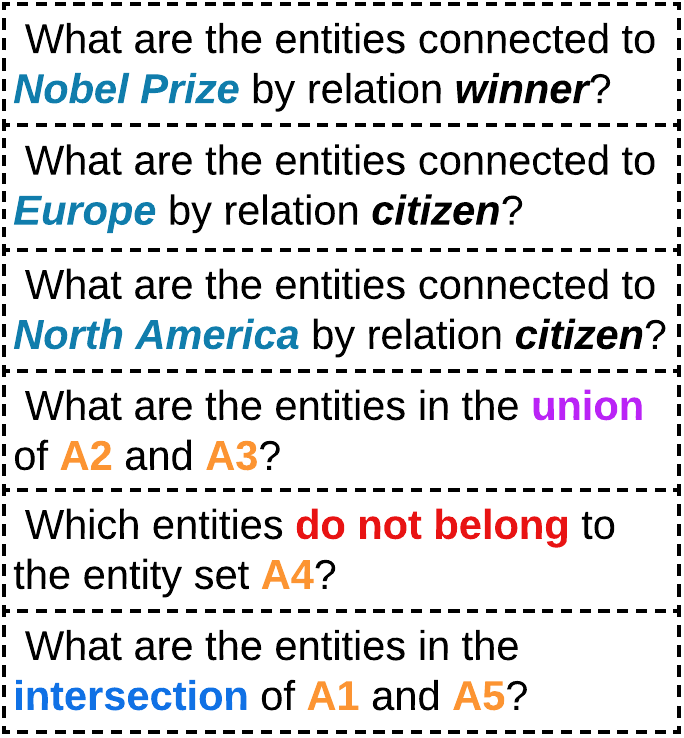
The image presents a series of six knowledge graph queries, formatted as questions within dashed-line boxes. The queries relate to entities, relations, and sets (A1, A2, A3, A4, A5). The image does not contain any charts, diagrams, or numerical data. It is purely textual.
### Content Details
Here's a transcription of each query:
1. "What are the entities connected to **Nobel Prize** by relation **winner**?"
2. "What are the entities connected to **Europe** by relation **citizen**?"
3. "What are the entities connected to **North America** by relation **citizen**?"
4. "What are the entities in the **union** of **A2** and **A3**?"
5. "Which entities do not **belong to** the entity set **A4**?"
6. "What are the entities in the **intersection** of **A1** and **A5**?"
### Key Observations
The queries utilize specific terminology common in knowledge graph databases:
* **Entities:** Nobel Prize, Europe, North America, A1, A2, A3, A4, A5.
* **Relations:** winner, citizen, union, intersection, belong to.
* **Set Operations:** union, intersection.
The queries are designed to retrieve information from a knowledge graph based on these entities and relations. The use of sets (A1-A5) suggests a structured organization of entities within the graph.
### Interpretation
The image represents a set of instructions or prompts for querying a knowledge graph. The queries are focused on identifying relationships between entities and performing set operations on entity collections. This suggests the knowledge graph contains information about people, places, awards, and potentially other concepts, and that these concepts are interconnected through defined relationships. The queries are likely intended to test the functionality of a knowledge graph system or to extract specific information from it. The queries are not self-contained; they require a knowledge graph to provide meaningful answers.