## Textual Query List: Entity-Relationship and Set Operations
### Overview
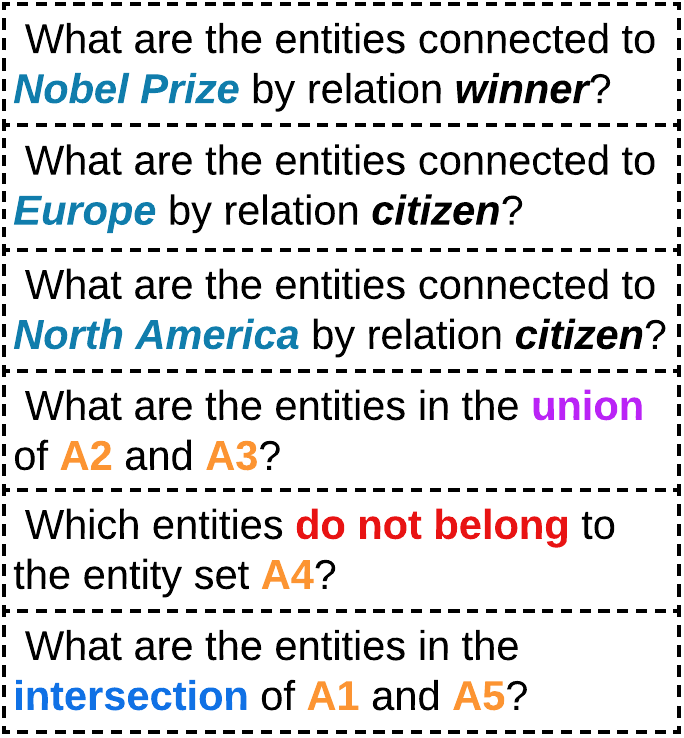
The image displays a vertical list of six distinct questions, each enclosed within a rectangular box defined by a dashed black border. The questions are presented in English and appear to be structured queries, likely for a knowledge graph, database, or logical reasoning system. Key terms within each question are highlighted using specific colors and text styles to denote their semantic role.
### Components/Axes
The image is composed solely of text elements arranged in a stacked, list-like format. There are no traditional chart axes, legends, or data points. The primary structural and semantic components are:
* **Container Boxes:** Six separate boxes with dashed black outlines, stacked vertically.
* **Text Content:** Each box contains one complete question in English.
* **Stylistic Highlighting:** Specific words or phrases within the questions are formatted with distinct colors and font styles (bold, italics) to categorize them.
### Detailed Analysis
The following is a precise transcription of the text within each box, from top to bottom. The color and style of highlighted text are noted in brackets.
**Box 1 (Top):**
* **Text:** "What are the entities connected to **Nobel Prize** by relation *winner*?"
* **Highlighting:** "Nobel Prize" is in blue. "winner" is in bold italics.
**Box 2:**
* **Text:** "What are the entities connected to **Europe** by relation *citizen*?"
* **Highlighting:** "Europe" is in blue. "citizen" is in bold italics.
**Box 3:**
* **Text:** "What are the entities connected to **North America** by relation *citizen*?"
* **Highlighting:** "North America" is in blue. "citizen" is in bold italics.
**Box 4:**
* **Text:** "What are the entities in the **union** of A2 and A3?"
* **Highlighting:** "union" is in purple. "A2" and "A3" are in orange.
**Box 5:**
* **Text:** "Which entities **do not belong** to the entity set A4?"
* **Highlighting:** "do not belong" is in red. "A4" is in orange.
**Box 6 (Bottom):**
* **Text:** "What are the entities in the **intersection** of A1 and A5?"
* **Highlighting:** "intersection" is in blue. "A1" and "A5" are in orange.
### Key Observations
1. **Query Pattern:** The first three questions follow an identical syntactic pattern: "What are the entities connected to [Entity] by relation [Relation]?" This suggests a template for querying direct relationships in a knowledge graph.
2. **Color-Coded Semantics:** The highlighting scheme appears consistent and meaningful:
* **Blue:** Used for named entities (Nobel Prize, Europe, North America) and the set operation "intersection".
* **Bold Italics:** Used exclusively for relationship types (winner, citizen).
* **Purple:** Used for the set operation "union".
* **Orange:** Used for identifiers of entity sets (A1, A2, A3, A4, A5).
* **Red:** Used for the negation concept "do not belong".
3. **Set Theory Operations:** The last three questions shift from relational queries to operations on abstract entity sets (A1-A5), involving union, negation (complement), and intersection.
4. **Spatial Layout:** The questions are presented in a clear, top-to-bottom sequence without overlap. The dashed borders create a clean separation between distinct queries.
### Interpretation
This image is not a data visualization but a **structured query template or test set**. It demonstrates two fundamental types of information retrieval operations:
1. **Relational Lookup (Boxes 1-3):** These questions are designed to retrieve entities based on a specific, named relationship to a given anchor entity. This is a core operation in knowledge graphs and semantic networks. The use of "citizen" for geographical entities (Europe, North America) and "winner" for an award (Nobel Prize) illustrates how relations define connections between different types of nodes.
2. **Set-Theoretic Operations (Boxes 4-6):** These questions operate on pre-defined collections of entities (sets A1-A5). They test the ability to compute:
* **Union:** Combining all elements from two sets.
* **Negation/Complement:** Identifying elements outside a specified set.
* **Intersection:** Finding common elements between two sets.
The color-coding is a critical visual aid that reinforces the grammatical and logical roles of the terms, making the query structure immediately apparent. The progression from concrete relational queries to abstract set operations suggests this could be part of an educational exercise, a benchmark for a reasoning system, or a specification for a query language interface. The absence of specific answers or data indicates the image's purpose is to define the *questions themselves*, not to present results.