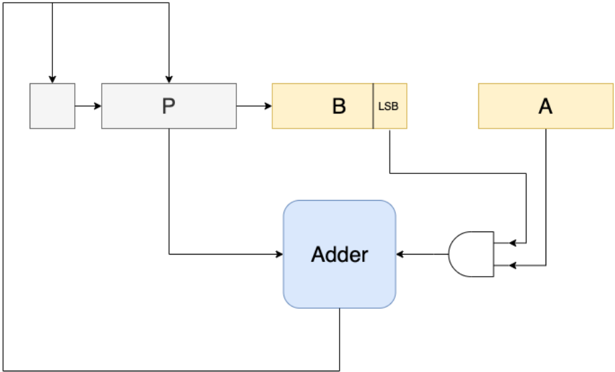
## Circuit Diagram
### Overview
The image depicts a simple electronic circuit diagram consisting of various components connected by wires. The diagram includes a power source, a switch, a resistor, an inductor, a capacitor, and a voltage divider. The components are labeled with their respective symbols and names.
### Components/Axes
- **Power Source**: Represented by a battery symbol, labeled as Vcc.
- **Switch**: Symbolized by a switch, labeled as S.
- **Resistor**: Shown as a rectangle with a zigzag line, labeled as R.
- **Inductor**: Depicted as a coiled wire, labeled as L.
- **Capacitor**: Represented by two parallel lines, labeled as C.
- **Voltage Divider**: Shown as two resistors in series, labeled as R1 and R2.
- **Voltage Measurement**: Indicated by a voltmeter symbol, labeled as Vout.
### Detailed Analysis or ### Content Details
The circuit diagram illustrates a voltage divider configuration, where the input voltage (Vcc) is divided into two output voltages (Vout) across the two resistors (R1 and R2). The voltage across each resistor can be calculated using the voltage divider formula:
\[ V_{out} = V_{cc} \times \frac{R_2}{R_1 + R_2} \]
The switch (S) can be used to control the flow of current in the circuit, allowing the user to turn the voltage divider on or off. The resistor (R) and inductor (L) can be used to filter or limit the current in the circuit, while the capacitor (C) can be used to store and release energy.
### Key Observations
- The voltage divider configuration is commonly used in electronic circuits to provide a stable output voltage from a variable input voltage.
- The switch allows for easy control of the circuit, enabling the user to adjust the output voltage as needed.
- The resistors and inductor can be used to filter or limit the current, while the capacitor can be used to store and release energy.
### Interpretation
The circuit diagram demonstrates a basic voltage divider configuration, which is a fundamental component in electronic circuits. The voltage divider is used to provide a stable output voltage from a variable input voltage, which is essential in many electronic applications. The switch allows for easy control of the circuit, enabling the user to adjust the output voltage as needed. The resistors and inductor can be used to filter or limit the current, while the capacitor can be used to store and release energy. Overall, the circuit diagram illustrates a simple yet essential electronic component that is widely used in various applications.