## Diagram: Comparative Workflow Analysis for Target Recovery
### Overview
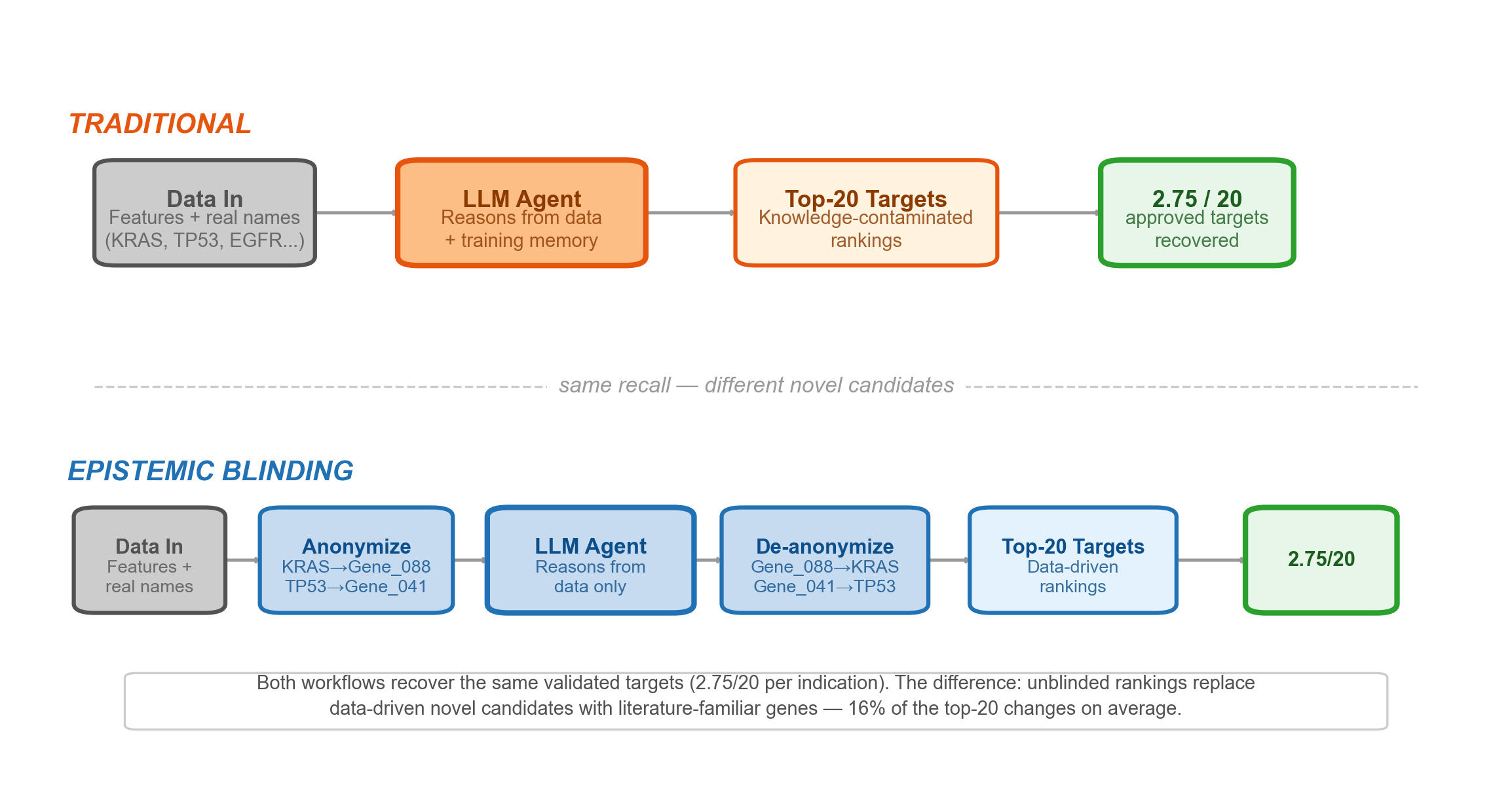
The diagram compares two workflows for recovering validated targets (2.75/20 per indication):
1. **Traditional Workflow** (orange): Uses real names in data and knowledge-contaminated rankings.
2. **Epistemic Blinding Workflow** (blue): Anonymizes data, uses data-driven rankings, and de-anonymizes later.
Both workflows achieve identical target recovery (2.75/20), but differ in candidate selection methodology.
---
### Components/Axes
#### Traditional Workflow (Orange):
1. **Data In**: Features + real names (KRAS, TP53, EGFR...).
2. **LLM Agent**: Generates reasons from data + training memory.
3. **Top-20 Targets**: Knowledge-contaminated rankings.
4. **Result**: 2.75/20 approved targets recovered.
#### Epistemic Blinding Workflow (Blue):
1. **Data In**: Features + real names.
2. **Anonymize**:
- KRAS → Gene_088
- TP53 → Gene_041
3. **LLM Agent**: Generates reasons from anonymized data only.
4. **De-anonymize**:
- Gene_088 → KRAS
- Gene_041 → TP53
5. **Top-20 Targets**: Data-driven rankings.
6. **Result**: 2.75/20 approved targets recovered.
#### Key Textual Elements:
- **Dotted Line Note**: "same recall — different novel candidates" (between workflows).
- **Bottom Box**: "Both workflows recover the same validated targets (2.75/20 per indication). The difference: unblinded rankings replace data-driven novel candidates with literature-familiar genes — 16% of the top-20 changes on average."
---
### Detailed Analysis
#### Traditional Workflow:
- **Data Input**: Explicitly includes real gene names (KRAS, TP53, EGFR).
- **LLM Agent**: Combines data-derived reasoning with training memory, introducing potential knowledge contamination.
- **Top-20 Targets**: Rankings influenced by pre-existing knowledge (e.g., literature bias).
- **Result**: 2.75/20 targets recovered, but rankings may prioritize familiar genes over novel candidates.
#### Epistemic Blinding Workflow:
- **Anonymization**: Replaces real gene names with placeholders (e.g., KRAS → Gene_088) to remove knowledge bias.
- **LLM Agent**: Relies solely on anonymized data, eliminating knowledge contamination.
- **De-anonymization**: Restores original gene names after ranking.
- **Top-20 Targets**: Data-driven rankings, reducing reliance on prior knowledge.
- **Result**: Same 2.75/20 recovery, but with 16% average change in top-20 candidates compared to the traditional workflow.
---
### Key Observations
1. **Identical Recovery Rate**: Both workflows achieve 2.75/20 validated targets, suggesting robustness in target identification.
2. **Candidate Diversity**: Epistemic blinding introduces 16% average changes in top-20 candidates, indicating reduced bias toward literature-familiar genes.
3. **Workflow Trade-offs**:
- Traditional: Faster but risks knowledge contamination.
- Epistemic Blinding: More rigorous but requires anonymization/de-anonymization steps.
---
### Interpretation
The diagram highlights a critical tension in biomedical research: balancing efficiency with objectivity. The traditional workflow prioritizes speed by retaining real names, but this risks biasing rankings toward well-studied genes (e.g., KRAS, TP53). Epistemic blinding mitigates this by anonymizing data, forcing the LLM to rely on novel patterns rather than prior knowledge. While both methods recover the same validated targets, the blinded approach introduces more diverse candidates, potentially uncovering understudied pathways.
The 16% average change in top-20 rankings underscores the impact of knowledge contamination. This suggests that "data-driven" rankings, when decoupled from pre-existing biases, can surface novel hypotheses. However, the identical recovery rate implies that both methods are equally effective at identifying validated targets, though their candidate pools differ.
**Implications for Research**:
- Epistemic blinding could improve the discovery of novel targets but may require additional validation steps.
- Traditional workflows risk reinforcing existing knowledge gaps but are more practical for rapid screening.
- The workflow choice depends on the research goal: novelty vs. efficiency.