## Flowchart: Protocol Document Processing Workflow
### Overview
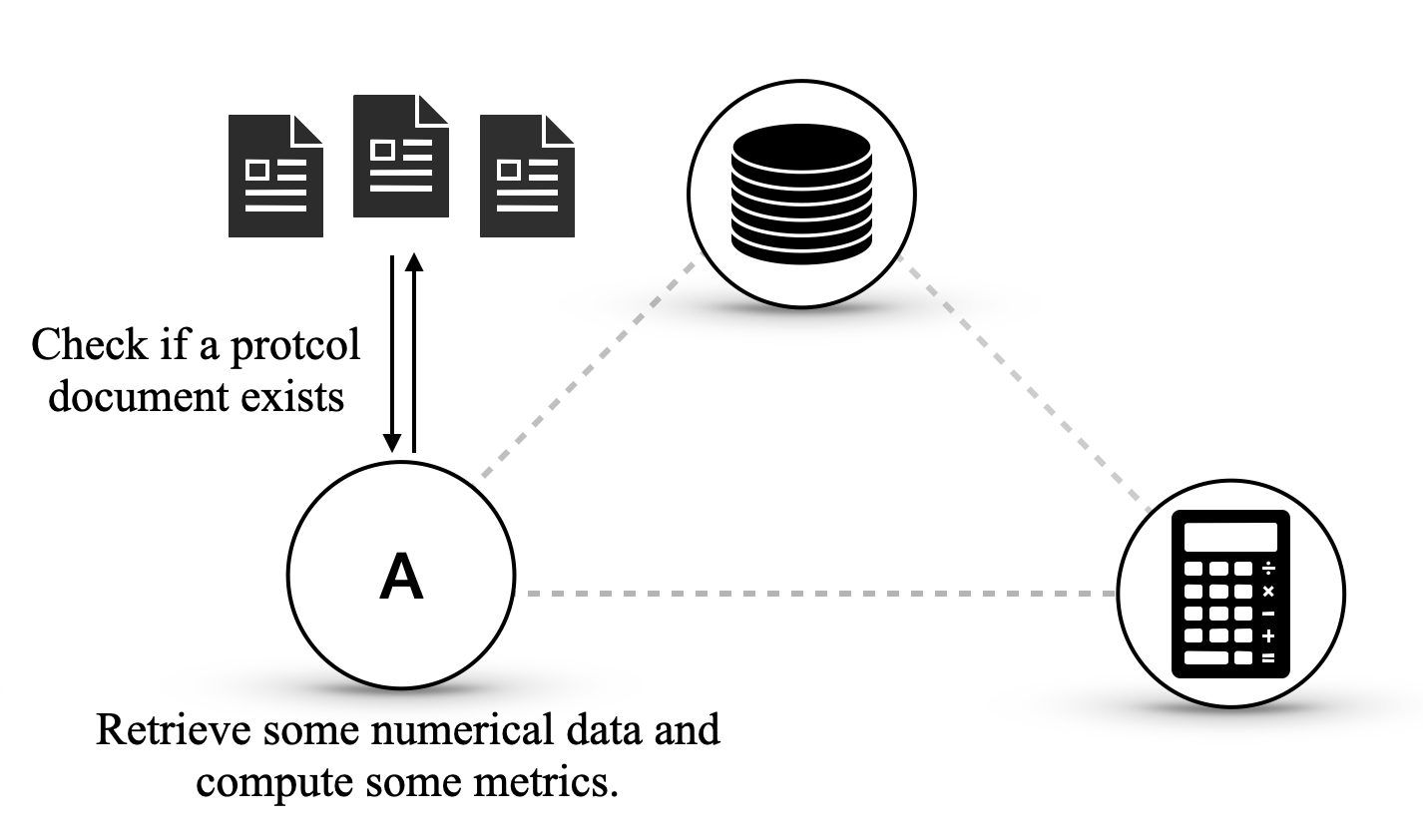
The image depicts a flowchart with three primary components:
1. **Document Check**: Three document icons labeled "Check if a protocol document exists"
2. **Central Processing Node**: A circle labeled "A"
3. **Calculation Module**: A calculator icon
Dashed arrows connect these elements, suggesting conditional or iterative relationships.
### Components/Axes
- **Top Row**: Three document icons (black with white text)
- Label: "Check if a protocol document exists"
- Arrows: Vertical bidirectional arrows connecting documents to circle "A"
- **Center**: Circle labeled "A"
- Dashed arrows connect to:
- Stack of disks (symbolizing data storage/processing)
- Calculator icon (symbolizing computation)
- **Bottom Right**: Calculator icon
- Label: "Retrieve some numerical data and compute some metrics"
### Detailed Analysis
- **Document Check**:
- Three identical document icons represent protocol document verification.
- Bidirectional arrows imply potential feedback loops (e.g., document validation may require rechecking).
- **Central Node "A"**:
- Acts as a decision/processing hub.
- Dashed arrows to disks and calculator suggest conditional execution (e.g., "A" determines whether to proceed to storage or computation).
- **Calculator Module**:
- Explicitly tied to numerical data retrieval and metric computation.
### Key Observations
- **Conditional Flow**: The dashed arrows indicate optional or probabilistic steps (e.g., computation may only occur if certain conditions in "A" are met).
- **Data Dependency**: The stack of disks (data storage) is linked to "A," implying data retrieval precedes computation.
- **No Numerical Data**: The flowchart lacks quantitative values, focusing on process logic rather than metrics.
### Interpretation
This flowchart outlines a protocol-driven workflow:
1. **Document Validation**: Ensures compliance or correctness of input documents.
2. **Central Decision ("A")**: Determines next steps (e.g., data storage vs. computation).
3. **Metric Computation**: Final step for generating numerical outputs.
The use of dashed arrows suggests flexibility, allowing the process to adapt based on document validity or intermediate results. The absence of explicit numerical thresholds implies the workflow is designed for general protocol adherence rather than specific quantitative analysis.