## Knowledge Graph and Question Answering Diagram
### Overview
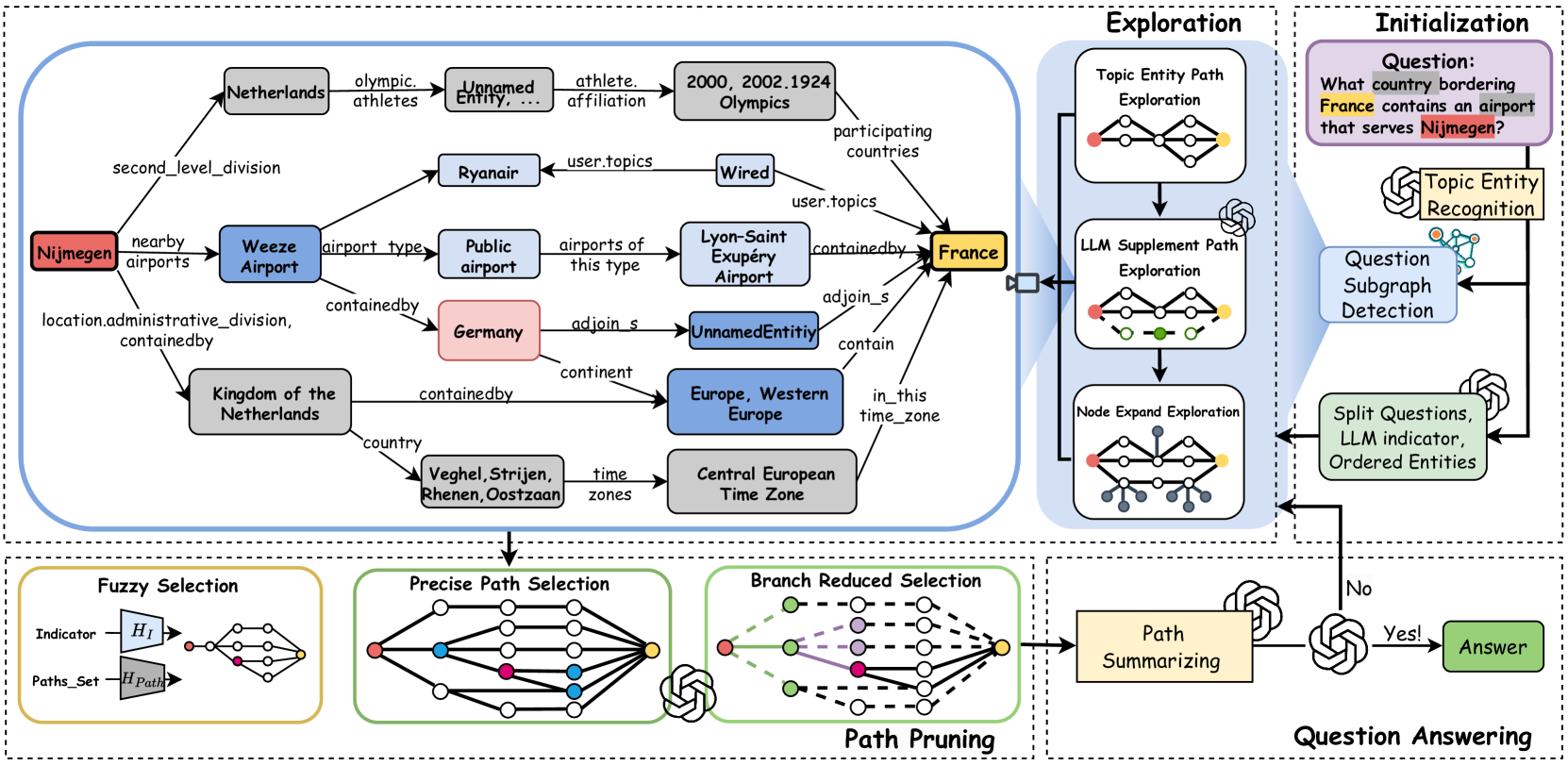
The image is a diagram illustrating a knowledge graph and a question-answering process. It depicts how a question is processed through various stages, including initialization, exploration, path pruning, and question answering, using a knowledge graph to find the answer.
### Components/Axes
**1. Knowledge Graph (Left Side):**
* Nodes: Represent entities (e.g., "Nijmegen," "Weeze Airport," "France," "Germany," "Kingdom of the Netherlands," "Europe, Western Europe," "Central European Time Zone," "Olympics," "Ryanair," "Wired," "Lyon-Saint Exupéry Airport").
* Edges: Represent relationships between entities (e.g., "nearby airports," "containedby," "country," "user.topics," "adjoin_s," "in_this_time_zone").
* Node Colors:
* Red: "Nijmegen," "Germany," "France"
* Blue: "Weeze Airport," "Public airport," "Europe, Western Europe"
* Gray: "Kingdom of the Netherlands," "Veghel, Strijen, Rhenen, Oostzaan," "Central European Time Zone," "Olympics," "Unnamed Entity"
**2. Question Answering Process (Right Side):**
* **Initialization:**
* Question: "What country bordering France contains an airport that serves Nijmegen?"
* Topic Entity Recognition
* Question Subgraph Detection
* Split Questions, LLM indicator, Ordered Entities
* **Exploration:**
* Topic Entity Path Exploration
* LLM Supplement Path Exploration
* Node Expand Exploration
* **Path Pruning:**
* Fuzzy Selection: Indicator (H_I), Paths_Set (H_Path)
* Precise Path Selection
* Branch Reduced Selection
* **Question Answering:**
* Path Summarizing
* Answer (Yes/No)
### Detailed Analysis or ### Content Details
**Knowledge Graph Details:**
* "Nijmegen" is connected to "Weeze Airport" via "nearby airports."
* "Weeze Airport" is connected to "Public airport" via "airport type."
* "Weeze Airport" is "containedby" "Germany."
* "Nijmegen" is "location.administrative_division, containedby" "Kingdom of the Netherlands."
* "Kingdom of the Netherlands" is "country" connected to "Veghel, Strijen, Rhenen, Oostzaan."
* "Germany" is "continent" connected to "Europe, Western Europe."
* "Europe, Western Europe" is "in_this_time_zone" connected to "Central European Time Zone."
* "France" is connected to "Lyon-Saint Exupéry Airport" via "containedby."
* "France" is connected to "Europe, Western Europe" via "contain."
* "France" is connected to "Wired" via "user.topics."
* "France" is connected to "Olympics" via "participating countries."
* "Wired" is connected to "Ryanair" via "user.topics."
* "Olympics" is connected to "Unnamed Entity" via "olympic. athletes."
* "Unnamed Entity" is connected to "Olympics" via "athlete. affiliation."
* "Germany" is connected to "Unnamed Entity" via "adjoin_s."
* "France" is connected to "Unnamed Entity" via "adjoin_s."
**Question Answering Process Details:**
* The question "What country bordering France contains an airport that serves Nijmegen?" initiates the process.
* The question is processed through Topic Entity Recognition and Question Subgraph Detection.
* The question is split into smaller parts, and LLM indicators and ordered entities are identified.
* The Exploration phase involves Topic Entity Path Exploration, LLM Supplement Path Exploration, and Node Expand Exploration.
* Path Pruning involves Fuzzy Selection, Precise Path Selection, and Branch Reduced Selection.
* Path Summarizing leads to the final answer (Yes/No).
### Key Observations
* The diagram illustrates a complex system for question answering using a knowledge graph.
* The knowledge graph contains various entities and their relationships.
* The question-answering process involves multiple stages of exploration and pruning.
* The use of LLM (Large Language Model) is integrated into the process.
### Interpretation
The diagram demonstrates a sophisticated approach to question answering that leverages a knowledge graph and LLMs. The system aims to find relevant information within the knowledge graph to answer complex questions. The process involves breaking down the question, exploring potential paths within the graph, pruning irrelevant paths, and summarizing the remaining paths to arrive at an answer. The integration of LLMs suggests the use of natural language processing techniques to enhance the accuracy and efficiency of the question-answering process. The diagram highlights the importance of structured knowledge representation and advanced algorithms in building intelligent systems that can understand and respond to human queries.