## Diagram: Knowledge Graph Exploration and Question Answering
### Overview
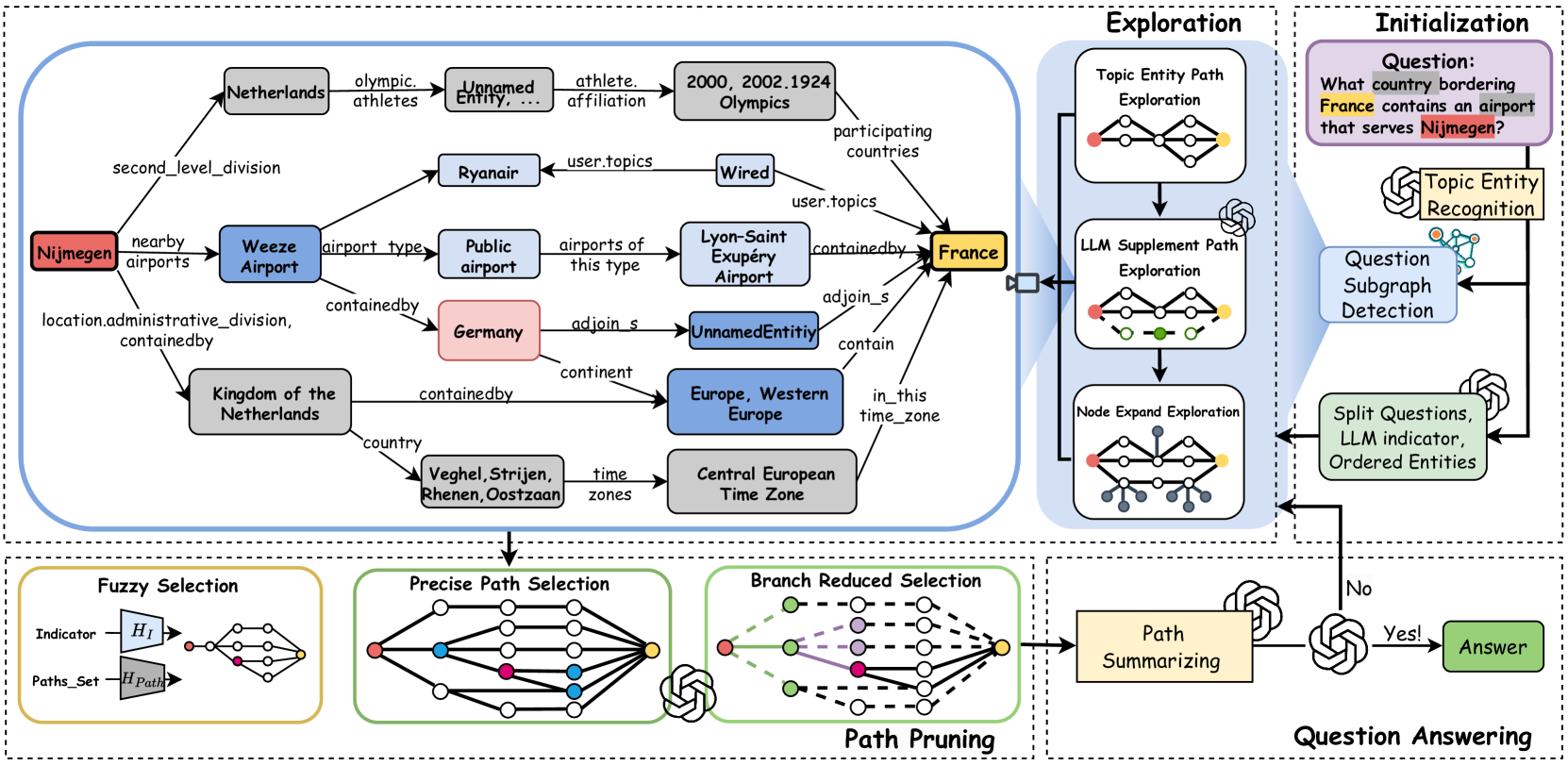
This diagram illustrates a system for exploring a knowledge graph to answer a natural language question. The process begins with question initialization, proceeds through knowledge graph exploration, path pruning, and culminates in question answering. The diagram depicts a flow of information through several stages, utilizing various techniques like LLM supplementation and fuzzy/precise selection.
### Components/Axes
The diagram is segmented into four main sections: Initialization (top-right), Exploration (right), Path Pruning (bottom-center), and Question Answering (bottom-right). Nodes represent entities or concepts within the knowledge graph. Edges represent relationships between these entities. The diagram uses color-coding to differentiate paths and processes.
* **Initialization:** Contains "Question" box with the query: "What country bordering France contains an airport that serves Nijmegen?". Also includes "Topic Entity Recognition", "Question Subgraph Detection", and "Split Questions".
* **Exploration:** Includes "Topic Entity Path Exploration", "LLM Supplement Path Exploration", "Node Expand Exploration".
* **Path Pruning:** Contains "Fuzzy Selection", "Precise Path Selection", "Branch Reduced Selection", and "Path Summarizing".
* **Question Answering:** Contains a decision node ("Yes"/"No") leading to "Answer".
* **Entities:** Netherlands, Nijmegen, Weeze Airport, Ryanair, Germany, France, Kingdom of the Netherlands, Europe, Western Europe, Central European Time Zone, Lyon-Saint Exupéry Airport, Unnamed Entity (appears multiple times), Olympics (2000, 2002, 1924).
* **Relationships:** olympic_athletes, athlete_affiliation, nearby, airports, second_level_division, airport_type, public_airport, airports_of_this_type, containedby, adjain_s, contain, country, time_zones, in_this_time_zone, user_topics, participating_countries.
* **Colors:** Paths are represented by different colors (red, green, blue, purple) to indicate different exploration routes. The "Fuzzy Selection" component uses a gradient from light to dark yellow.
### Detailed Analysis or Content Details
The diagram shows a question ("What country bordering France contains an airport that serves Nijmegen?") being processed through a knowledge graph.
1. **Initialization:** The question is parsed, and key entities (Nijmegen, France) are identified. A subgraph related to the question is detected.
2. **Exploration:** The system explores paths originating from the identified entities.
* **Netherlands** is connected to "olympic_athletes" and "Unnamed Entity" via "athlete_affiliation". It's also connected to "Nijmegen" via "nearby" and "Weeze Airport" via "airports".
* **Nijmegen** is connected to "Weeze Airport" via "airports".
* **Weeze Airport** is a "Public Airport" of type "airport".
* **Germany** contains "Weeze Airport" via "containedby".
* **France** is connected to "participating countries" via "user_topics". It also contains "Lyon-Saint Exupéry Airport" via "containedby".
* **Kingdom of the Netherlands** contains "Netherlands" via "country".
* **Europe** contains "Germany" and "Kingdom of the Netherlands" via "containedby".
* **Central European Time Zone** is in "Europe, Western Europe" via "in_this_time_zone".
3. **Path Pruning:** Multiple paths are explored, and a pruning process is applied.
* **Fuzzy Selection:** Paths are evaluated based on an "Indicator" (H1) and "Paths_Set" (H Path). The color gradient suggests a degree of confidence or relevance.
* **Precise Path Selection:** Paths are refined based on more specific criteria.
* **Branch Reduced Selection:** Redundant or less promising branches are eliminated.
4. **Question Answering:** The remaining paths are summarized, and a decision is made (Yes/No) to determine the answer.
### Key Observations
* The diagram highlights the iterative nature of knowledge graph exploration. Multiple paths are explored simultaneously.
* The "Fuzzy Selection" stage suggests the use of probabilistic or approximate matching techniques.
* The diagram emphasizes the importance of path pruning to reduce computational complexity and improve accuracy.
* The question is complex, requiring multiple hops through the knowledge graph to find the answer.
* The use of "Unnamed Entity" suggests that some entities in the knowledge graph are not explicitly labeled.
### Interpretation
This diagram represents a sophisticated system for question answering over a knowledge graph. The system leverages the power of LLMs to supplement path exploration and employs a combination of fuzzy and precise matching techniques to identify relevant information. The path pruning process is crucial for managing the complexity of the knowledge graph and ensuring efficient query processing. The diagram suggests a system designed to handle complex, multi-hop questions that require reasoning over a large and interconnected knowledge base. The presence of "Unnamed Entity" indicates a potential area for improvement in the knowledge graph's completeness or labeling. The system appears to be designed for a scenario where the knowledge graph is not perfectly curated and requires robust techniques for handling ambiguity and uncertainty.