## Annotated Image: Visual Scene Inference Analysis
### Overview
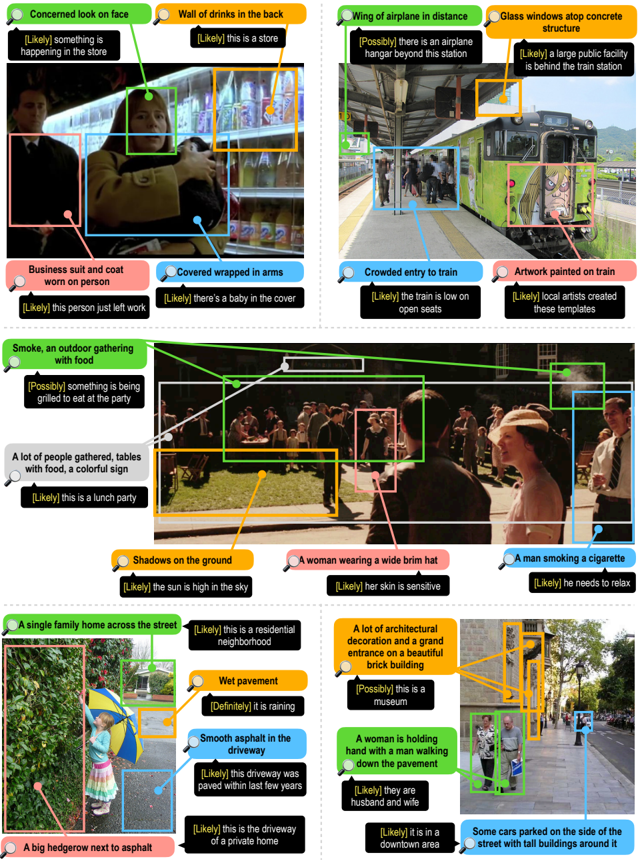
The image is a composite of five distinct photographic scenes, each overlaid with bounding boxes and text labels. The annotations function as a "scene understanding" demonstration, where specific visual elements are identified (e.g., "Wet pavement") and then paired with a logical inference or deduction (e.g., "[Definitely] it is raining"). The image serves as an example of how computer vision systems attempt to derive context and situational meaning from raw visual data.
### Components/Axes
The image is divided into four primary quadrants, with a large central scene spanning the middle.
* **Top-Left:** A woman in a store.
* **Top-Right:** A train station platform.
* **Center:** An outdoor social gathering.
* **Bottom-Left:** A child in a driveway.
* **Bottom-Right:** A street scene with pedestrians.
### Detailed Analysis
#### 1. Top-Left: Store Scene
* **Green Box (Top-Left):** "Concerned look on face" -> *[Likely] something is happening in the store*
* **Orange Box (Top-Right):** "Wall of drinks in the back" -> *[Likely] this is a store*
* **Pink Box (Bottom-Left):** "Business suit and coat worn on person" -> *[Likely] this person just left work*
* **Blue Box (Bottom-Center):** "Covered wrapped in arms" -> *[Likely] there's a baby in the cover*
#### 2. Top-Right: Train Station Scene
* **Green Box (Far Left):** "Wing of airplane in distance" -> *[Possibly] there is an airplane hangar beyond this station*
* **Orange Box (Top-Right):** "Glass windows atop concrete structure" -> *[Likely] a large public facility is behind the train station*
* **Blue Box (Center):** "Crowded entry to train" -> *[Likely] the train is low on open seats*
* **Pink Box (Bottom-Right):** "Artwork painted on train" -> *[Likely] local artists created these templates*
#### 3. Center: Outdoor Party Scene
* **Green Box (Top-Left/Center):** "Smoke, an outdoor gathering with food" -> *[Possibly] something is being grilled to eat at the party*
* **White Box (Top-Center):** "A lot of people gathered, tables with food, a colorful sign" -> *[Likely] this is a lunch party*
* **Orange Box (Bottom-Left):** "Shadows on the ground" -> *[Likely] the sun is high in the sky*
* **Pink Box (Center):** "A woman wearing a wide brim hat" -> *[Likely] her skin is sensitive*
* **Blue Box (Bottom-Right):** "A man smoking a cigarette" -> *[Likely] he needs to relax*
#### 4. Bottom-Left: Driveway Scene
* **Pink Box (Left):** "A big hedgerow next to asphalt"
* **Green Box (Top-Center):** "A single family home across the street" -> *[Likely] this is a residential neighborhood*
* **Orange Box (Center):** "Wet pavement" -> *[Definitely] it is raining*
* **Blue Box (Bottom-Center):** "Smooth asphalt in the driveway" -> *[Likely] this driveway was paved within last few years*
* **Black Box (Bottom-Right):** *[Likely] this is the driveway of a private home*
#### 5. Bottom-Right: Street Scene
* **Orange Box (Top-Left):** "A lot of architectural decoration and a grand entrance on a brick building" -> *[Possibly] this is a museum*
* **Green Box (Bottom-Left):** "A woman is holding hand with a man walking down the pavement" -> *[Likely] they are husband and wife*
* **Blue Box (Bottom-Right):** "Some cars parked on the side of the street with tall buildings around it" -> *[Likely] it is in a downtown area*
### Key Observations
* **Inference Hierarchy:** The annotations utilize a confidence-based hierarchy: "[Definitely]" for physical observations (e.g., wet pavement), "[Likely]" for high-probability social or situational inferences, and "[Possibly]" for speculative interpretations.
* **Stereotyping/Social Norms:** The inferences rely heavily on common social assumptions (e.g., holding hands implies a married couple; a woman in a hat implies sensitive skin; a man smoking implies a need to relax).
* **Spatial Grounding:** The bounding boxes are generally accurate in their placement, effectively isolating the subject matter being described.
### Interpretation
This image demonstrates the application of "Semantic Scene Understanding." It illustrates how AI models are trained to move beyond simple object detection (identifying a "man" or "building") to higher-level reasoning.
The data suggests a system attempting to "read" human behavior and environmental context. However, the inferences are often subjective. For example, while "wet pavement" is an objective fact, the inference that a man smoking "needs to relax" is a subjective psychological projection. This highlights the limitations of current AI in distinguishing between objective environmental facts and subjective human motivations. The document serves as a case study in how AI interprets visual input through the lens of learned social patterns.