## Math Problem with Solution
### Overview
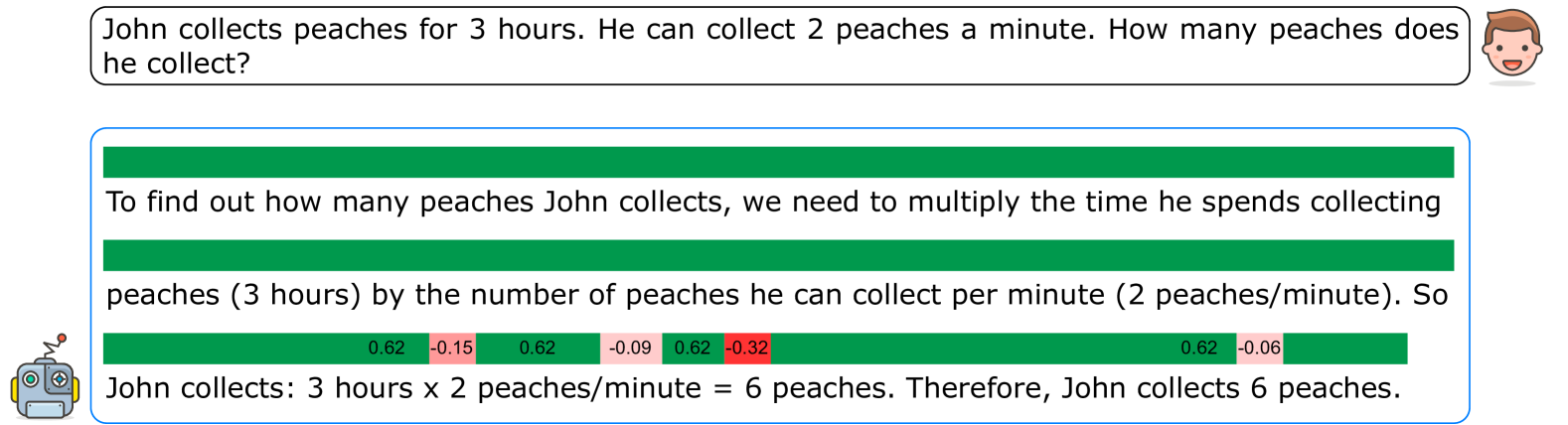
The image presents a math problem about calculating the number of peaches John collects, along with a solution. The problem states that John collects peaches for 3 hours and can collect 2 peaches per minute. The question asks how many peaches he collects in total. The solution attempts to multiply the time spent collecting by the number of peaches collected per minute, but the calculation is incorrect.
### Components/Axes
* **Problem Statement:** "John collects peaches for 3 hours. He can collect 2 peaches a minute. How many peaches does he collect?"
* **Solution Explanation:** "To find out how many peaches John collects, we need to multiply the time he spends collecting peaches (3 hours) by the number of peaches he can collect per minute (2 peaches/minute). So"
* **Incorrect Calculation:** "John collects: 3 hours x 2 peaches/minute = 6 peaches. Therefore, John collects 6 peaches."
* **Colored Blocks:** There are green and red colored blocks with numerical values above them. The values are: 0.62 (green), -0.15 (red), 0.62 (green), -0.09 (red), 0.62 (green), -0.32 (red), 0.62 (green), -0.06 (red).
### Detailed Analysis or Content Details
The problem is a straightforward multiplication problem, but the solution provided is incorrect. The error lies in not converting the time units to be consistent. The time is given in hours, while the rate of collection is given in peaches per minute.
To solve the problem correctly:
1. Convert 3 hours to minutes: 3 hours * 60 minutes/hour = 180 minutes
2. Multiply the total minutes by the number of peaches collected per minute: 180 minutes * 2 peaches/minute = 360 peaches
Therefore, John collects 360 peaches.
The colored blocks with numerical values appear to be unrelated to the problem and solution. They might be artifacts or remnants from an image processing or editing tool.
### Key Observations
* The problem is clearly stated.
* The solution provided is incorrect due to a failure to convert units.
* The colored blocks with numerical values are irrelevant to the problem.
* The correct answer is 360 peaches.
### Interpretation
The image presents a math problem and an incorrect solution. The error highlights the importance of unit conversion in problem-solving. The presence of irrelevant colored blocks suggests that the image might have been edited or processed, leaving behind these artifacts. The problem is designed to test basic multiplication skills and the understanding of time units. The incorrect solution could be a deliberate mistake to encourage critical thinking and problem-solving skills.