\n
## Educational Illustration: Peach Collection Problem
### Overview
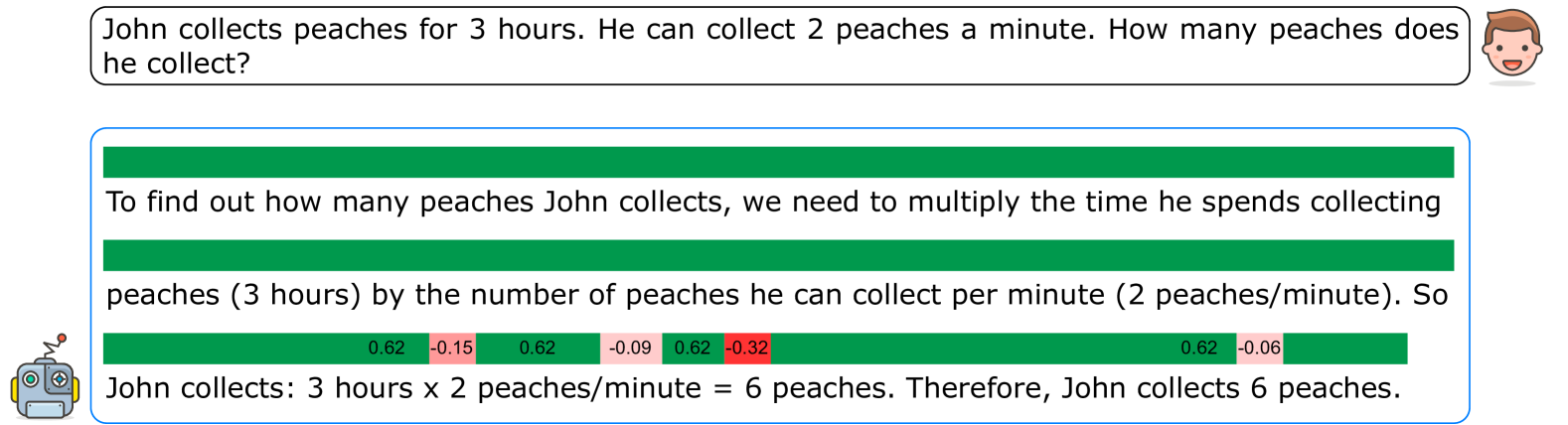
The image presents a word problem related to calculating the total number of peaches collected by John, given his collection rate and duration. The solution is provided step-by-step with a visual representation of the calculation.
### Components/Axes
The image consists of three main sections:
1. **Problem Statement:** A text box at the top containing the word problem.
2. **Solution Explanation:** A large green rectangular area explaining the method to solve the problem.
3. **Calculation & Answer:** A text box at the bottom displaying the calculation and the final answer.
There are also small cartoon images of a person and a peach.
### Detailed Analysis or Content Details
The problem statement reads: "John collects peaches for 3 hours. He can collect 2 peaches a minute. How many peaches does he collect?".
The solution explanation states: "To find out how many peaches John collects, we need to multiply the time he spends collecting peaches (3 hours) by the number of peaches he can collect per minute (2 peaches/minute). So John collects: 3 hours x 2 peaches/minute = 6 peaches. Therefore, John collects 6 peaches."
Below the explanation, there are a series of numbers displayed in green boxes: 0.62, -0.15, 0.62, -0.09, 0.62, -0.32, 0.62, -0.06. These numbers do not appear to be directly related to the problem's solution and may be extraneous visual elements.
### Key Observations
The core information is the word problem and its solution. The numbers in the green boxes are visually present but do not contribute to the problem's logic or solution. The problem is a simple multiplication problem involving unit conversion (hours to minutes is not explicitly done, but implied).
### Interpretation
The image is designed as an educational tool to demonstrate a simple mathematical problem-solving process. It presents a real-world scenario (collecting peaches) and guides the viewer through the steps to arrive at the correct answer. The extraneous numbers may be a distraction or a placeholder for future interactive elements. The image effectively illustrates the concept of rate (peaches per minute) and its application in calculating total quantity. The problem is straightforward and suitable for elementary school students learning basic multiplication and problem-solving skills.