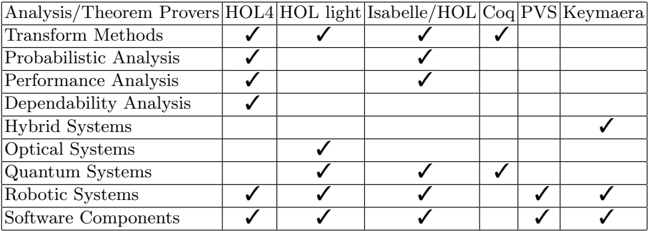
## Table: Theorem Prover Capabilities for Various Analysis Methods
### Overview
The image displays a comparison table evaluating the capabilities of seven different automated theorem provers across eight distinct analysis or system domains. The table uses checkmarks (✓) to indicate support or capability.
### Components/Axes
- **Structure**: A grid with 9 rows and 8 columns.
- **Header Row (Row 1)**: Contains the column titles.
- Column 1: `Analysis/Theorem Provers` (This is the row header column).
- Columns 2-8: Names of theorem provers: `HOL4`, `HOL light`, `Isabelle/HOL`, `Coq`, `PVS`, `Keymaera`.
- **Row Headers (Column 1)**: Lists the analysis methods or system types being evaluated.
- `Transform Methods`
- `Probabilistic Analysis`
- `Performance Analysis`
- `Dependability Analysis`
- `Hybrid Systems`
- `Optical Systems`
- `Quantum Systems`
- `Robotic Systems`
- `Software Components`
- **Data Cells**: Contain either a checkmark (`✓`) or are empty, indicating the presence or absence of capability.
### Detailed Analysis
The following table reconstructs the content of the image. A `✓` indicates the theorem prover in that column supports the analysis method in that row.
| Analysis/Theorem Provers | HOL4 | HOL light | Isabelle/HOL | Coq | PVS | Keymaera |
| :--- | :---: | :---: | :---: | :---: | :---: | :---: |
| **Transform Methods** | ✓ | ✓ | ✓ | ✓ | | |
| **Probabilistic Analysis** | ✓ | | ✓ | | | |
| **Performance Analysis** | ✓ | | ✓ | | | |
| **Dependability Analysis** | ✓ | | | | | |
| **Hybrid Systems** | | | | | | ✓ |
| **Optical Systems** | | ✓ | | | | |
| **Quantum Systems** | | ✓ | ✓ | ✓ | | |
| **Robotic Systems** | ✓ | ✓ | ✓ | | ✓ | ✓ |
| **Software Components** | ✓ | ✓ | ✓ | | ✓ | ✓ |
### Key Observations
1. **Prover Coverage**:
* **HOL4** and **Isabelle/HOL** are the most broadly capable, each supporting 5 of the 8 listed analysis methods.
* **HOL light** supports 4 methods.
* **Keymaera** is highly specialized, supporting only 3 methods, but is the sole prover listed for **Hybrid Systems**.
* **Coq** and **PVS** have more limited, specific applications within this comparison.
2. **Method Support**:
* **Transform Methods** is the most widely supported capability, with 4 out of 7 provers (HOL4, HOL light, Isabelle/HOL, Coq) indicating support.
* **Robotic Systems** and **Software Components** are also well-supported, each with 5 provers.
* **Hybrid Systems**, **Optical Systems**, and **Dependability Analysis** are niche capabilities, each supported by only one prover (Keymaera, HOL light, and HOL4, respectively).
3. **Patterns of Exclusivity**:
* **Keymaera** is the only prover for **Hybrid Systems**.
* **HOL4** is the only prover for **Dependability Analysis**.
* **HOL light** is the only prover for **Optical Systems**.
### Interpretation
This table serves as a capability matrix for selecting an appropriate automated theorem prover based on the required analysis domain. The data suggests a landscape of specialization rather than universal tools.
* **General-Purpose vs. Specialized Tools**: HOL4 and Isabelle/HOL appear to be general-purpose workhorses for formal methods, covering a wide range of traditional analysis types (Transform, Probabilistic, Performance) and complex system domains (Robotic, Software). In contrast, Keymaera is a specialized tool for hybrid systems (which combine continuous and discrete dynamics), a domain where other provers lack capability.
* **Domain-Specific Gaps**: The table highlights significant gaps in tool coverage. For instance, formal analysis of **Optical Systems** or **Quantum Systems** appears to require specific, less common tooling (HOL light, Isabelle/HOL, Coq). This could indicate either a research gap or highly specialized tool development.
* **Implications for Practitioners**: A user needing to perform **Dependability Analysis** on a system model would, according to this table, be directed to HOL4. Someone working on **Hybrid Systems** would have no choice but to use Keymaera. For **Robotic Systems** or **Software Components**, they have a wide selection of five capable provers, allowing choice based on other factors like syntax, library support, or integration.
* **Underlying Message**: The table implicitly argues for a multi-tool approach in formal methods. No single prover dominates all domains, suggesting that complex, multi-faceted system verification may require integrating results from multiple specialized provers. The empty cells represent not just a lack of feature, but potential opportunities for tool development or research.