# Technical Document Extraction: Hierarchical Word Tree Diagram
## 1. Image Overview
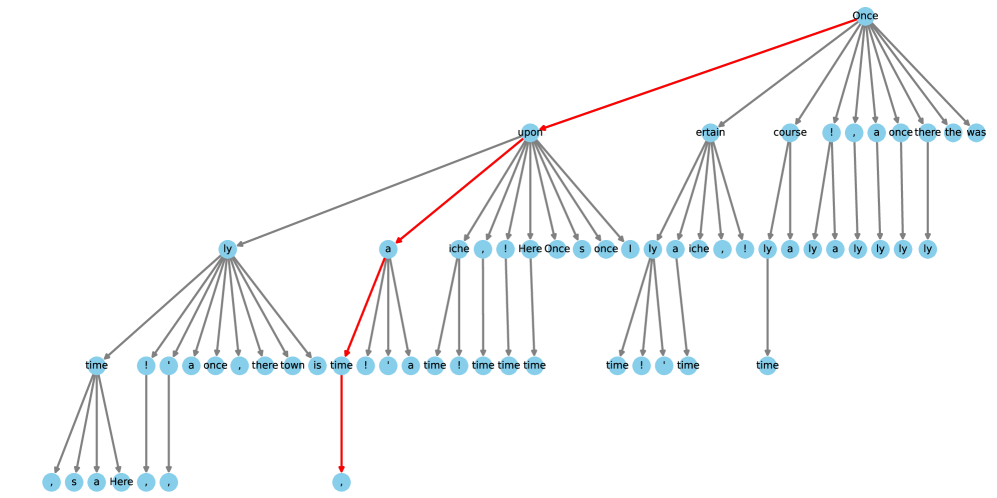
This image is a directed graph or "word tree" diagram, likely representing a predictive text model, a suffix tree, or a linguistic probability map. It visualizes the relationships between words and punctuation marks in a hierarchical structure. The diagram uses light blue circular nodes containing text, connected by grey and red directed arrows.
## 2. Component Isolation
### Region A: Root Node (Top Right)
The tree originates from a single root node labeled **"Once"**.
### Region B: Primary Branches (Level 1)
From the root node "Once", there are 10 directed edges leading to the following nodes (ordered roughly left to right):
1. **upon** (connected via a **red** arrow)
2. **ertain**
3. **course**
4. **!**
5. **,**
6. **a**
7. **once**
8. **there**
9. **the**
10. **was**
### Region C: Secondary Branches (Level 2)
The node **"upon"** serves as a secondary hub, branching into several subsequent nodes:
- **a** (connected via a **red** arrow)
- **the**
- **time**
- **an**
- **his**
- **their**
- **this**
- **my**
- **every**
- **that**
### Region D: Tertiary Branches (Level 3)
The node **"a"** (following "upon") branches further into:
- **time** (connected via a **red** arrow)
- **midnight**
- **summer**
- **bright**
- **dark**
- **cold**
- **long**
- **certain**
- **dreary**
- **stormy**
## 3. Visual Encoding and Symbology
- **Nodes**: Light blue circles with black sans-serif text.
- **Edges (Arrows)**:
- **Grey Arrows**: Represent standard transitions or lower-probability paths.
- **Red Arrows**: Highlight a specific path or the highest-probability sequence: **"Once" → "upon" → "a" → "time"**.
- **Directionality**: The graph flows generally from right to left and top to bottom, indicating a temporal or sequential progression of text.