## Diagram: Tree Structures with Labeled Nodes and Arrows
### Overview
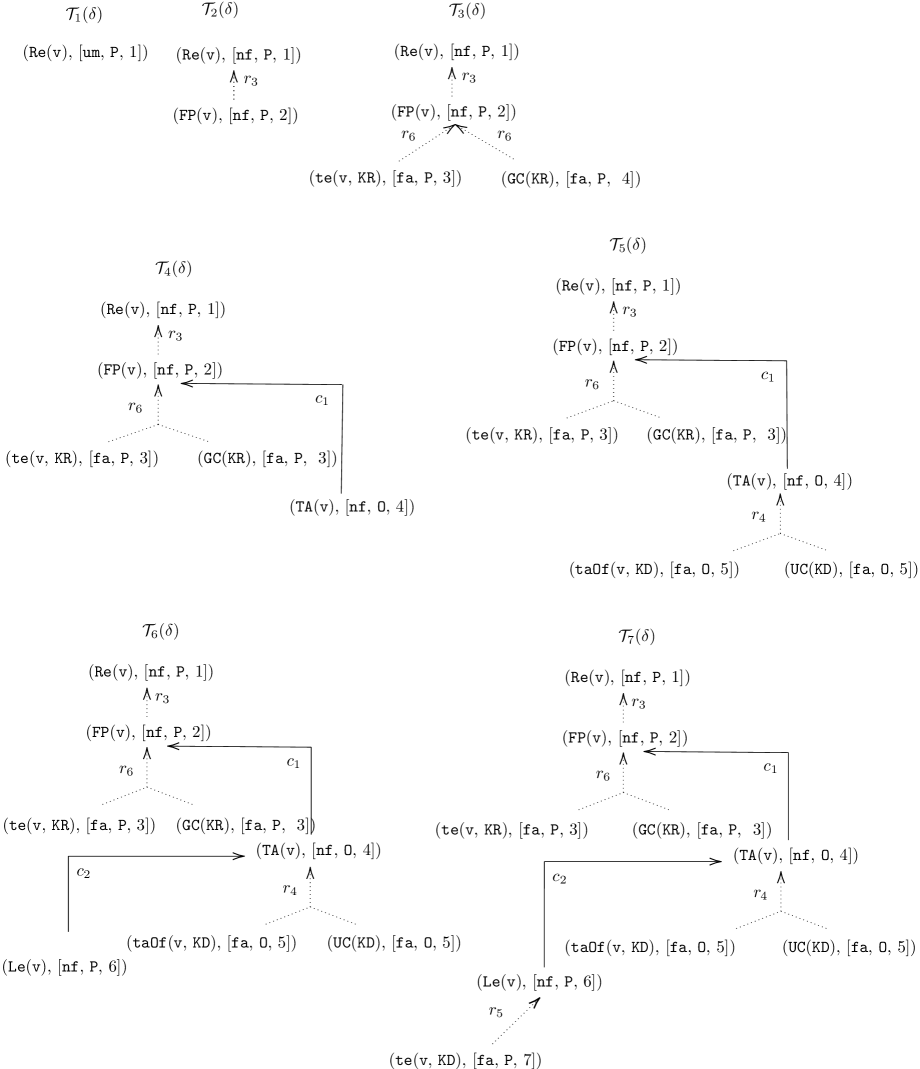
The image presents seven tree-like diagrams, labeled T1(δ) through T7(δ). Each diagram consists of nodes containing tuples of symbols and values, connected by arrows labeled with 'r' followed by a number or 'c' followed by a number. The nodes represent states or entities, and the arrows represent transitions or relationships between them.
### Components/Axes
* **Nodes:** Each node contains a tuple of the form (Symbol(v), [Attribute, Value1, Value2]).
* Symbols include: Re, FP, te, GC, TA, taOf, UC, Le.
* Attributes include: um, nf, fa.
* Values are represented by P, 0, and numerical constants (1, 2, 3, 4, 5, 6, 7).
* **Arrows:** Arrows connect the nodes, indicating relationships or transitions.
* Arrows are labeled with r1, r3, r4, r5, r6, c1, and c2.
* **Diagram Titles:** Each diagram is labeled T1(δ) through T7(δ).
### Detailed Analysis
**T1(δ):**
* Top node: (Re(v), [um, P, 1])
**T2(δ):**
* Top node: (Re(v), [nf, P, 1])
* Bottom node: (FP(v), [nf, P, 2])
* Connection: Dotted line between the nodes.
**T3(δ):**
* Top node: (Re(v), [nf, P, 1])
* Intermediate node: (FP(v), [nf, P, 2])
* Bottom left node: (te(v, KR), [fa, P, 3])
* Bottom right node: (GC(KR), [fa, P, 4])
* Connections: Dotted lines from the intermediate node to the bottom nodes, labeled r6. An "and" symbol (∧) and "r3" connect the top and intermediate nodes.
**T4(δ):**
* Top node: (Re(v), [nf, P, 1])
* Intermediate node: (FP(v), [nf, P, 2])
* Bottom left node: (te(v, KR), [fa, P, 3])
* Bottom right node: (GC(KR), [fa, P, 3])
* Lowest node: (TA(v), [nf, 0, 4])
* Connections: Dotted lines from the intermediate node to the bottom left and right nodes, labeled r6. An arrow labeled c1 points from the right of the intermediate node to the right of the diagram. Dotted lines from the bottom left and right nodes to the lowest node, labeled r4. An "and" symbol (∧) and "r3" connect the top and intermediate nodes.
**T5(δ):**
* Top node: (Re(v), [nf, P, 1])
* Intermediate node: (FP(v), [nf, P, 2])
* Bottom left node: (te(v, KR), [fa, P, 3])
* Bottom right node: (GC(KR), [fa, P, 3])
* Second lowest node: (TA(v), [nf, 0, 4])
* Lowest left node: (taOf(v, KD), [fa, 0, 5])
* Lowest right node: (UC(KD), [fa, 0, 5])
* Connections: Dotted lines from the intermediate node to the bottom left and right nodes, labeled r6. An arrow labeled c1 points from the right of the intermediate node to the right of the diagram. Dotted lines from the bottom left and right nodes to the second lowest node, labeled r4. Dotted lines from the second lowest node to the lowest left and right nodes. An "and" symbol (∧) and "r3" connect the top and intermediate nodes.
**T6(δ):**
* Top node: (Re(v), [nf, P, 1])
* Intermediate node: (FP(v), [nf, P, 2])
* Bottom left node: (te(v, KR), [fa, P, 3])
* Bottom right node: (GC(KR), [fa, P, 3])
* Second lowest node: (TA(v), [nf, 0, 4])
* Third lowest left node: (taOf(v, KD), [fa, 0, 5])
* Third lowest right node: (UC(KD), [fa, 0, 5])
* Lowest node: (Le(v), [nf, P, 6])
* Connections: Dotted lines from the intermediate node to the bottom left and right nodes, labeled r6. An arrow labeled c1 points from the right of the intermediate node to the right of the diagram. An arrow labeled c2 points from the left of the intermediate node to the left of the diagram. Dotted lines from the bottom left and right nodes to the second lowest node, labeled r4. Dotted lines from the second lowest node to the third lowest left and right nodes. Dotted line from the third lowest left node to the lowest node. An "and" symbol (∧) and "r3" connect the top and intermediate nodes.
**T7(δ):**
* Top node: (Re(v), [nf, P, 1])
* Intermediate node: (FP(v), [nf, P, 2])
* Bottom left node: (te(v, KR), [fa, P, 3])
* Bottom right node: (GC(KR), [fa, P, 3])
* Second lowest node: (TA(v), [nf, 0, 4])
* Third lowest left node: (taOf(v, KD), [fa, 0, 5])
* Third lowest right node: (UC(KD), [fa, 0, 5])
* Fourth lowest node: (Le(v), [nf, P, 6])
* Lowest node: (te(v, KD), [fa, P, 7])
* Connections: Dotted lines from the intermediate node to the bottom left and right nodes, labeled r6. An arrow labeled c1 points from the right of the intermediate node to the right of the diagram. An arrow labeled c2 points from the left of the intermediate node to the left of the diagram. Dotted lines from the bottom left and right nodes to the second lowest node, labeled r4. Dotted lines from the second lowest node to the third lowest left and right nodes. Dotted line from the third lowest left node to the fourth lowest node, labeled r5. Dotted line from the fourth lowest node to the lowest node. An "and" symbol (∧) and "r3" connect the top and intermediate nodes.
### Key Observations
* The diagrams represent a progression or evolution, with increasing complexity from T1(δ) to T7(δ).
* The nodes represent states or entities, and the arrows represent transitions or relationships between them.
* The labels on the arrows (r1, r3, r4, r5, r6, c1, c2) likely denote different types of transitions or relationships.
* The values within the nodes change as the diagrams progress, suggesting a change in state or properties.
### Interpretation
The diagrams likely represent a formal system or process, possibly related to knowledge representation or automated reasoning. The nodes represent states or concepts, and the arrows represent rules or inferences. The progression from T1(δ) to T7(δ) could represent the application of these rules to derive new knowledge or reach a conclusion. The symbols and attributes within the nodes likely have specific meanings within the context of this system. The 'c' arrows likely represent some kind of control flow or communication between different parts of the system. The 'r' arrows likely represent rules or transformations.