\n
## Diagram: Flow Diagrams of Processes T1 to T7
### Overview
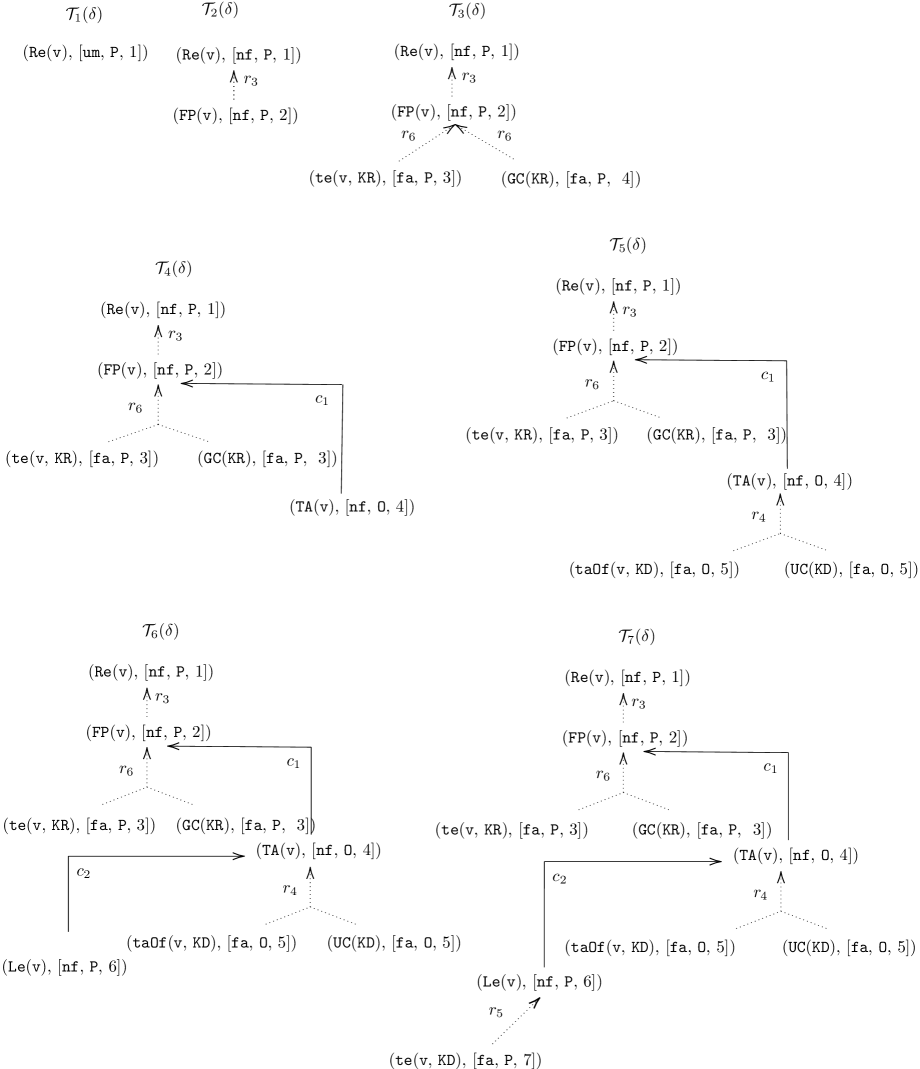
The image presents seven separate flow diagrams, labeled T1(δ) through T7(δ). Each diagram depicts a series of processes and transitions, represented by labeled boxes and arrows. The diagrams appear to illustrate a sequence of operations or a state machine, with each step involving specific inputs and outputs. The diagrams are arranged in a 2x3 grid, with T1 in the top-left and T7 in the bottom-right.
### Components/Axes
Each diagram shares a similar structure:
* **Boxes:** Represent processes or states, labeled with abbreviations and numerical values.
* **Arrows:** Indicate transitions between states, labeled with abbreviations.
* **Labels:** Each box and arrow is labeled with a combination of abbreviations and numbers.
* **Common Labels:** `Re(v)`, `nf`, `P`, `r3`, `FP(v)`, `te(v, KR)`, `GC(KR)`, `TA(v)`, `taOf(v, KD)`, `UC(KD)`, `Le(v)`, `r5`, `r6`, `r7`, `r4`, `c1`, `c2`.
* **Numerical Values:** The numbers associated with the labels vary between 1 and 5.
* **δ:** Appears in each diagram title, suggesting a parameter or variable.
### Detailed Analysis or Content Details
**T1(δ)**
* Process 1: `Re(v), [nf, P, 1])`
* Transition 1: `r3`
* Process 2: `FP(v), [nf, P, 2])`
* Transition 2: `r6`
* Process 3: `te(v, KR), [fa, P, 3])`
**T2(δ)**
* Process 1: `Re(v), [nf, P, 1])`
* Transition 1: `r3`
* Process 2: `FP(v), [nf, P, 2])`
* Transition 2: `r6`
* Process 3: `te(v, KR), [fa, P, 3])`
* Process 4: `GC(KR), [fa, P, 4])`
**T3(δ)**
* Process 1: `Re(v), [nf, P, 1])`
* Transition 1: `r3`
* Process 2: `FP(v), [nf, P, 2])`
* Transition 2: `r6`
* Process 3: `te(v, KR), [fa, P, 3])`
* Process 4: `GC(KR), [fa, P, 3])`
**T4(δ)**
* Process 1: `Re(v), [nf, P, 1])`
* Transition 1: `r3`
* Process 2: `FP(v), [nf, P, 2])`
* Transition 2: `r6`
* Process 3: `te(v, KR), [fa, P, 3])`
* Process 4: `GC(KR), [fa, P, 3])`
* Process 5: `TA(v), [nf, 0, 4])`
**T5(δ)**
* Process 1: `Re(v), [nf, P, 1])`
* Transition 1: `r3`
* Process 2: `FP(v), [nf, P, 2])`
* Transition 2: `r6`
* Process 3: `te(v, KR), [fa, P, 3])`
* Process 4: `GC(KR), [fa, P, 3])`
* Process 5: `TA(v), [nf, 0, 4])`
* Process 6: `taOf(v, KD), [fa, 0, 5])`
* Process 7: `UC(KD), [fa, 0, 5])`
**T6(δ)**
* Process 1: `Re(v), [nf, P, 1])`
* Transition 1: `r3`
* Process 2: `FP(v), [nf, P, 2])`
* Transition 2: `r6`
* Process 3: `te(v, KR), [fa, P, 3])`
* Process 4: `GC(KR), [fa, P, 3])`
* Process 5: `TA(v), [nf, 0, 4])`
* Process 6: `taOf(v, KD), [fa, 0, 5])`
* Process 7: `UC(KD), [fa, 0, 5])`
* Transition 3: `r4`
* Process 8: `Le(v), [nf, P, 7])`
**T7(δ)**
* Process 1: `Re(v), [nf, P, 1])`
* Transition 1: `r3`
* Process 2: `FP(v), [nf, P, 2])`
* Transition 2: `r6`
* Process 3: `te(v, KR), [fa, P, 3])`
* Process 4: `GC(KR), [fa, P, 3])`
* Process 5: `TA(v), [nf, 0, 4])`
* Process 6: `taOf(v, KD), [fa, 0, 5])`
* Process 7: `UC(KD), [fa, 0, 5])`
* Transition 3: `r4`
* Process 8: `Le(v), [nf, P, 7])`
### Key Observations
* The initial three processes (`Re(v)`, `FP(v)`, `te(v, KR)`) are consistent across all diagrams.
* The diagrams progressively add processes, with T5, T6, and T7 introducing `TA(v)`, `taOf(v, KD)`, and `UC(KD)`.
* T6 and T7 introduce a final process `Le(v)` and a transition `r4`.
* The values within the square brackets change across diagrams, suggesting different states or conditions.
* The diagrams appear to represent a branching process, where each diagram explores a different path or outcome.
### Interpretation
The diagrams likely represent a series of state transitions within a system. The parameter δ suggests that the behavior of the system is dependent on some external variable. The consistent initial processes indicate a common starting point, while the diverging paths represent different possible outcomes or responses to different inputs. The addition of processes in later diagrams suggests increasing complexity or the introduction of new functionalities. The labels `fa`, `nf`, `P`, `KD`, and `KR` likely represent specific parameters or conditions within the system. The numerical values within the brackets could represent thresholds, probabilities, or other quantitative measures. The diagrams could be used to model a complex system, such as a biological pathway, a computer program, or a control system. The diagrams are highly abstract and require domain-specific knowledge to fully interpret. The consistent structure across the diagrams suggests a systematic approach to analyzing the system's behavior under different conditions.