TECHNICAL ASSET FINGERPRINT
f4f0d04595a8a0a9c55652a5
Click to view fullscreen
Press ESC or click to close
FOUND IN PAPERS
EXPERT: healer-alpha-free VERSION 1
RUNTIME: free/openrouter/healer-alpha
INTEL_VERIFIED
\n
## Diagram Type: Hierarchical State Transition Trees
### Overview
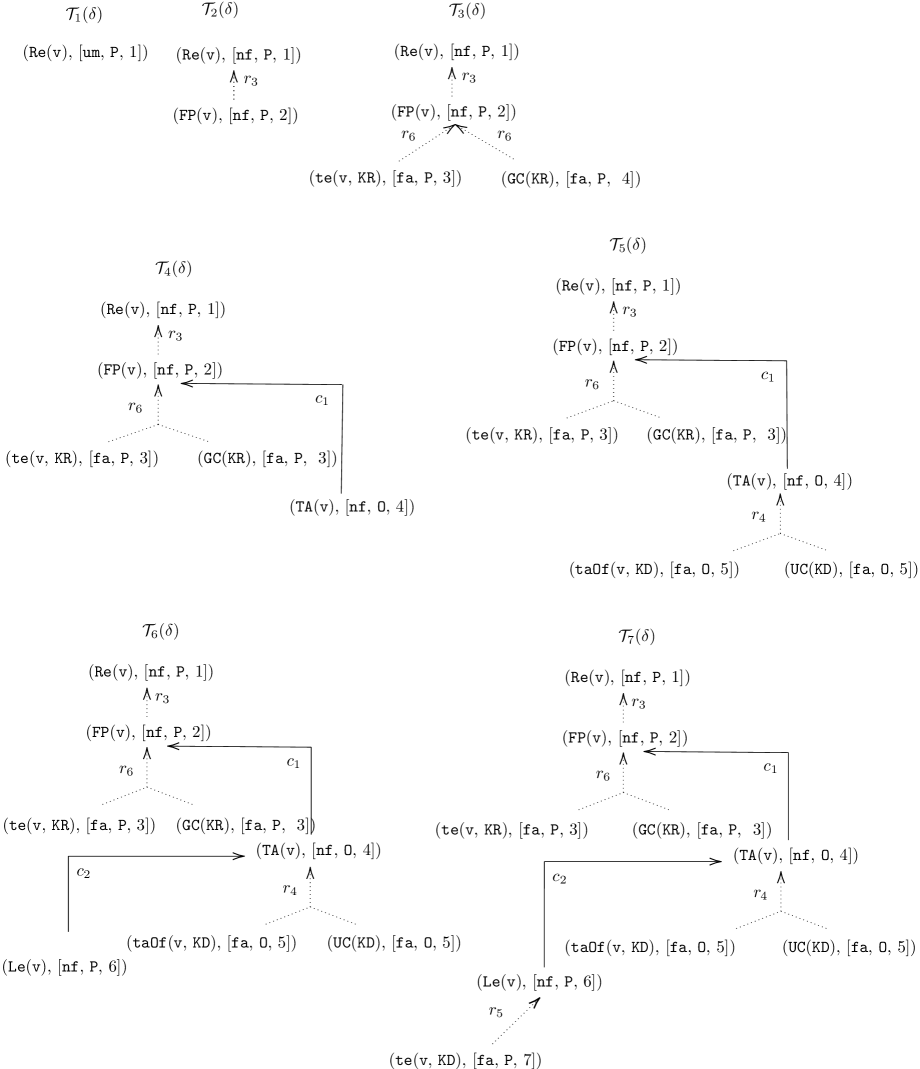
The image displays seven distinct hierarchical tree diagrams, labeled **T₁(δ)** through **T₇(δ)**, arranged in a grid pattern. Each diagram represents a structured process or state machine, with nodes containing complex symbolic expressions and edges labeled with transition rules (e.g., `r₃`, `c₁`). The diagrams appear to model a formal system, likely from computer science, logic, or process algebra, showing different configurations or derivations from a common base structure.
### Components/Axes
* **Diagram Labels:** Each tree is titled at its top: `T₁(δ)`, `T₂(δ)`, `T₃(δ)`, `T₄(δ)`, `T₅(δ)`, `T₆(δ)`, `T₇(δ)`.
* **Node Structure:** Nodes are textual expressions in the format `(Function/Process(Variable), [Attribute1, Attribute2, Attribute3])`.
* **Edge Labels:** Directed edges (arrows) connecting nodes are labeled with identifiers such as `r₃`, `r₆`, `c₁`, `c₂`, `r₄`, `r₅`. Solid lines indicate primary transitions; dashed lines indicate secondary or conditional transitions.
* **Spatial Layout:**
* **Top Row:** `T₁(δ)` (left), `T₂(δ)` (center), `T₃(δ)` (right).
* **Middle Row:** `T₄(δ)` (left), `T₅(δ)` (right).
* **Bottom Row:** `T₆(δ)` (left), `T₇(δ)` (right).
### Detailed Analysis
**Transcription of All Diagrams:**
**T₁(δ)**
* **Root Node (Top):** `(Re(v), [um, P, 1])`
* **Structure:** A single node. No edges or children.
**T₂(δ)**
* **Root Node (Top):** `(Re(v), [nf, P, 1])`
* **Edge:** A dashed arrow labeled `r₃` points downward from the root.
* **Child Node:** `(FP(v), [nf, P, 2])`
**T₃(δ)**
* **Root Node (Top):** `(Re(v), [nf, P, 1])`
* **Edge:** A dashed arrow labeled `r₃` points downward from the root.
* **Child Node (Middle):** `(FP(v), [nf, P, 2])`
* **Edges:** Two dashed arrows labeled `r₆` point downward from the middle node.
* **Child Nodes (Bottom):**
* Left: `(te(v, KR), [fa, P, 3])`
* Right: `(GC(KR), [fa, P, 4])`
**T₄(δ)**
* **Root Node (Top):** `(Re(v), [nf, P, 1])`
* **Edge:** A dashed arrow labeled `r₃` points downward from the root.
* **Child Node (Upper Middle):** `(FP(v), [nf, P, 2])`
* **Edges:**
* A dashed arrow labeled `r₆` points downward from the upper middle node.
* A solid arrow labeled `c₁` points leftward from a lower node back to the upper middle node.
* **Child Nodes (Lower Middle):**
* Left: `(te(v, KR), [fa, P, 3])`
* Right: `(GC(KR), [fa, P, 3])`
* **Grandchild Node (Bottom):** `(TA(v), [nf, 0, 4])` is connected via a solid line from the `(GC(KR), ...)` node.
**T₅(δ)**
* **Root Node (Top):** `(Re(v), [nf, P, 1])`
* **Edge:** A dashed arrow labeled `r₃` points downward from the root.
* **Child Node (Upper Middle):** `(FP(v), [nf, P, 2])`
* **Edges:**
* A dashed arrow labeled `r₆` points downward from the upper middle node.
* A solid arrow labeled `c₁` points leftward from a lower node back to the upper middle node.
* **Child Nodes (Lower Middle):**
* Left: `(te(v, KR), [fa, P, 3])`
* Right: `(GC(KR), [fa, P, 3])`
* **Grandchild Node (Bottom Middle):** `(TA(v), [nf, 0, 4])` is connected via a solid line from the `(GC(KR), ...)` node.
* **Edges:** Two dashed arrows labeled `r₄` point downward from the grandchild node.
* **Great-Grandchild Nodes (Bottom):**
* Left: `(taOf(v, KD), [fa, 0, 5])`
* Right: `(UC(KD), [fa, 0, 5])`
**T₆(δ)**
* **Root Node (Top):** `(Re(v), [nf, P, 1])`
* **Edge:** A dashed arrow labeled `r₃` points downward from the root.
* **Child Node (Upper Middle):** `(FP(v), [nf, P, 2])`
* **Edges:**
* A dashed arrow labeled `r₆` points downward from the upper middle node.
* A solid arrow labeled `c₁` points leftward from a lower node back to the upper middle node.
* **Child Nodes (Lower Middle):**
* Left: `(te(v, KR), [fa, P, 3])`
* Right: `(GC(KR), [fa, P, 3])`
* **Grandchild Node (Bottom Middle):** `(TA(v), [nf, 0, 4])` is connected via a solid line from the `(GC(KR), ...)` node.
* **Edges:**
* Two dashed arrows labeled `r₄` point downward from the grandchild node.
* A solid arrow labeled `c₂` points leftward from the grandchild node to a new node.
* **Great-Grandchild Nodes (Bottom):**
* Left (connected via `c₂`): `(Le(v), [nf, P, 6])`
* Center-Left (connected via `r₄`): `(taOf(v, KD), [fa, 0, 5])`
* Center-Right (connected via `r₄`): `(UC(KD), [fa, 0, 5])`
**T₇(δ)**
* **Root Node (Top):** `(Re(v), [nf, P, 1])`
* **Edge:** A dashed arrow labeled `r₃` points downward from the root.
* **Child Node (Upper Middle):** `(FP(v), [nf, P, 2])`
* **Edges:**
* A dashed arrow labeled `r₆` points downward from the upper middle node.
* A solid arrow labeled `c₁` points leftward from a lower node back to the upper middle node.
* **Child Nodes (Lower Middle):**
* Left: `(te(v, KR), [fa, P, 3])`
* Right: `(GC(KR), [fa, P, 3])`
* **Grandchild Node (Bottom Middle):** `(TA(v), [nf, 0, 4])` is connected via a solid line from the `(GC(KR), ...)` node.
* **Edges:**
* Two dashed arrows labeled `r₄` point downward from the grandchild node.
* A solid arrow labeled `c₂` points leftward from the grandchild node to a new node.
* **Great-Grandchild Nodes (Bottom):**
* Left (connected via `c₂`): `(Le(v), [nf, P, 6])`
* Center-Left (connected via `r₄`): `(taOf(v, KD), [fa, 0, 5])`
* Center-Right (connected via `r₄`): `(UC(KD), [fa, 0, 5])`
* **Edge:** A dashed arrow labeled `r₅` points downward from the `(Le(v), ...)` node.
* **Great-Great-Grandchild Node (Very Bottom):** `(te(v, KD), [fa, P, 7])`
### Key Observations
1. **Progressive Complexity:** The diagrams show a clear progression from a single node (`T₁`) to a deeply nested tree (`T₇`), suggesting an iterative application of rules.
2. **Common Substructures:** The chain `(Re(v), ...) -> r₃ -> (FP(v), ...) -> r₆ -> {(te(v, KR), ...), (GC(KR), ...)}` is a recurring core pattern present in `T₂` through `T₇`.
3. **Rule Application:** Edge labels (`r₃`, `r₆`, `r₄`, `r₅`) likely denote transformation or inference rules. The labels `c₁` and `c₂` on solid, backward-pointing arrows may represent conditions or constraints that enable further transitions.
4. **Attribute Changes:** The third attribute in the bracketed lists changes systematically (e.g., from `1` to `2` to `3`...), possibly indicating a step counter, depth, or priority level. The second attribute changes between `um`, `nf`, and `fa`.
5. **Node Introduction:** New node types (`TA`, `taOf`, `UC`, `Le`, `te(v, KD)`) are introduced in later diagrams (`T₄` onwards), expanding the system's state space.
### Interpretation
These diagrams almost certainly represent **derivation trees** or **operational semantics** for a formal system, such as a process calculus, logic programming language, or state transition system.
* **What the data suggests:** The sequence `T₁` to `T₇` demonstrates how a complex system state is built from an initial state (`Re(v)`) through the sequential application of rules. The `r` rules appear to be *reduction* or *reaction* rules that decompose or transform processes. The `c` rules appear to be *communication* or *coordination* rules that create feedback loops or enable new interactions.
* **How elements relate:** The root `Re(v)` is the initial request or process. `FP(v)` likely represents a "First Phase" or "Forwarding Process." `GC(KR)` and `te(v, KR)` could be "Garbage Collection" and "terminal evaluation" related to a knowledge resource (`KR`). The later nodes (`TA`, `UC`, `Le`) suggest "Task Assignment," "Use Case," and "Lifecycle Event," indicating the system manages workflow or resource lifecycle.
* **Notable patterns/anomalies:** The shift from `[um, P, 1]` in `T₁` to `[nf, P, 1]` in all others is significant, suggesting `T₁` is a special "unmatched" or initial state. The introduction of the `c₂` loop in `T₆` and its extension in `T₇` shows how the system can generate increasingly complex, potentially recursive behavior. The diagrams serve as a visual proof or trace of system behavior under defined operational rules.
DECODING INTELLIGENCE...