## Flowchart: Face Verification Pipeline Using VGG-Face
### Overview
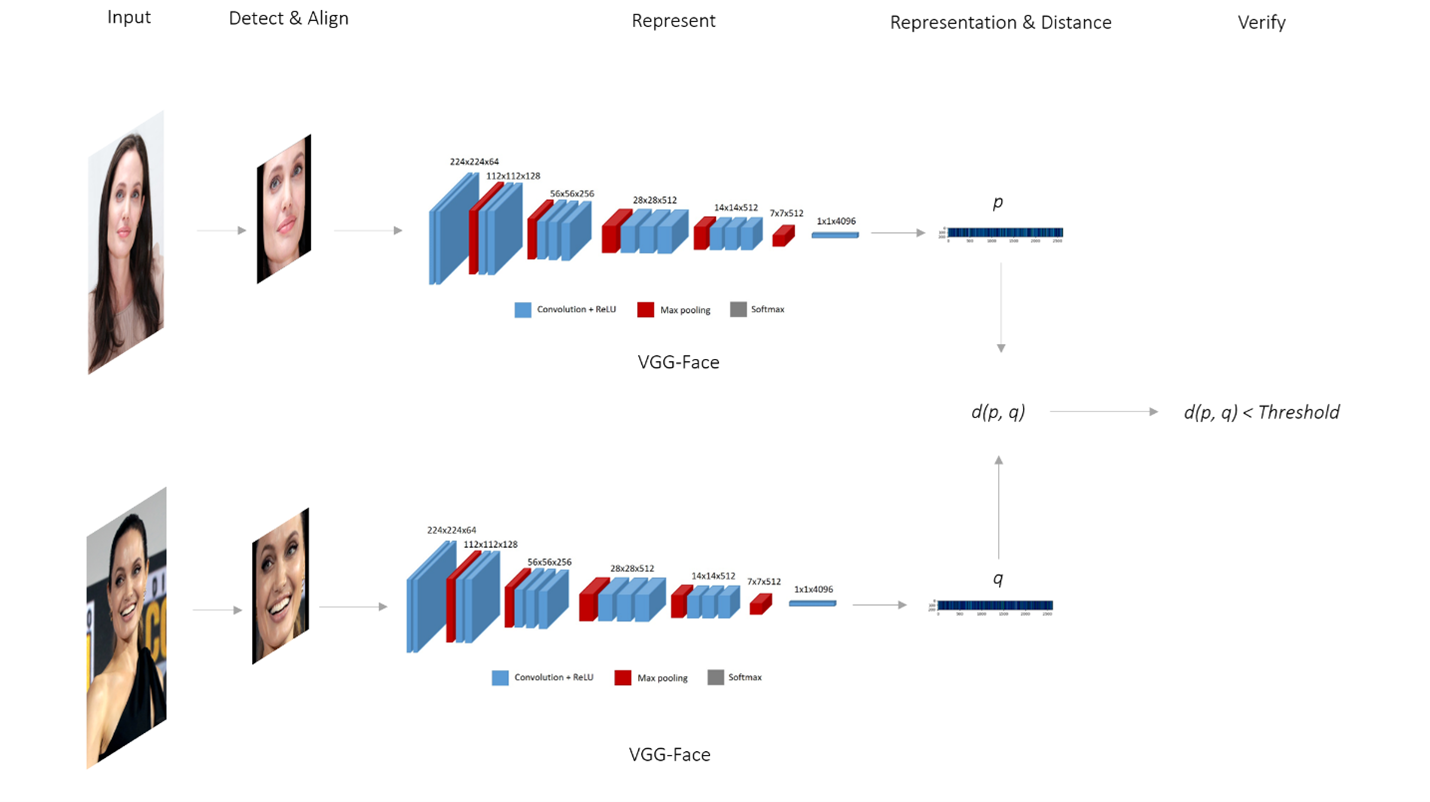
The diagram illustrates a technical pipeline for face verification using the VGG-Face model. It shows two input images processed through sequential stages: **Detect & Align**, **Represent**, **Representation & Distance**, and **Verify**. Each stage transforms the input into a numerical representation, culminating in a binary verification decision based on a distance threshold.
---
### Components/Axes
1. **Input Images**: Two distinct face images (top and bottom) labeled as "Input."
2. **Stages**:
- **Detect & Align**: Normalizes face orientation and crops to a standardized region.
- **Represent**: Extracts hierarchical features via convolutional layers (ReLU activation) and max pooling.
- **Representation & Distance**: Computes a distance metric (`d(p, q)`) between feature vectors `p` and `q`.
- **Verify**: Compares `d(p, q)` to a threshold to determine a match.
3. **Legend**:
- **Blue**: Convolution + ReLU operations.
- **Red**: Max pooling layers.
- **Gray**: Softmax activation.
4. **Axes**:
- Horizontal flow: Left-to-right progression through stages.
- Vertical separation: Two parallel paths for input images.
---
### Detailed Analysis
1. **Detect & Align**:
- Input images are preprocessed to align facial landmarks (e.g., eyes, nose).
- Output: Normalized face patches (e.g., 224x224 pixels).
2. **Represent**:
- **Convolutional Layers**:
- Input: 224x224x3 (RGB).
- Output: 224x224x64 → 112x112x128 → 56x56x256 → 28x28x512 → 14x14x512 → 7x7x512.
- **Max Pooling**: Reduces spatial dimensions (e.g., 224→112).
- **Softmax**: Final layer for feature normalization.
3. **Representation & Distance**:
- Feature vectors `p` and `q` are extracted as 1x4096 dimensional embeddings.
- Distance metric `d(p, q)` computes Euclidean or cosine similarity.
4. **Verify**:
- Threshold comparison: `d(p, q) < Threshold` → Match (True/False).
---
### Key Observations
1. **Symmetry**: Both input images follow identical processing steps, emphasizing reproducibility.
2. **Threshold Dependency**: Verification outcome hinges on a predefined distance threshold.
3. **Feature Hierarchy**: Deeper layers (e.g., 7x7x512) capture abstract facial features (e.g., identity-specific patterns).
4. **VGG-Face Integration**: Pre-trained weights likely used for feature extraction, enabling cross-dataset generalization.
---
### Interpretation
This pipeline demonstrates a **deep learning-based face verification system**:
- **Detect & Align** ensures robustness to pose/occlusion variations.
- **Represent** leverages VGG-Face’s convolutional architecture to learn discriminative features.
- **Representation & Distance** quantifies similarity, critical for applications like biometric authentication.
- The **threshold** acts as a tunable parameter balancing false positives/negatives.
The diagram underscores the importance of **normalization** (via alignment) and **hierarchical feature learning** (via VGG-Face) in achieving accurate face matching. The absence of numerical threshold values suggests system-specific tuning, while the parallel processing paths highlight scalability for batch verification tasks.