## [Code Comparison Diagram]: LLM vs. LLM + APOLLO Proof Generation
### Overview
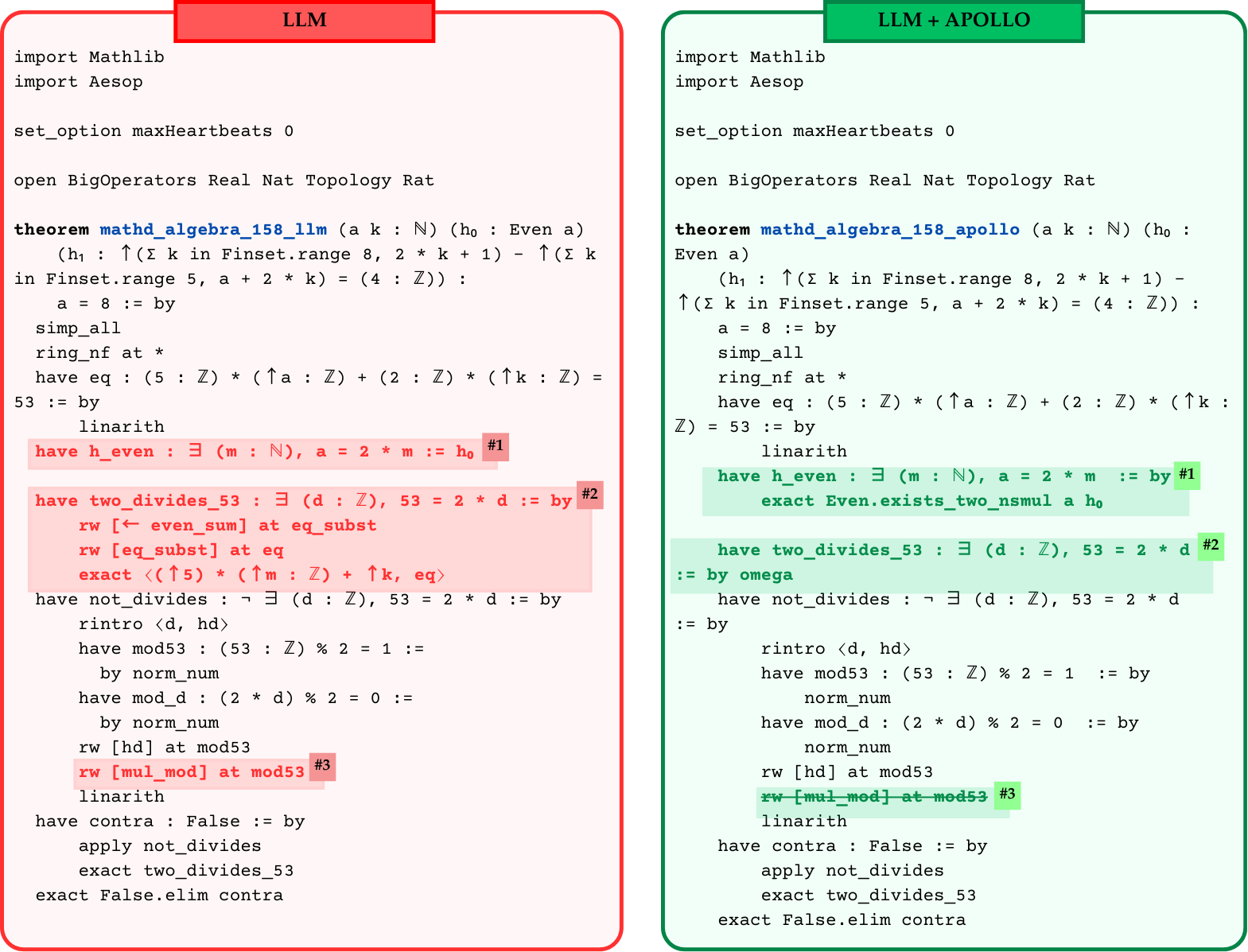
The image presents a side-by-side comparison of two Lean 4 code blocks. The left block, titled "LLM" and outlined in red, shows a proof generated by a Large Language Model. The right block, titled "LLM + APOLLO" and outlined in green, shows a proof for the same theorem generated by an LLM augmented with a system called APOLLO. The comparison highlights differences in proof strategy and conciseness, with specific lines of code highlighted in corresponding colors to indicate key differences.
### Components/Axes
* **Layout**: Two vertical panels.
* **Left Panel**: Header "LLM" in a red box. Code block with a red outline. Certain lines are highlighted with a light red background.
* **Right Panel**: Header "LLM + APOLLO" in a green box. Code block with a green outline. Certain lines are highlighted with a light green background.
* **Content**: Both panels contain formal mathematical proof code written in the Lean 4 programming language and theorem prover.
* **Highlighted Lines**: Numbered tags (#1, #2, #3) are placed next to specific lines in both panels to draw direct comparisons.
### Detailed Analysis
**Common Code (Present in Both Panels):**
The initial setup and theorem statement are identical.
```lean
import Mathlib
import Aesop
set_option maxHeartbeats 0
open BigOperators Real Nat Topology Rat
theorem mathd_algebra_158_llm (a k : ℕ) (h₀ : Even a)
(h₁ : ↑(∑ k in Finset.range 8, 2 * k + 1) - ↑(∑ k in Finset.range 5, a + 2 * k) = (4 : ℤ)) :
a = 8 := by
simp_all
ring_nf at *
have eq : (5 : ℤ) * (↑a : ℤ) + (2 : ℤ) * (↑k : ℤ) = 53 := by
linarith
```
*The theorem `mathd_algebra_158` (named `_llm` on the left, `_apollo` on the right) states: Given natural numbers `a` and `k`, where `a` is even, and a hypothesis `h₁` about the difference of two sums equaling 4, prove that `a = 8`.*
**Divergent Proof Steps (Highlighted Comparisons):**
**Comparison #1: Proving `a` is even.**
* **LLM (Left, Red Highlight):**
```lean
have h_even : ∃ (m : ℕ), a = 2 * m := h₀
```
*Directly uses the hypothesis `h₀` (which states `Even a`).*
* **LLM + APOLLO (Right, Green Highlight):**
```lean
have h_even : ∃ (m : ℕ), a = 2 * m := by
exact Even.exists_two_nsmul a h₀
```
*Uses a tactic block and the specific lemma `Even.exists_two_nsmul` to unpack the definition of `Even`.*
**Comparison #2: Proving 53 is even (a step towards contradiction).**
* **LLM (Left, Red Highlight):**
```lean
have two_divides_53 : ∃ (d : ℤ), 53 = 2 * d := by
rw [← even_sum] at eq_subst
rw [eq_subst] at eq
exact <(↑5) * (↑m : ℤ) + ↑k, eq>
```
*Attempts a complex rewrite strategy involving a previously defined `eq_subst` (not shown in the common code) and constructs a proof term.*
* **LLM + APOLLO (Right, Green Highlight):**
```lean
have two_divides_53 : ∃ (d : ℤ), 53 = 2 * d := by omega
```
*Uses the `omega` tactic, a powerful automated decision procedure for linear integer arithmetic, to discharge the goal directly.*
**Comparison #3: A rewrite step within the contradiction proof.**
* **LLM (Left, Red Highlight):**
```lean
rw [mul_mod] at mod53
```
* **LLM + APOLLO (Right, Green Highlight):**
```lean
rw [mul_mod] at mod53
```
*This line is identical in both proofs. The highlight indicates it is part of the divergent proof context but the tactic call itself is the same.*
**Remaining Common Code (Post-Divergence):**
Both proofs converge again after the highlighted sections to finish the contradiction:
```lean
have not_divides : ¬ ∃ (d : ℤ), 53 = 2 * d := by
rintro <d, hd>
have mod53 : (53 : ℤ) % 2 = 1 := by norm_num
have mod_d : (2 * d) % 2 = 0 := by norm_num
rw [hd] at mod53
linarith
have contra : False := by
apply not_divides
exact two_divides_53
exact False.elim contra
```
### Key Observations
1. **Proof Conciseness**: The APOLLO-augmented proof is significantly shorter and more direct. The key differences are at tags #1 and #2.
2. **Tactic Sophistication**: The LLM proof uses more manual, low-level tactics (`rw`, constructing proof terms). The APOLLO proof leverages higher-level, automated tactics (`omega`) and standard library lemmas (`Even.exists_two_nsmul`).
3. **Identical Structure**: Despite the different tactics, the overall logical structure of the proof (establishing an equation, deriving a contradiction from the parity of 53) is the same in both versions.
4. **Language**: The code is written in **Lean 4**, a functional programming language and interactive theorem prover. All text is in English and Lean 4's syntax.
### Interpretation
This diagram serves as a technical demonstration of how an augmentation system (APOLLO) can enhance the output of a base LLM for formal mathematical reasoning.
* **What the data suggests**: The LLM alone can produce a correct but verbose and somewhat "naive" proof, using rewrites and explicit term construction. APOLLO guides or refines the output to produce a proof that is more idiomatic, concise, and leverages the prover's automation (`omega`) and extensive mathematical library more effectively.
* **How elements relate**: The side-by-side layout with color-coded highlights creates a direct visual diff, making it easy to compare the proof strategies line-by-line. The numbered tags explicitly link corresponding conceptual steps (proving evenness, proving 53 is even) across the two implementations.
* **Notable patterns**: The most striking pattern is the replacement of a multi-line, manual proof for `two_divides_53` with a single tactic call (`by omega`). This indicates that APOLLO is particularly effective at identifying goals that can be solved by the prover's built-in automation, a key skill in efficient formal proof writing.
* **Underlying significance**: The comparison illustrates a potential path for AI-assisted formal verification: using LLMs to generate initial proof sketches or steps, and then employing specialized systems (like APOLLO) to refine, optimize, and complete them into polished, efficient proofs. This hybrid approach aims to combine the creative, high-level reasoning of LLMs with the precision and rigor of symbolic theorem provers.