## Flowchart: Mathematical Proof Validation Process
### Overview
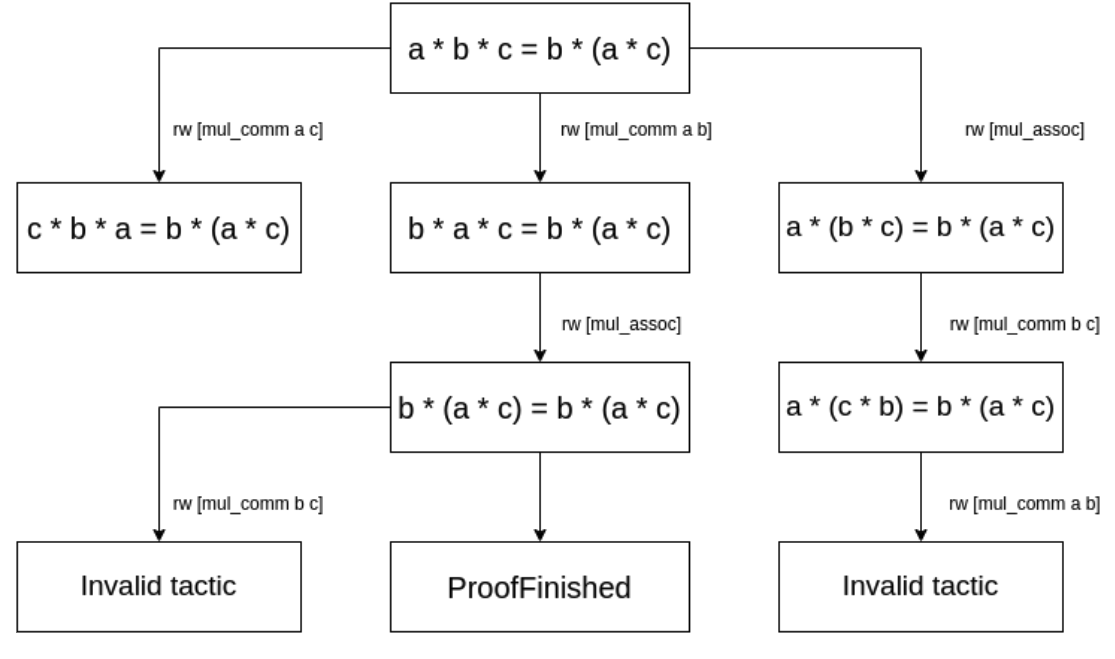
The flowchart illustrates a step-by-step validation process for mathematical proofs involving associative and commutative properties of multiplication. It demonstrates how different rewrite rules (rew) are applied to transform equations, with outcomes leading to either a valid proof or invalid tactics.
### Components/Axes
- **Nodes**: Rectangular boxes containing mathematical equations or status labels ("ProofFinished", "Invalid tactic").
- **Edges**: Arrows connecting nodes, labeled with rewrite rules (e.g., "rw [mul_comm a c]").
- **Key Equations**:
- Top node: `a * b * c = b * (a * c)`
- Left branch: `c * b * a = b * (a * c)` → `Invalid tactic`
- Middle branch: `b * a * c = b * (a * c)` → `ProofFinished`
- Right branch: `a * (b * c) = b * (a * c)` → `Invalid tactic`
### Detailed Analysis
1. **Top Node**:
- Equation: `a * b * c = b * (a * c)`
- Branches into three paths via rewrite rules:
- **Left Path**:
- Apply `rw [mul_comm a c]` → `c * b * a = b * (a * c)`
- Apply `rw [mul_comm b c]` → `Invalid tactic`
- **Middle Path**:
- Apply `rw [mul_comm a b]` → `b * a * c = b * (a * c)`
- Apply `rw [mul_assoc]` → `ProofFinished`
- **Right Path**:
- Apply `rw [mul_assoc]` → `a * (b * c) = b * (a * c)`
- Apply `rw [mul_comm b c]` → `Invalid tactic`
2. **Status Outcomes**:
- **ProofFinished**: Achieved only via the middle path using `mul_assoc` after `mul_comm a b`.
- **Invalid tactic**: All other paths terminate here, indicating incorrect rule application.
### Key Observations
- **Valid Path Dependency**: The only successful proof requires applying `mul_comm a b` first, followed by `mul_assoc`.
- **Commutativity Constraints**: Direct application of `mul_comm` to non-adjacent terms (e.g., `a` and `c` in the left path) leads to invalidity.
- **Associativity Role**: `mul_assoc` is critical for restructuring terms but only valid when applied after specific commutative steps.
### Interpretation
This flowchart models a formal proof system where the order of applying algebraic rules (commutativity and associativity) determines validity. The system enforces strict syntactic constraints:
- Commutativity (`mul_comm`) can only swap adjacent terms.
- Associativity (`mul_assoc`) requires terms to be grouped correctly before/after commutativity.
- Invalid tactics arise from premature or misaligned rule application, highlighting the importance of proof strategy in formal systems. The structure mirrors automated theorem proving, where rule application sequences must adhere to logical dependencies.