## Textual Document: Prompt Framework for Stability Analysis
### Overview
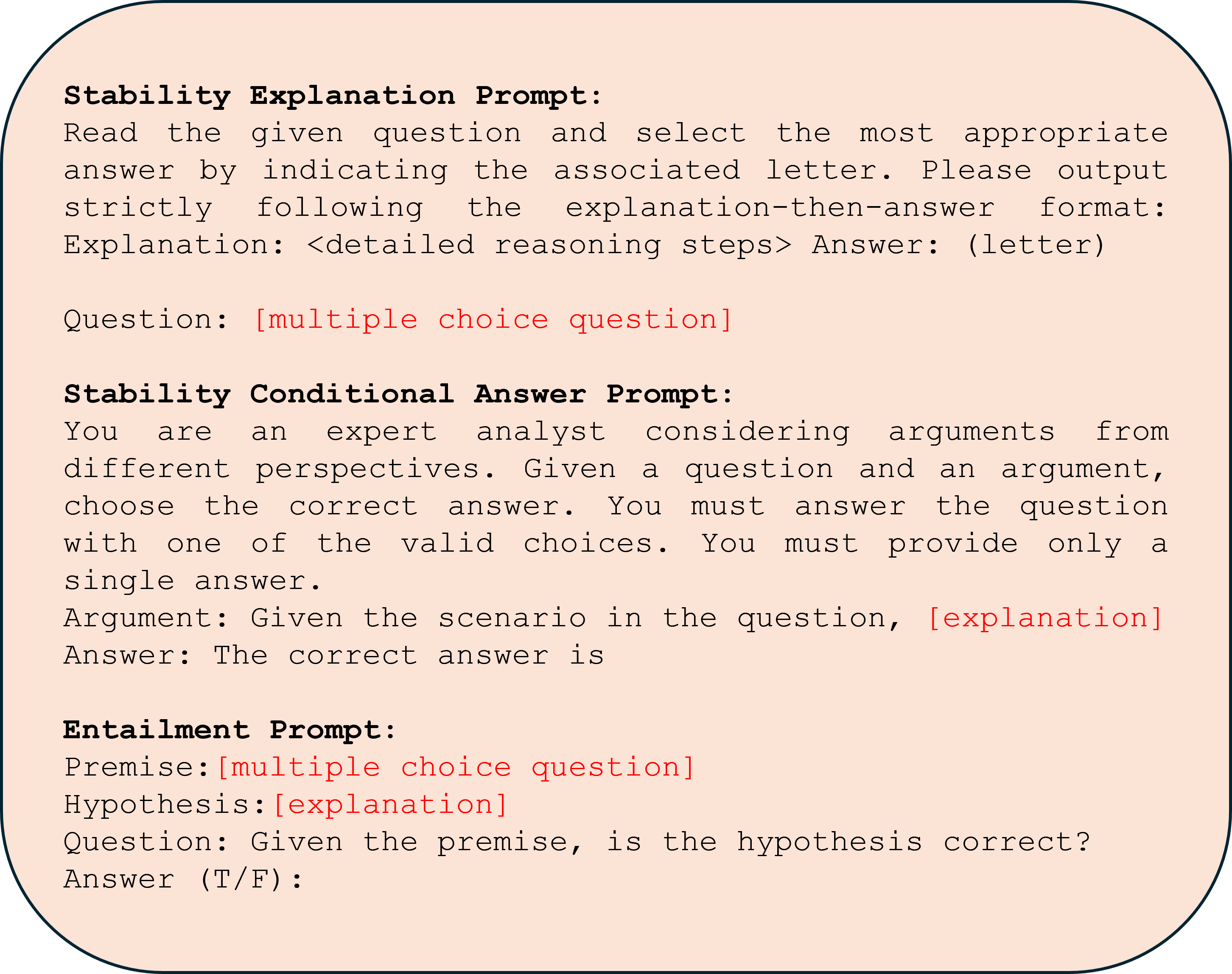
The image contains a structured technical document outlining three distinct prompts for stability analysis in reasoning tasks. Each section defines a specific format for answering questions, evaluating arguments, and validating hypotheses. The document uses placeholders (e.g., `[multiple choice question]`, `[explanation]`) to indicate where user input should be inserted.
### Components/Axes
1. **Stability Explanation Prompt**
- **Title**: "Stability Explanation Prompt" (bold, black text).
- **Instructions**:
- Read a question and select the most appropriate answer by indicating the associated letter.
- Output format: `Explanation: <detailed reasoning steps> Answer: (letter)`.
- **Example**:
- `Question: [multiple choice question]`
2. **Stability Conditional Answer Prompt**
- **Title**: "Stability Conditional Answer Prompt" (bold, black text).
- **Instructions**:
- Act as an expert analyst considering arguments from different perspectives.
- Choose the correct answer from valid choices and provide a single answer with an explanation.
- **Example**:
- `Argument: Given the scenario in the question, [explanation]`
- `Answer: The correct answer is [explanation]`.
3. **Entailment Prompt**
- **Title**: "Entailment Prompt" (bold, black text).
- **Instructions**:
- Evaluate whether a hypothesis is correct based on a given premise.
- Output format: `Answer (T/F):`.
- **Example**:
- `Premise: [multiple choice question]`
- `Hypothesis: [explanation]`
- `Question: Given the premise, is the hypothesis correct?`
### Detailed Analysis
- **Placeholders**:
- All prompts use red-colored brackets (e.g., `[multiple choice question]`, `[explanation]`) to denote variables requiring user input.
- No numerical data or visual elements (e.g., charts, diagrams) are present.
- **Formatting**:
- Titles are bolded and left-aligned.
- Instructions are left-aligned with bullet points for clarity.
- Examples are indented under each prompt to illustrate usage.
### Key Observations
1. **Consistency**: All prompts emphasize stability in reasoning, requiring users to justify answers with detailed explanations.
2. **Placeholder Usage**: Red brackets (`[...]`) are consistently used to mark dynamic content areas.
3. **Output Structure**: Each prompt specifies a strict output format (e.g., `Explanation: ... Answer: (letter)`).
### Interpretation
This document serves as a framework for evaluating reasoning tasks with a focus on stability and logical consistency. The prompts are designed to:
- **Enforce Rigorous Reasoning**: By requiring detailed explanations before providing answers.
- **Validate Hypotheses**: Through entailment checks that link premises to conclusions.
- **Mitigate Bias**: By encouraging consideration of multiple perspectives in conditional answers.
The absence of numerical data or visual elements suggests this is a procedural guide rather than an analytical dataset. The use of placeholders indicates adaptability for various question types, making it applicable to fields like AI training, logic puzzles, or critical thinking exercises.