## Text Prompts for Question Answering
### Overview
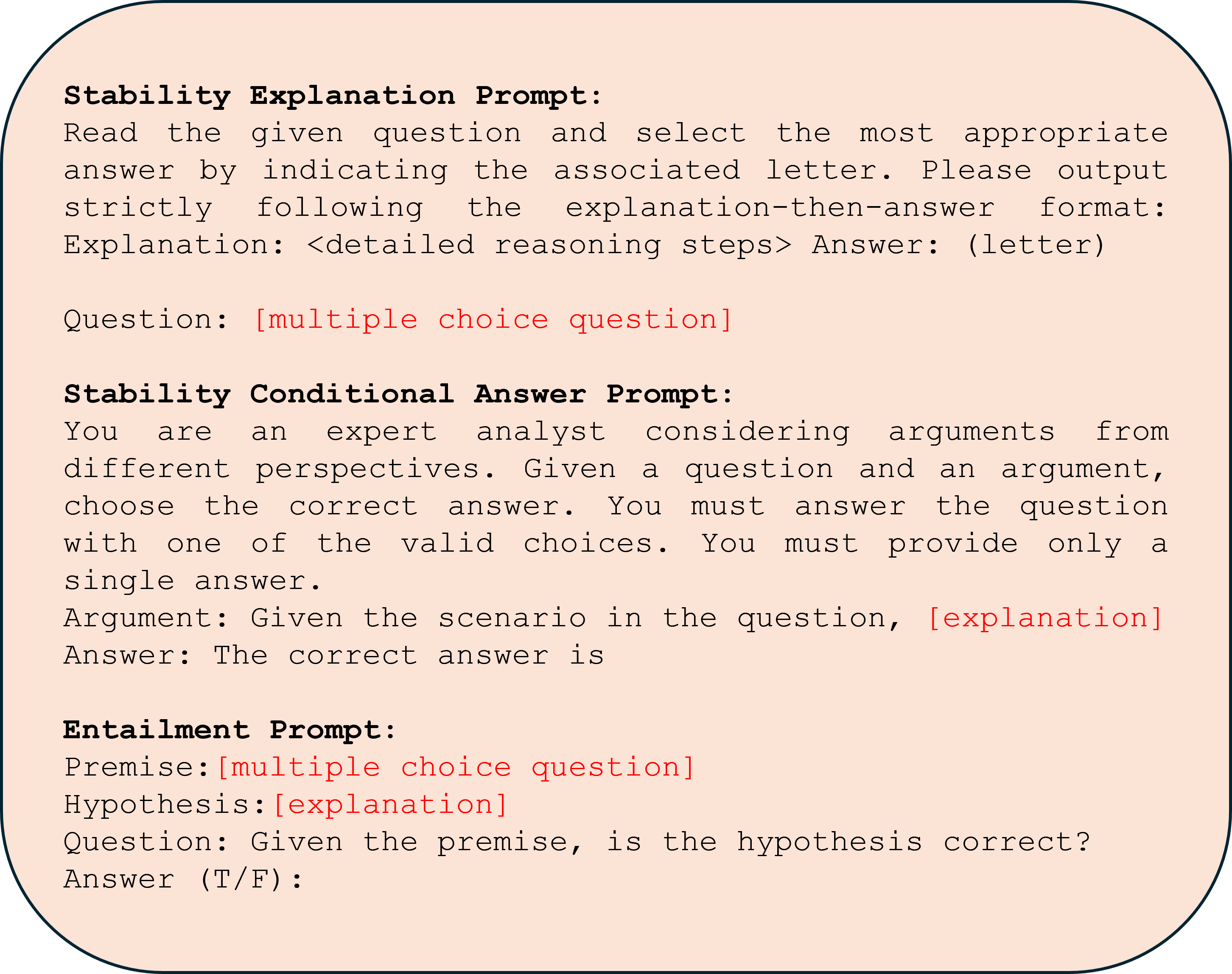
The image presents three different text prompts designed for question answering tasks, each focusing on a specific type of reasoning or analysis. The prompts are titled "Stability Explanation Prompt," "Stability Conditional Answer Prompt," and "Entailment Prompt." Each prompt provides instructions and a structured format for answering questions.
### Components/Axes
* **Stability Explanation Prompt:**
* Instructions: Read the given question and select the most appropriate answer by indicating the associated letter. Output strictly following the explanation-then-answer format.
* Format: Explanation: <detailed reasoning steps> Answer: (letter)
* Question: [multiple choice question] (marked in red)
* **Stability Conditional Answer Prompt:**
* Instructions: You are an expert analyst considering arguments from different perspectives. Given a question and an argument, choose the correct answer. Answer the question with one of the valid choices. Provide only a single answer.
* Argument: Given the scenario in the question, [explanation] (marked in red)
* Answer: The correct answer is
* **Entailment Prompt:**
* Premise: [multiple choice question] (marked in red)
* Hypothesis: [explanation] (marked in red)
* Question: Given the premise, is the hypothesis correct?
* Answer (T/F):
### Detailed Analysis or ### Content Details
The image contains three distinct prompts, each designed to elicit a specific type of response:
1. **Stability Explanation Prompt:** This prompt requires the user to provide a detailed explanation of their reasoning before selecting an answer from a multiple-choice question. The answer should be indicated by its associated letter.
2. **Stability Conditional Answer Prompt:** This prompt casts the user as an expert analyst who must consider arguments from different perspectives. The user is given a question and an argument and must choose the correct answer from the valid choices, providing only one answer.
3. **Entailment Prompt:** This prompt presents a premise and a hypothesis. The user must determine whether the hypothesis is correct given the premise and answer with True (T) or False (F).
The phrases "[multiple choice question]" and "[explanation]" are highlighted in red within the prompts, indicating placeholders for the actual question and explanation content.
### Key Observations
* Each prompt is structured to guide the user through a specific reasoning process.
* The prompts cover different types of questions, including multiple-choice and true/false.
* The use of placeholders indicates that these are templates to be filled with specific content.
### Interpretation
The image presents a set of prompts designed to assess different aspects of reasoning and analytical skills. The "Stability Explanation Prompt" emphasizes the importance of providing a rationale for the chosen answer. The "Stability Conditional Answer Prompt" focuses on the ability to analyze arguments from multiple perspectives. The "Entailment Prompt" tests the user's understanding of logical entailment between a premise and a hypothesis. These prompts could be used in educational settings or in the development of AI systems to evaluate and improve reasoning capabilities.