\n
## Text Document: Prompt Definitions
### Overview
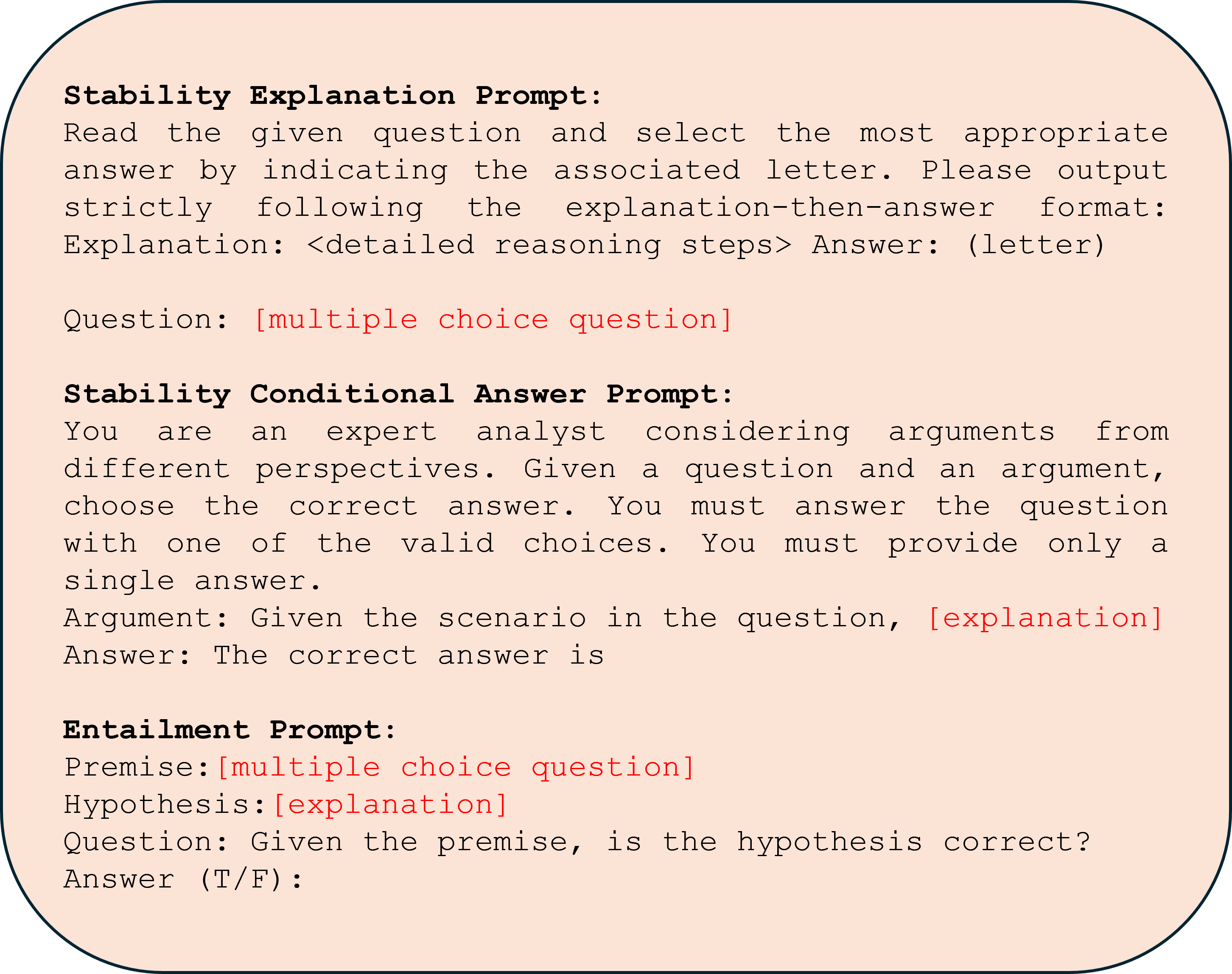
The image presents a text document outlining three different prompt types for a language model, likely related to reasoning and answer selection. The prompts are named "Stability Explanation Prompt", "Stability Conditional Answer Prompt", and "Entailment Prompt". Each prompt type includes a description of its purpose and the expected output format.
### Components/Axes
The document is structured into three distinct sections, each defining a prompt type. Each section contains:
* **Prompt Name:** (e.g., "Stability Explanation Prompt") - Bolded text.
* **Prompt Description:** A paragraph explaining the prompt's function.
* **Output Format:** Specific instructions on how the language model should format its response.
* **Example Fields:** Placeholder text indicating the expected input and output elements (e.g., "Question: [multiple choice question]").
### Detailed Analysis or Content Details
**1. Stability Explanation Prompt:**
* **Description:** Asks the model to read a question and select the most appropriate answer, indicating the associated letter.
* **Output Format:** "Explanation: <detailed reasoning steps> Answer: (letter)"
* **Example Input:** "Question: [multiple choice question]"
**2. Stability Conditional Answer Prompt:**
* **Description:** Instructs the model to act as an expert analyst, considering arguments from different perspectives, and choose the correct answer from valid choices.
* **Output Format:** "Argument: Given the scenario in the question, [explanation] Answer: The correct answer is"
* **Example Input:** "Argument: Given the scenario in the question, [explanation]"
**3. Entailment Prompt:**
* **Description:** Presents a premise and a hypothesis and asks the model to determine if the hypothesis is correct given the premise.
* **Output Format:** "Premise: [multiple choice question] Hypothesis:[explanation] Question: Given the premise, is the hypothesis correct? Answer (T/F):"
* **Example Input:** "Premise: [multiple choice question]" and "Hypothesis:[explanation]"
### Key Observations
The prompts are designed to elicit different types of reasoning from the language model:
* **Explanation:** Requires the model to justify its answer.
* **Conditional Analysis:** Requires the model to consider multiple perspectives.
* **Entailment:** Requires the model to assess logical relationships between statements.
The consistent use of bracketed placeholders ([...]) indicates that these are intended to be replaced with actual content during prompt execution.
### Interpretation
This document defines a set of prompts intended to evaluate and refine the reasoning capabilities of a language model. The prompts are structured to encourage not just correct answers, but also transparent reasoning processes. The variety of prompt types suggests a comprehensive approach to assessing the model's ability to handle different types of logical challenges. The emphasis on specific output formats ensures consistency and facilitates automated evaluation of the model's responses. The prompts are designed to test the model's ability to provide explanations, consider different viewpoints, and assess logical entailment, all of which are crucial for building reliable and trustworthy AI systems.