# Technical Document Extraction: Flowchart Analysis
## Section (a): Input
### Task Description
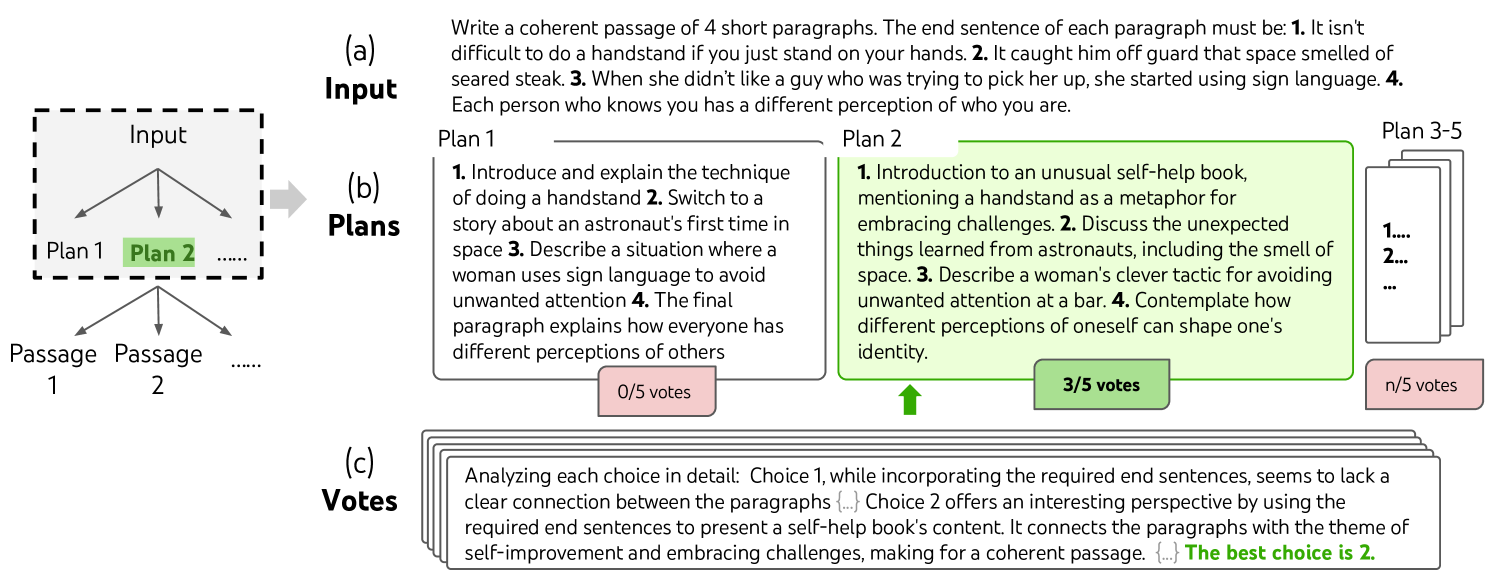
- **Objective**: Write a coherent passage of 4 short paragraphs.
- **Constraints**:
1. Each paragraph must end with a specific sentence:
- Paragraph 1: *"It isn't difficult to do a handstand if you just stand on your hands."*
- Paragraph 2: *"It caught him off guard that space smelled of seared steak."*
- Paragraph 3: *"When she didn't like a guy who was trying to pick her up, she started using sign language."*
- Paragraph 4: *"Each person who knows you has a different perception of who you are."*
## Section (b): Plans
### Plan 1
1. Introduce and explain the technique of doing a handstand.
2. Switch to a story about an astronaut's first time in space.
3. Describe a situation where a woman uses sign language to avoid unwanted attention.
4. Final paragraph explains how everyone has different perceptions of others.
### Plan 2 (Selected)
1. Introduction to an unusual self-help book.
2. Mention a handstand as a metaphor for embracing challenges.
3. Discuss unexpected things learned from astronauts (e.g., smell of space).
4. Describe a woman's clever tactic for avoiding unwanted attention at a bar.
5. Conclude with how different self-perceptions shape identity.
### Plan 3-5
- Placeholder for additional plans (not detailed in the image).
### Voting Results
- **Plan 1**: 0/5 votes
- **Plan 2**: 3/5 votes (selected, indicated by green upward arrow)
- **Plan 3-5**: n/5 votes (not specified)
## Section (c): Votes
### Analysis of Plan 2
- **Strengths**:
- Connects paragraphs thematically (self-improvement, embracing challenges).
- Incorporates required end sentences while maintaining coherence.
- **Weaknesses**:
- Plan 1 lacks clear paragraph connections despite including required sentences.
- **Conclusion**: *"The best choice is 2."*
## Diagram Components
1. **Input Box**:
- Contains task description and paragraph constraints.
2. **Plans Section**:
- Three plans with detailed content and voting results.
3. **Votes Section**:
- Comparative analysis of Plan 1 and Plan 2.
4. **Flow Arrows**:
- Connect Input → Plans → Votes.
5. **Color Coding**:
- Green highlights Plan 2 and its selection.
- Pink boxes indicate vote counts (0/5, n/5).