\n
## Horizontal Bar Chart: CiteME Paper Tags
### Overview
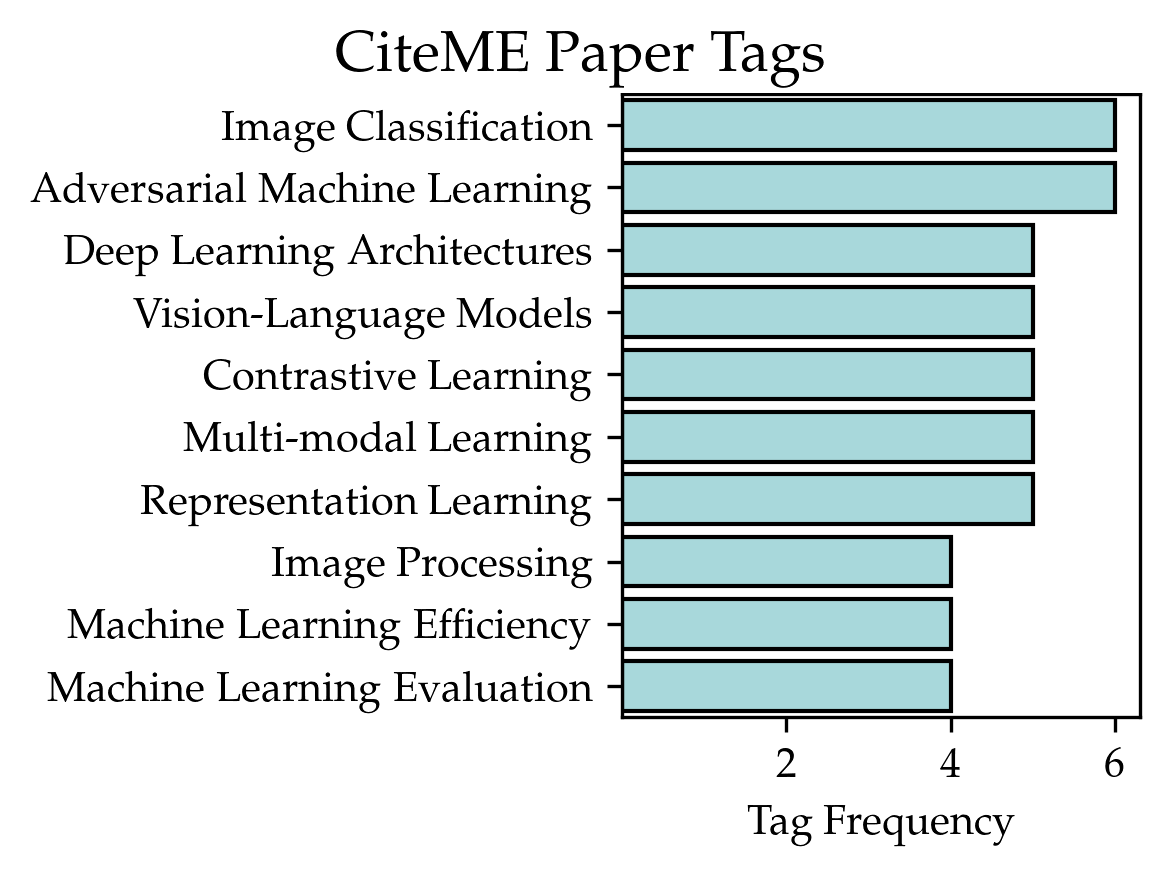
The image presents a horizontal bar chart displaying the frequency of various tags associated with papers on CiteME. The chart visualizes the distribution of tags, allowing for a quick comparison of their prevalence.
### Components/Axes
* **Title:** "CiteME Paper Tags" - positioned at the top-center of the image.
* **X-axis:** "Tag Frequency" - ranging from approximately 0 to 6, with markers at 2, 4, and 6.
* **Y-axis:** Lists the following tags (from top to bottom):
* Image Classification
* Adversarial Machine Learning
* Deep Learning Architectures
* Vision-Language Models
* Contrastive Learning
* Multi-modal Learning
* Representation Learning
* Image Processing
* Machine Learning Efficiency
* Machine Learning Evaluation
* **Bars:** Each tag is represented by a horizontal bar, with the length of the bar corresponding to its frequency. The bars are a light grey color.
### Detailed Analysis
The chart displays the frequency of each tag. The trend is to read the length of each bar to determine the frequency.
* **Image Classification:** Approximately 5.6
* **Adversarial Machine Learning:** Approximately 5.2
* **Deep Learning Architectures:** Approximately 4.8
* **Vision-Language Models:** Approximately 4.6
* **Contrastive Learning:** Approximately 4.4
* **Multi-modal Learning:** Approximately 4.2
* **Representation Learning:** Approximately 3.8
* **Image Processing:** Approximately 3.4
* **Machine Learning Efficiency:** Approximately 3.2
* **Machine Learning Evaluation:** Approximately 5.0
### Key Observations
* "Image Classification" and "Adversarial Machine Learning" have the highest tag frequencies, both around 5.6 and 5.2 respectively.
* "Machine Learning Efficiency" has the lowest tag frequency, at approximately 3.2.
* The tags are relatively evenly distributed across the frequency range, with most falling between 3 and 5.
### Interpretation
The chart suggests that papers on CiteME frequently cover topics related to Image Classification, Adversarial Machine Learning, and Deep Learning Architectures. This indicates a strong focus on these areas within the research represented on the platform. The lower frequency of "Machine Learning Efficiency" might suggest that optimization and efficiency are less central themes in the papers, or that these aspects are discussed under different tags. The data provides insight into the key research areas within the CiteME dataset, which could be useful for researchers seeking relevant papers or for understanding the current trends in the field. The relatively close frequencies of many tags suggest a diverse range of research interests, rather than a single dominant theme.