## Diagram: AI Model vs. Human Visual Reasoning Evaluation
### Overview
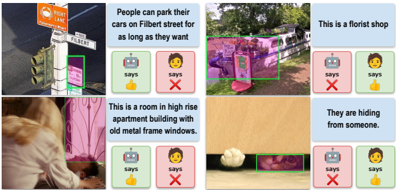
This image is a 2x2 grid representing a comparative dataset used to evaluate AI visual reasoning against human judgment. Each quadrant contains an image with a green bounding box highlighting a specific region of interest, a descriptive text statement, and a binary evaluation (Thumbs Up/Down) attributed to a "Robot" and a "Human." The layout suggests a study on AI hallucination or misinterpretation of visual data.
### Components/Axes
The image is organized into four distinct quadrants. Each quadrant follows a consistent structure:
* **Visual Input (Left side of quadrant):** A photograph with a green bounding box highlighting a specific object or area.
* **Textual Statement (Top-right of quadrant):** A caption or claim about the image.
* **Evaluation Block (Bottom-right of quadrant):**
* **Robot says:** Icon of a robot head paired with a Thumbs Up or Thumbs Down icon.
* **Human says:** Icon of a person head paired with a Thumbs Up or Thumbs Down icon.
### Detailed Analysis
#### Quadrant 1 (Top-Left)
* **Visual:** A street sign reading "FILBERT" and a parking sign reading "RIGHT LANE". A green box highlights the parking sign.
* **Text:** "People can park their cars on Filbert street for as long as they want"
* **Evaluation:**
* **Robot:** Thumbs Up (Indicates the AI agrees with the statement).
* **Human:** Thumbs Down (Indicates the human disagrees with the statement).
* **Trend:** The AI fails to interpret the parking restriction sign correctly, while the human correctly identifies that parking is likely restricted.
#### Quadrant 2 (Top-Right)
* **Visual:** A canal boat decorated with flowers. A green box highlights the boat and flowers.
* **Text:** "This is a florist shop"
* **Evaluation:**
* **Robot:** Thumbs Down (Indicates the AI disagrees with the statement).
* **Human:** Thumbs Up (Indicates the human agrees with the statement).
* **Trend:** The AI correctly identifies that the object is not a florist shop, whereas the human (in this specific dataset context) accepts the premise or identifies it as such.
#### Quadrant 3 (Bottom-Left)
* **Visual:** An interior shot of a person near a window. A green box highlights the window frame.
* **Text:** "This is a room in high rise apartment building with old metal frame windows."
* **Evaluation:**
* **Robot:** Thumbs Up (Indicates the AI agrees with the statement).
* **Human:** Thumbs Down (Indicates the human disagrees with the statement).
* **Trend:** The AI hallucinates context (high-rise apartment) based on the visual input, while the human identifies the statement as incorrect.
#### Quadrant 4 (Bottom-Right)
* **Visual:** A hand or object visible under a door. A green box highlights the hand/object.
* **Text:** "They are hiding from someone."
* **Evaluation:**
* **Robot:** Thumbs Down (Indicates the AI disagrees with the statement).
* **Human:** Thumbs Up (Indicates the human agrees with the statement).
* **Trend:** The AI fails to infer the narrative context (hiding), while the human correctly interprets the scene.
### Key Observations
* **Systematic Disagreement:** In all four examples, the "Robot" and "Human" evaluations are opposites.
* **AI Failure Modes:** The "Robot" evaluations demonstrate common AI failure modes:
* **Hallucination:** Inventing details not present (e.g., "high rise apartment").
* **Misinterpretation of Text/Symbols:** Failing to read or understand the implications of the parking sign.
* **Lack of Narrative Inference:** Failing to understand the intent behind the scene (e.g., "hiding").
* **Bounding Boxes:** The green boxes appear to be "attention maps" or "object detection" regions, showing that the AI is looking at the correct area but failing to derive the correct semantic meaning from it.
### Interpretation
This image serves as a diagnostic tool for evaluating Visual Question Answering (VQA) or image captioning models. It highlights the gap between **object detection** (the AI successfully finding the window, the sign, the boat, the hand) and **semantic reasoning** (the AI failing to understand the *meaning* of those objects).
The "Robot" represents an AI model that is technically capable of identifying objects but lacks the common sense or contextual knowledge to interpret them correctly. The "Human" represents the ground truth. This type of data is typically used to train models to be more robust or to identify specific weaknesses in current computer vision architectures.