## Collage of Annotated Photographs: Statement Evaluation Set
### Overview
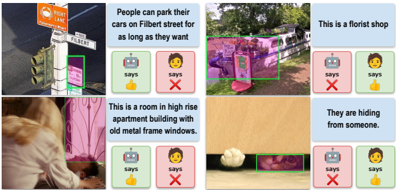
The image is a digital collage composed of six distinct panels arranged in a 2x3 grid (two rows, three columns). Each panel contains a photograph on the left and a corresponding text box on the right. The text boxes present a declarative statement about the image, followed by two evaluation icons: a green thumbs-up and a red thumbs-down, each labeled with the word "says" above them. The overall purpose appears to be a visual exercise in evaluating the truthfulness or accuracy of statements based on photographic evidence.
### Components/Axes
* **Layout:** A grid of six panels. Each panel is a self-contained unit with a photograph and an associated text box.
* **Text Box Structure (per panel):**
1. A statement in English describing or interpreting the adjacent photograph.
2. Two evaluation icons positioned side-by-side below the statement:
* **Left Icon:** A green thumbs-up symbol. Above it, the word "says" is written in a small, sans-serif font.
* **Right Icon:** A red thumbs-down symbol. Above it, the word "says" is written in the same small, sans-serif font.
* **Language:** All embedded text is in English. No other languages are present.
### Detailed Analysis / Content Details
**Panel-by-Panel Breakdown:**
1. **Top-Left Panel:**
* **Photograph:** A close-up of street signs at an intersection. The visible signs read "FILBERT ST" and "HYDE ST". A "NO PARKING" sign is partially visible below.
* **Statement:** "People can park their cars on Filbert street for as long as they want"
* **Evaluation Icons:** Green thumbs-up ("says") and Red thumbs-down ("says").
2. **Top-Middle Panel:**
* **Photograph:** A bright pink newspaper vending machine or distribution box on a sidewalk. It has a clear plastic front showing newspapers inside.
* **Statement:** "This is a florist shop"
* **Evaluation Icons:** Green thumbs-up ("says") and Red thumbs-down ("says").
3. **Top-Right Panel:**
* **Photograph:** A cat's face and paws are visible as it peeks out from a dark space, likely under a bed or piece of furniture.
* **Statement:** "They are hiding from someone."
* **Evaluation Icons:** Green thumbs-up ("says") and Red thumbs-down ("says").
4. **Bottom-Left Panel:**
* **Photograph:** An interior view of a room. Pink curtains are drawn across a window. The window frame appears to be made of metal.
* **Statement:** "This is a room in high rise apartment building with old metal frame windows."
* **Evaluation Icons:** Green thumbs-up ("says") and Red thumbs-down ("says").
5. **Bottom-Middle Panel:**
* **Photograph:** A white, soft object (possibly a pillow, cushion, or a small pet) is partially visible, tucked into a corner or against a surface.
* **Statement:** "They are hiding from someone."
* **Evaluation Icons:** Green thumbs-up ("says") and Red thumbs-down ("says").
6. **Bottom-Right Panel:**
* **Photograph:** A close-up, slightly blurry image. It appears to show the top of a person's head with dark hair, or possibly an object, against a light background.
* **Statement:** "They are hiding from someone."
* **Evaluation Icons:** Green thumbs-up ("says") and Red thumbs-down ("says").
### Key Observations
* **Repetitive Statement:** The statement "They are hiding from someone." is used in three separate panels (top-right, bottom-middle, bottom-right) with three different photographs. This creates a pattern and suggests the exercise may test the interpretation of ambiguous visual cues.
* **Statement Specificity:** The statements vary in specificity. Some are factual and verifiable (e.g., the street name, the object being a newspaper box), while others are interpretive and subjective (e.g., the act of "hiding").
* **Visual Evidence vs. Claim:** There is a clear disconnect in at least one panel. The top-middle panel's claim ("This is a florist shop") is directly contradicted by the visual evidence of a newspaper vending machine.
* **Consistent UI Elements:** The evaluation icons ("says" with thumbs-up/down) are graphically identical across all panels, establishing a consistent interface for response.
### Interpretation
This collage functions as a **visual reasoning or fact-checking exercise**. It presents a series of image-text pairs where the viewer is prompted to judge the validity of a statement based on photographic evidence.
* **Purpose:** The setup mimics tasks used in training or evaluating multimodal AI systems or human critical thinking, where the goal is to align textual claims with visual data. The dual "says" icons likely represent two possible judgments (e.g., "True" vs. "False" or "Agree" vs. "Disagree").
* **Data Relationship:** The core relationship is between the **photographic data** (the ground truth) and the **linguistic claim** (the hypothesis). The evaluation icons represent the output of a reasoning process comparing the two.
* **Notable Pattern:** The repetition of the "hiding" statement with different images is particularly significant. It tests whether the same conclusion can be drawn from varied visual contexts, highlighting the challenge of interpreting intent or narrative from static images. One image (the cat) strongly supports the claim, while the others (the white object, the blurry close-up) are far more ambiguous, potentially serving as outliers or tests of over-interpretation.
* **Underlying Theme:** The set explores the gap between objective observation and subjective interpretation. It demonstrates how language can frame perception (e.g., calling a cat "they" and ascribing the motive of "hiding") and how easily claims can be mismatched with evidence (the florist shop claim). The exercise emphasizes the need for precise, evidence-based reasoning when connecting visual and textual information.