## Diagram: Coalition Structures and Valuation Forms
### Overview
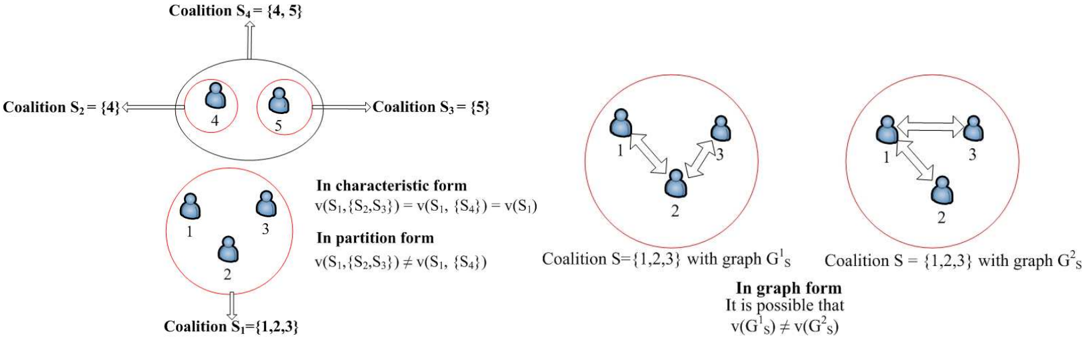
The image depicts a comparative analysis of coalition structures and their valuation forms. It includes three primary sections:
1. **Coalition Relationships**: Visual representation of coalitions S₁={1,2,3}, S₂={4}, S₃={5}, and S₄={4,5} with directional arrows indicating hierarchical or associative relationships.
2. **Form Comparisons**: Two sub-diagrams for coalition S₁={1,2,3} comparing "characteristic form," "partition form," and "graph form" with associated equations.
3. **Graph Variants**: Two graph representations (G¹_S and G²_S) for coalition S₁, highlighting potential differences in valuation.
### Components/Axes
- **Coalition Labels**:
- S₁={1,2,3} (left-bottom circle, red outline)
- S₂={4} (left-middle circle, red outline)
- S₃={5} (left-top circle, red outline)
- S₄={4,5} (left-top circle, black outline)
- **Graph Labels**:
- G¹_S (right-middle graph, red outline)
- G²_S (right-right graph, red outline)
- **Textual Elements**:
- Equations:
- `v(S₁,S₂,S₃) = v(S₁, S₄) = v(S₁)` (characteristic/partition form)
- `v(S₁,S₂,S₃) ≠ v(S₁, S₄)` (partition form)
- `v(G¹_S) ≠ v(G²_S)` (graph form note)
- Descriptions:
- "In characteristic form" (left-middle circle)
- "In partition form" (left-bottom circle)
- "In graph form" (right-center text)
### Detailed Analysis
- **Coalition Relationships**:
- S₄={4,5} is a superset of S₂={4} and S₃={5}, with arrows indicating inclusion or dependency.
- S₁={1,2,3} is isolated but connected to S₂ and S₃ via S₄.
- **Form Comparisons**:
- **Characteristic Form**: Valuation equality across S₁, S₂, S₃, and S₄.
- **Partition Form**: Valuation differs between S₁ and S₄ despite shared elements.
- **Graph Form**: Two graph variants (G¹_S and G²_S) for S₁ show potential valuation divergence.
- **Graph Variants**:
- G¹_S and G²_S differ in edge configurations (e.g., bidirectional vs. unidirectional arrows), suggesting structural impacts on valuation.
### Key Observations
1. **Valuation Consistency**: Characteristic and partition forms enforce valuation equality for overlapping coalitions (e.g., S₁ and S₄).
2. **Graph Sensitivity**: Graph forms (G¹_S vs. G²_S) introduce variability in valuation, implying structural dependencies.
3. **Hierarchical Structure**: S₄ acts as a bridge between S₂ and S₃, while S₁ remains a standalone coalition.
### Interpretation
The diagram illustrates how coalition valuations depend on structural and relational properties:
- **Characteristic/Partition Forms**: Prioritize set membership over relational dynamics, leading to uniform valuations.
- **Graph Forms**: Introduce sensitivity to relational structures (e.g., edge directions), allowing for differentiated valuations.
- **Implications**: The inequality `v(G¹_S) ≠ v(G²_S)` suggests that graph topology (e.g., communication patterns, influence flows) critically affects coalition outcomes. This aligns with game-theoretic models where relational complexity alters strategic value.
The analysis underscores the importance of structural representation in coalition analysis, particularly in systems where relational dependencies (e.g., power dynamics, resource allocation) influence collective outcomes.