## Coalition Structures and Forms
### Overview
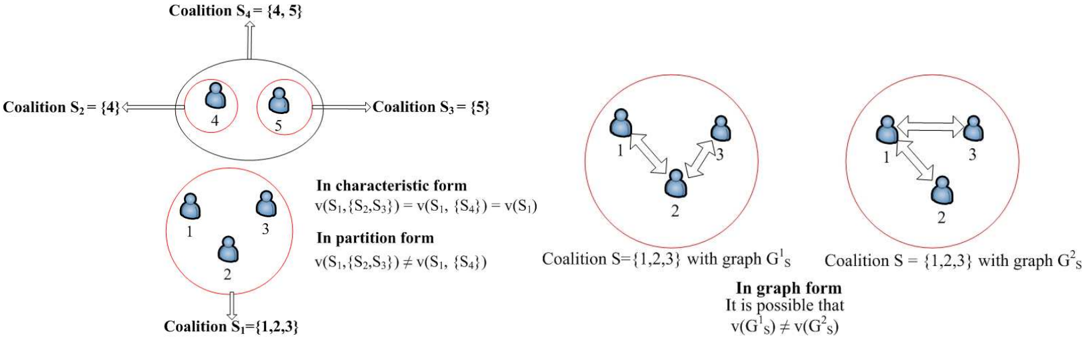
The image illustrates different coalition structures and their representation in characteristic, partition, and graph forms. It depicts coalitions of agents (represented by human-like icons) and their relationships, along with mathematical expressions defining their values.
### Components/Axes
* **Coalitions:** Sets of agents, labeled as S1, S2, S3, S4, and S.
* **Agents:** Individual actors within the coalitions, numbered 1 through 5.
* **Characteristic Form:** A mathematical representation of coalition values.
* **Partition Form:** Another mathematical representation of coalition values.
* **Graph Form:** Representation of coalitions using graphs, showing relationships between agents.
* **Arrows:** Indicate relationships or interactions between agents within a coalition.
* **Circles:** Enclose agents belonging to a specific coalition.
### Detailed Analysis or ### Content Details
**Coalition Structures (Left Side):**
* **Coalition S1:** Contains agents 1, 2, and 3. It is represented by a circle enclosing the three agent icons. Label: "Coalition S1 = {1,2,3}" with an arrow pointing to the circle.
* **Coalition S2:** Contains agent 4. It is represented by a circle enclosing the agent icon. Label: "Coalition S2 = {4}" with an arrow pointing to the circle.
* **Coalition S3:** Contains agent 5. It is represented by a circle enclosing the agent icon. Label: "Coalition S3 = {5}" with an arrow pointing to the circle.
* **Coalition S4:** Contains agents 4 and 5. It is represented by a circle enclosing the two agent icons. Label: "Coalition S4 = {4,5}" with an arrow pointing to the circle.
**Mathematical Forms (Left Side):**
* **In characteristic form:**
* v(S1, {S2, S3}) = v(S1, {S4}) = v(S1)
* **In partition form:**
* v(S1, {S2, S3}) ≠ v(S1, {S4})
**Coalition Structures with Graphs (Right Side):**
* **Coalition S (Left):** Contains agents 1, 2, and 3. It is represented by a circle enclosing the three agent icons. Arrows indicate relationships: Agent 1 -> Agent 2, Agent 2 -> Agent 3, Agent 3 -> Agent 1. Label: "Coalition S = {1,2,3} with graph G's"
* **Coalition S (Right):** Contains agents 1, 2, and 3. It is represented by a circle enclosing the three agent icons. Arrows indicate relationships: Agent 1 <-> Agent 3, Agent 1 -> Agent 2, Agent 2 -> Agent 3. Label: "Coalition S = {1,2,3} with graph G²s"
**Graph Form (Bottom Right):**
* **In graph form:**
* It is possible that v(G's) ≠ v(G²s)
### Key Observations
* The image presents different ways to represent coalitions: as sets of agents, and through mathematical expressions defining their values.
* The characteristic form shows that the value of coalition S1 is the same whether it is considered alongside coalitions S2 and S3, or alongside coalition S4.
* The partition form shows that the value of coalition S1 is different depending on whether it is considered alongside coalitions S2 and S3, or alongside coalition S4.
* The graph form illustrates how relationships between agents within a coalition can be represented using graphs, and how different graph structures can lead to different coalition values.
### Interpretation
The image demonstrates the concept of coalition formation and valuation in game theory or multi-agent systems. It highlights that the value of a coalition can depend not only on the agents within it but also on the relationships between them and the context in which the coalition is formed. The different mathematical forms (characteristic and partition) represent different ways of defining the value of a coalition, while the graph form provides a visual representation of the relationships between agents. The statement "It is possible that v(G's) ≠ v(G²s)" suggests that the value of a coalition can be influenced by the specific structure of the relationships between its members. This is important in scenarios where the interactions and dependencies between agents play a significant role in determining the overall outcome.