## Diagram: Comparison of Agent Exploration and Path Generation Methods
### Overview
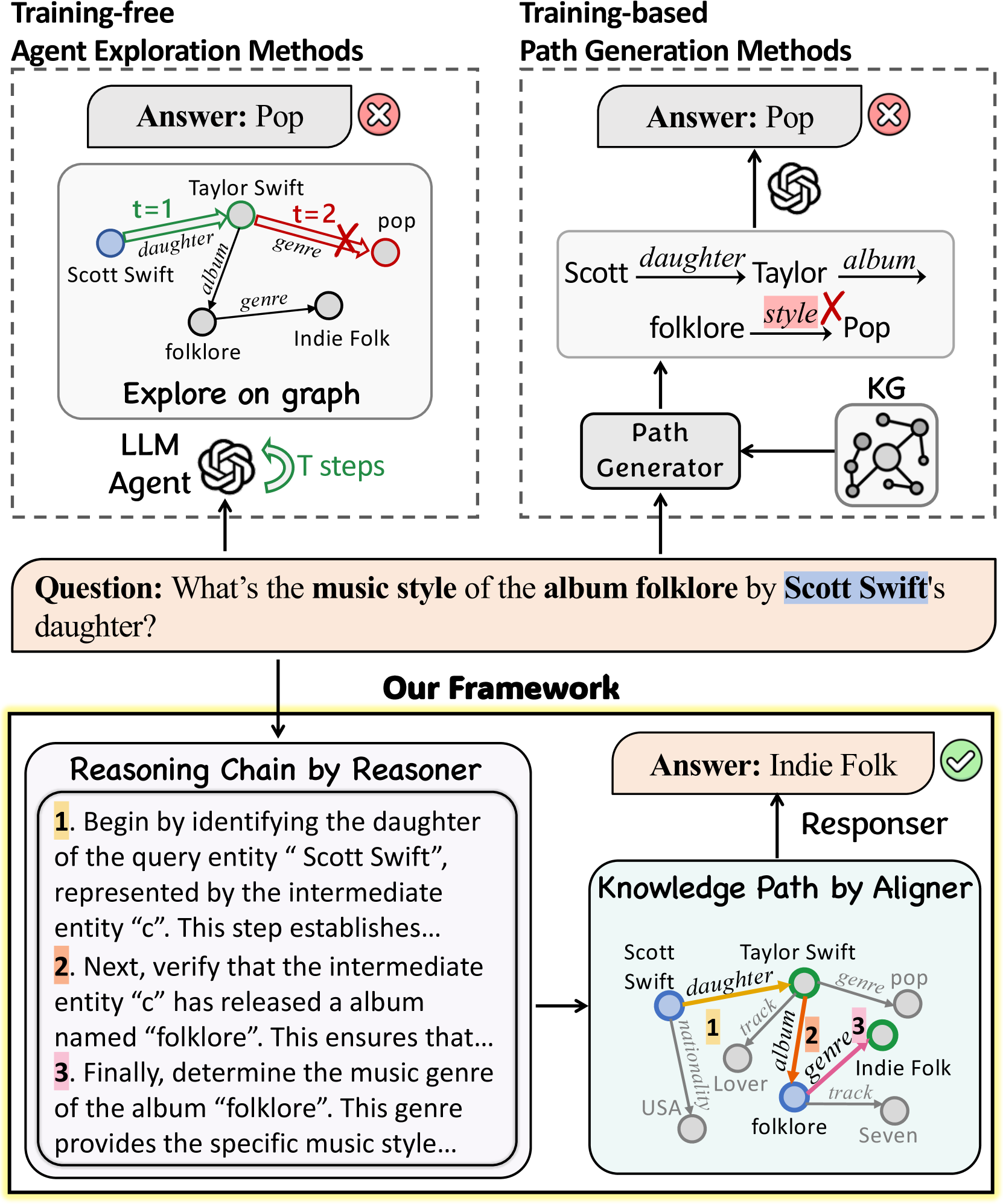
The image presents a comparative diagram illustrating two approaches to answering a question about music style: "What's the music style of the album folklore by Scott Swift's daughter?". The left side depicts a "Training-free Agent Exploration Method," while the right side shows a "Training-based Path Generation Method." Below these, "Our Framework" is presented, detailing a "Reasoning Chain by Reasoner" and a "Knowledge Path by Aligner" that correctly answers the question.
### Components/Axes
**Top Section:**
* **Titles:** "Training-free Agent Exploration Methods" (left), "Training-based Path Generation Methods" (right).
* **Answer Boxes:** Each method has an "Answer" box, both initially stating "Pop" with a red "X" indicating an incorrect answer.
* **Question:** "What's the music style of the album folklore by Scott Swift's daughter?"
**Left Side (Training-free Agent Exploration):**
* **Graph:** A simple graph with nodes representing entities (Scott Swift, Taylor Swift, Pop, Indie Folk, folklore) and edges representing relationships (daughter, album, genre).
* Scott Swift (blue node) is connected to Taylor Swift (green node) via "daughter" (t=1, green arrow).
* Taylor Swift (green node) is connected to Pop (red node) via "genre" (t=2, red arrow with an X).
* Taylor Swift (green node) is connected to folklore (grey node) via "album" (black arrow).
* folklore (grey node) is connected to Indie Folk (grey node) via "genre" (black arrow).
* **LLM Agent:** An icon representing a Large Language Model Agent.
* **T steps:** A green arrow indicating the agent takes T steps.
* **Explore on graph:** Label below the graph.
**Right Side (Training-based Path Generation):**
* **Graph:** A graph with nodes representing entities (Scott, Taylor, folklore, Pop) and edges representing relationships (daughter, album, style).
* Scott is connected to Taylor via "daughter".
* Taylor is connected to folklore via "album".
* folklore is connected to Pop via "style" (red X over style).
* **KG:** An icon representing a Knowledge Graph.
* **Path Generator:** A box labeled "Path Generator".
* **Arrow Flow:** Arrows indicate the flow of information from the question to the Path Generator, from the KG to the Path Generator, from the Path Generator to the graph, and from the graph to the "Answer" box.
**Bottom Section (Our Framework):**
* **Title:** "Our Framework"
* **Left Box (Reasoning Chain by Reasoner):**
* **Title:** "Reasoning Chain by Reasoner"
* **Steps:**
1. "Begin by identifying the daughter of the query entity 'Scott Swift', represented by the intermediate entity 'c'. This step establishes..."
2. "Next, verify that the intermediate entity 'c' has released a album named 'folklore'. This ensures that..."
3. "Finally, determine the music genre of the album 'folklore'. This genre provides the specific music style..."
* **Right Box (Knowledge Path by Aligner):**
* **Title:** "Knowledge Path by Aligner"
* **Graph:** A graph with nodes representing entities (Scott Swift, Taylor Swift, Pop, Indie Folk, folklore, USA, Lover, Seven) and edges representing relationships (daughter, album, genre, nationality, track).
* Scott Swift (blue node) is connected to Taylor Swift (green node) via "daughter" (orange arrow labeled "1").
* Taylor Swift (green node) is connected to Indie Folk (green node) via "genre" (pink arrow labeled "3").
* Taylor Swift (green node) is connected to folklore (blue node) via "album" (orange arrow labeled "2").
* Scott Swift (blue node) is connected to USA (grey node) via "nationality".
* Taylor Swift (green node) is connected to Lover (grey node) via "track".
* folklore (blue node) is connected to Seven (grey node) via "track".
* Taylor Swift (green node) is connected to Pop (green node) via "genre".
* **Responser:** Label above the "Answer" box.
* **Answer Box:** "Answer: Indie Folk" with a green checkmark indicating the correct answer.
### Detailed Analysis or ### Content Details
* **Incorrect Answers:** Both the "Training-free" and "Training-based" methods initially provide the incorrect answer "Pop."
* **Correct Answer:** "Our Framework" correctly identifies the answer as "Indie Folk."
* **Reasoning Chain:** The "Reasoning Chain by Reasoner" outlines the steps taken to arrive at the correct answer.
* **Knowledge Path:** The "Knowledge Path by Aligner" visually represents the connections between entities that lead to the correct answer.
### Key Observations
* The diagram highlights the difference between methods that rely on exploration versus those that use training to generate paths.
* The "Our Framework" section demonstrates a more effective approach to answering the question.
* The use of color and arrows helps to visually represent the flow of information and relationships between entities.
### Interpretation
The diagram illustrates the superiority of the proposed framework in answering complex questions compared to simpler exploration or path generation methods. The initial failure of both "Training-free" and "Training-based" methods underscores the need for a more sophisticated approach. "Our Framework," which combines reasoning and knowledge alignment, successfully identifies the correct answer, "Indie Folk." This suggests that a combination of structured reasoning and knowledge graph traversal is more effective for answering questions that require understanding relationships between entities. The diagram emphasizes the importance of considering multiple factors and relationships to arrive at an accurate conclusion.