## Diagram: Knowledge Graph Reasoning Framework Comparison
### Overview
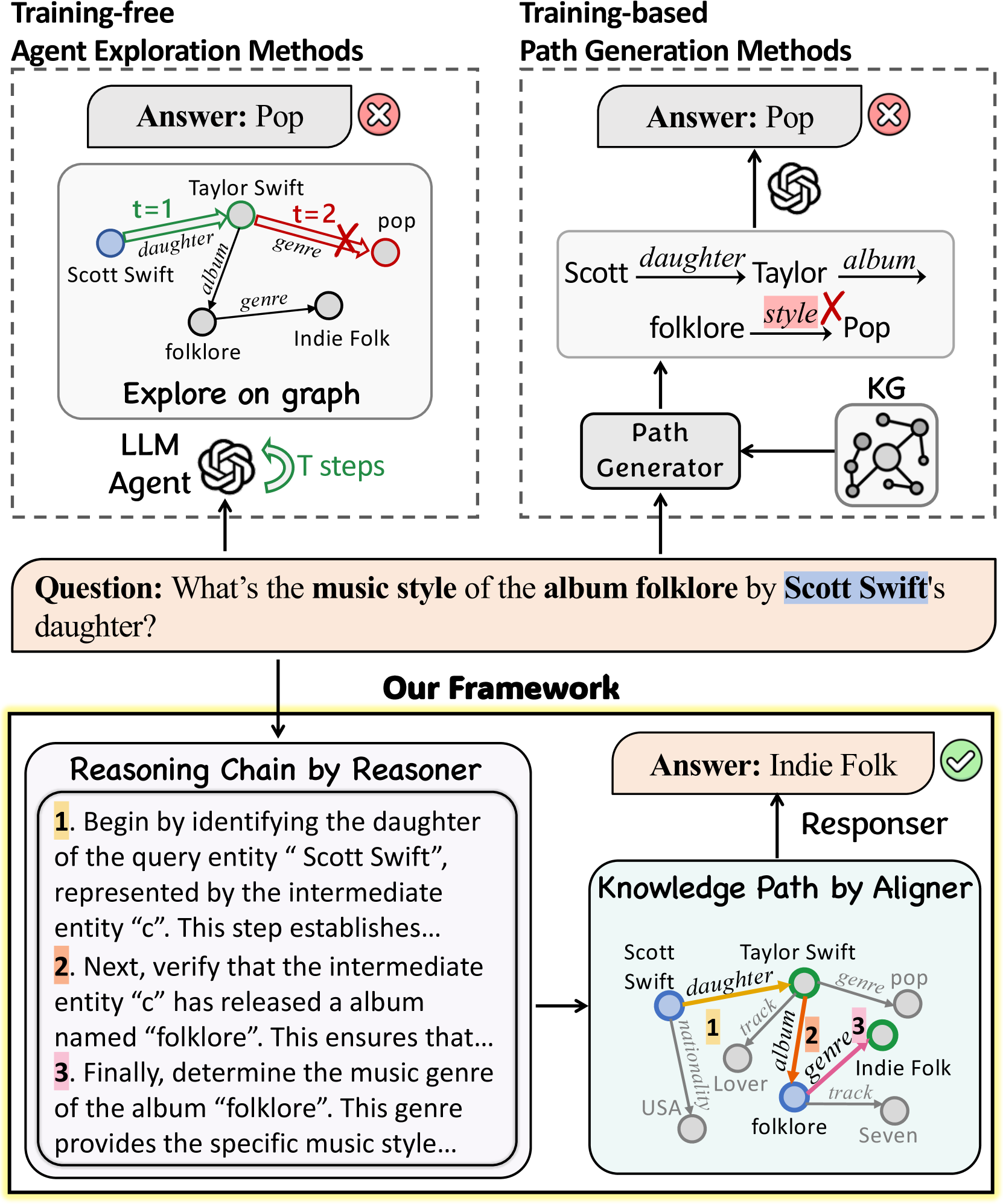
The image presents a comparative diagram illustrating two approaches to answering a knowledge-based question: "What's the music style of the album folklore by Scott Swift's daughter?". The two approaches are "Training-free Agent Exploration Methods" and "Training-based Path Generation Methods", contrasted with "Our Framework" which combines elements of both. Each approach is visualized using knowledge graphs and flow diagrams.
### Components/Axes
The diagram is divided into four main sections:
1. **Training-free Agent Exploration Methods** (Top-Left)
2. **Training-based Path Generation Methods** (Top-Right)
3. **Our Framework** (Bottom) - further divided into Reasoning Chain by Reasoner and Knowledge Path by Aligner.
Each section includes:
* A knowledge graph representing relationships between entities (Scott Swift, Taylor Swift, folklore, genre, pop, Indie Folk).
* A flow diagram illustrating the process of arriving at an answer.
* A "Question" box.
* An "Answer" box.
The knowledge graphs use nodes to represent entities and edges to represent relationships. The edges are labeled with relationship types (e.g., "daughter", "album", "genre", "style").
### Detailed Analysis or Content Details
**1. Training-free Agent Exploration Methods (Top-Left)**
* **Question:** "What's the music style of the album folklore by Scott Swift's daughter?"
* **Answer:** "Pop" (marked with a red 'X')
* **Knowledge Graph:**
* Nodes: Scott Swift, Taylor Swift, folklore, genre, pop, Indie Folk.
* Edges:
* Scott Swift -> daughter -> Taylor Swift
* Taylor Swift -> album -> folklore
* folklore -> genre -> Indie Folk
* Indie Folk -> genre -> pop (marked with a red 'X')
* **Flow Diagram:**
* LLM Agent -> Explore on graph -> T steps
* Time steps are indicated: t=1 and t=2.
* At t=1, the path is Scott Swift -> daughter -> Taylor Swift -> album -> folklore -> genre -> Indie Folk.
* At t=2, the path is Scott Swift -> daughter -> Taylor Swift -> album -> folklore -> genre -> pop (incorrect).
**2. Training-based Path Generation Methods (Top-Right)**
* **Question:** "What's the music style of the album folklore by Scott Swift's daughter?"
* **Answer:** "Pop" (marked with a red 'X')
* **Knowledge Graph:**
* Nodes: Scott Swift, Taylor Swift, folklore, album, style, Pop.
* Edges:
* Scott Swift -> daughter -> Taylor Swift
* Taylor Swift -> album -> folklore
* folklore -> style -> Pop (incorrect)
* **Flow Diagram:**
* Path Generator -> KG (Knowledge Graph)
* A circular arrow indicates iterative path generation.
**3. Our Framework (Bottom)**
* **Reasoning Chain by Reasoner:**
* Steps:
1. "Begin by identifying the daughter of the query entity “Scott Swift”, represented by the intermediate entity “c”. This step establishes…"
2. "Next, verify that the intermediate entity “c” has released an album named “folklore”. This ensures that…"
3. "Finally, determine the music genre of the album “folklore”. This genre provides the specific music style…"
* **Knowledge Path by Aligner:**
* **Answer:** "Indie Folk"
* **Knowledge Graph:**
* Nodes: Scott Swift, Taylor Swift, folklore, track, Indie Folk, Seven, USA, Lover.
* Edges:
* Scott Swift -> daughter -> Taylor Swift
* Taylor Swift -> album -> folklore
* folklore -> track -> Seven
* folklore -> genre -> Indie Folk
* Taylor Swift -> track -> Lover
* Taylor Swift -> location -> USA
* Numbered edges: 1 and 2.
### Key Observations
* Both the "Training-free" and "Training-based" methods initially arrive at the incorrect answer "Pop".
* "Our Framework" correctly identifies "Indie Folk" as the music style.
* The "Reasoning Chain" section outlines a logical, step-by-step approach to answering the question.
* The "Knowledge Path" section demonstrates a more complete knowledge graph with additional relationships.
* The red 'X' consistently marks incorrect paths or answers.
* The "Our Framework" utilizes a more detailed knowledge graph, including tracks and locations.
### Interpretation
The diagram demonstrates the limitations of simple knowledge graph traversal methods (Training-free and Training-based) and highlights the benefits of a more sophisticated framework that incorporates reasoning and alignment. The initial incorrect answers from the first two methods suggest that relying solely on direct paths in a knowledge graph can lead to errors, especially when multiple relationships exist. "Our Framework" addresses this by employing a reasoning chain to guide the exploration and an alignment process to ensure the selected path is logically sound. The inclusion of additional information in the "Knowledge Path" graph (tracks, location) suggests a richer representation of knowledge, which contributes to the more accurate answer. The diagram effectively illustrates a progression from naive knowledge graph querying to a more intelligent and reliable reasoning system. The use of the red 'X' is a clear visual indicator of the errors made by the initial methods, emphasizing the improvement achieved by "Our Framework".