\n
## 3D Diagram: L-Shaped Structure
### Overview
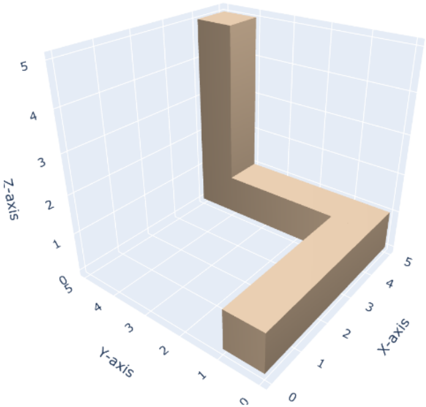
The image depicts a 3D diagram of an L-shaped structure, rendered with a light brown color scheme. The structure is positioned within a three-dimensional coordinate system defined by the X, Y, and Z axes. The diagram appears to be a visual representation of a geometric shape rather than a data-driven chart. There is no data presented in the image, only a visual representation of a shape.
### Components/Axes
* **Axes:** The diagram features three axes:
* X-axis: Ranges from 0 to 5.
* Y-axis: Ranges from 0 to 5.
* Z-axis: Ranges from 0 to 5.
* **Structure:** The L-shaped structure is composed of two rectangular prisms joined at a right angle.
* **Color Scheme:** The structure is rendered in two shades of brown, with a lighter shade for the horizontal section and a darker shade for the vertical section.
### Detailed Analysis or Content Details
The L-shaped structure can be described as follows:
* **Horizontal Section:** This section is a rectangular prism.
* Approximate X-axis extent: 2 to 5 (length ≈ 3 units).
* Approximate Y-axis extent: 0 to 3 (width ≈ 3 units).
* Approximate Z-axis height: 0 (lies on the XY-plane).
* **Vertical Section:** This section is also a rectangular prism.
* Approximate X-axis extent: 2 to 2 (width ≈ 0 units - effectively a line).
* Approximate Y-axis extent: 3 to 3 (length ≈ 0 units - effectively a line).
* Approximate Z-axis height: 0 to 5 (height ≈ 5 units).
The structure is positioned such that the vertical section rises from the end of the horizontal section.
### Key Observations
* The structure is a simple geometric shape with no apparent data or trends.
* The axes are clearly labeled, providing a coordinate system for the structure.
* The color scheme is consistent and visually appealing.
### Interpretation
The image serves as a visual representation of a 3D L-shaped structure. It does not convey any specific data or insights beyond the geometric properties of the shape. It could be used for illustrative purposes in a technical document related to geometry, 3D modeling, or spatial reasoning. The lack of data suggests the image is intended to demonstrate a shape rather than present analytical findings. The structure's positioning within the coordinate system allows for a clear understanding of its dimensions and orientation.