## 3D Coordinate System with L-Shaped Structure
### Overview
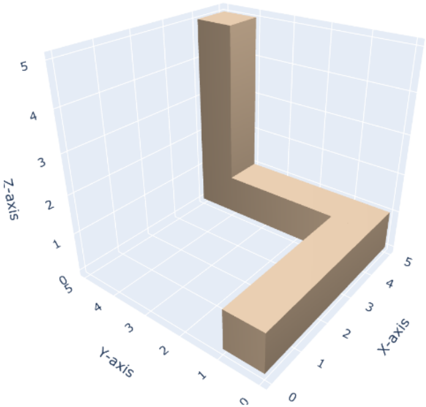
The image depicts a 3D Cartesian coordinate system with an L-shaped structure composed of two rectangular prisms. The axes (X, Y, Z) are labeled with numerical markers from 0 to 5. The structure is rendered in a uniform brown color, with no additional textures or annotations.
### Components/Axes
- **X-axis**: Labeled "X-axis" at the bottom, with numerical markers 0–5.
- **Y-axis**: Labeled "Y-axis" on the left, with numerical markers 0–5.
- **Z-axis**: Labeled "Z-axis" on the back wall, with numerical markers 0–5.
- **Structure**:
1. **Vertical Prism**: Extends along the Z-axis from (0,0,0) to (0,0,5).
2. **Horizontal Prism**: Extends along the X-axis from (0,0,0) to (5,0,0).
### Detailed Analysis
- **Axes**:
- All axes are orthogonal, forming a right-handed coordinate system.
- Grid lines are visible on all three planes (XY, YZ, XZ).
- **Structure**:
- The L-shape is formed by two prisms intersecting at the origin (0,0,0).
- Vertical prism: Height = 5 units (Z-axis).
- Horizontal prism: Length = 5 units (X-axis).
- No overlap or connection between the prisms beyond the origin.
### Key Observations
- The structure is axis-aligned, with no rotation or skew.
- The prisms occupy distinct regions: one along the Z-axis and one along the X-axis.
- No text, legends, or additional annotations are present.
### Interpretation
The image illustrates a basic 3D spatial configuration, likely used to demonstrate coordinate system orientation or geometric modeling. The L-shape suggests a modular or segmented design, possibly for applications in engineering, architecture, or computer graphics. The absence of labels or data points implies the focus is on spatial relationships rather than quantitative analysis.
## No numerical data, trends, or legends are present. The image serves as a static representation of a 3D coordinate system with a predefined geometric structure.