# Technical Document Analysis: Line Graph of L1 Error vs. n
## Title
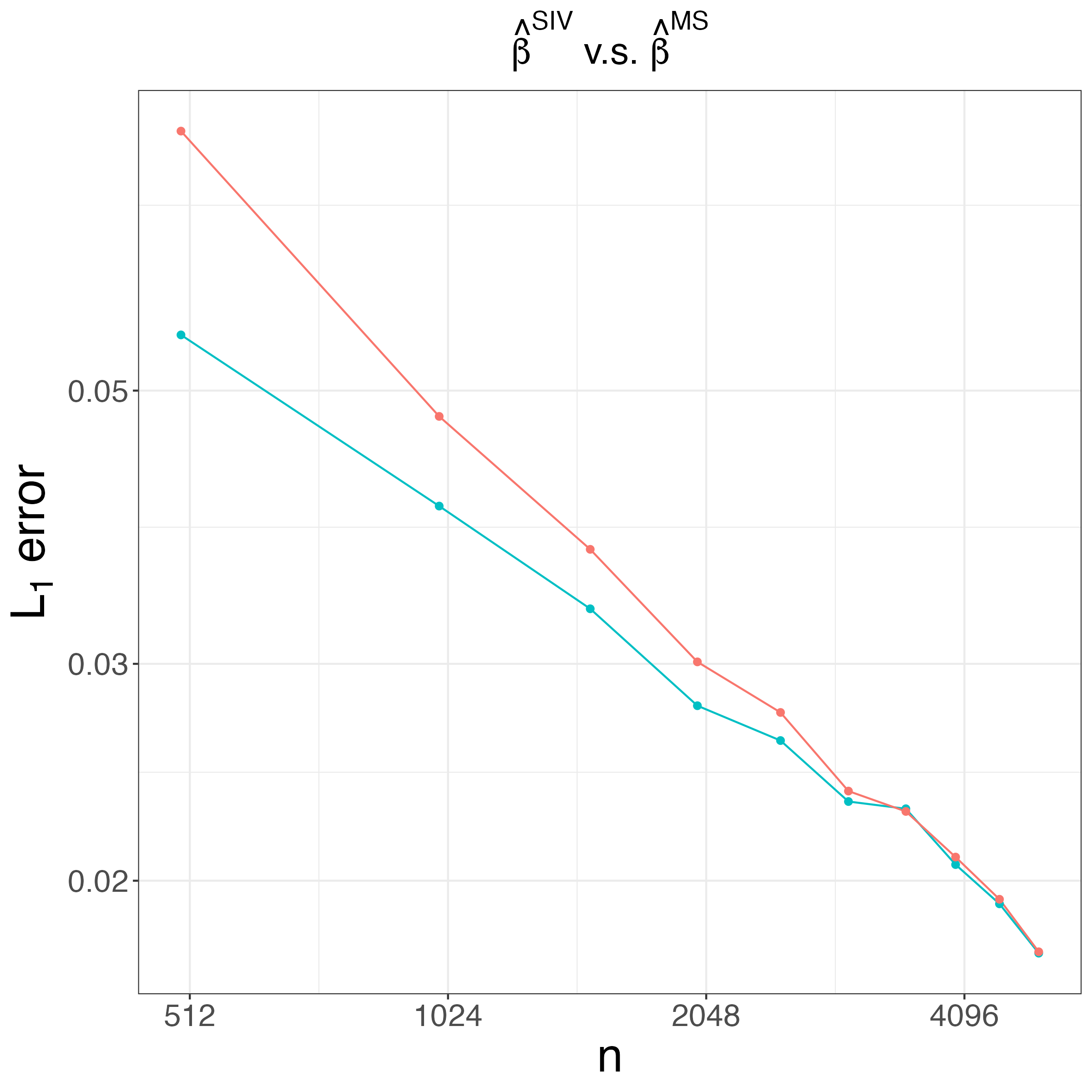
- **Graph Title**: "β_SIV vs. β_MS"
## Axes
- **X-Axis**:
- Label: "n"
- Tick Marks: 512, 1024, 2048, 4096
- **Y-Axis**:
- Label: "L₁ error"
- Range: 0.02 to 0.06 (increments of 0.01)
## Legend
- **Position**: Top of the graph
- **Labels**:
- **Red Line**: β_SIV
- **Teal Line**: β_MS
## Data Points and Trends
### β_SIV (Red Line)
- **Trend**: Steeply decreasing slope from left to right.
- **Key Points**:
- At n=512: L₁ error ≈ 0.06
- At n=1024: L₁ error ≈ 0.048
- At n=2048: L₁ error ≈ 0.03
- At n=4096: L₁ error ≈ 0.022
### β_MS (Teal Line)
- **Trend**: Gradually decreasing slope from left to right.
- **Key Points**:
- At n=512: L₁ error ≈ 0.053
- At n=1024: L₁ error ≈ 0.042
- At n=2048: L₁ error ≈ 0.028
- At n=4096: L₁ error ≈ 0.021
## Observations
1. **Convergence**: At n=4096, β_SIV (0.022) falls below β_MS (0.021), indicating a crossover point.
2. **Rate of Decrease**: β_SIV decreases more rapidly than β_MS across all n values.
3. **Initial Values**: β_SIV starts with a higher L₁ error (0.06 vs. 0.053) at n=512.
## Spatial Grounding
- **Legend**: Top-center placement, clearly associating colors with labels.
- **Data Points**: Red and teal markers align with their respective lines and legend entries.
## Conclusion
The graph compares the L₁ error performance of β_SIV and β_MS across increasing n values. β_SIV demonstrates a steeper decline in error, surpassing β_MS at n=4096. Both metrics show improved performance as n increases, with β_SIV achieving lower error rates at larger n.