## Text Block: Ball Trajectory and ASCII Representation
### Overview
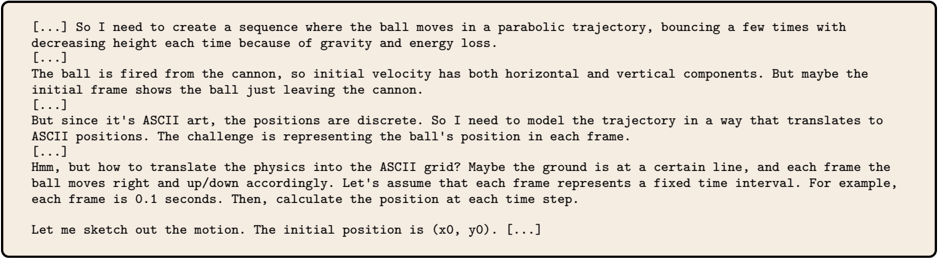
The image contains a block of text describing the problem of simulating a ball's parabolic trajectory with bounces in ASCII art. It outlines the considerations for modeling the motion, including gravity, energy loss, discrete positions, and translating physics into an ASCII grid.
### Components/Axes
There are no axes or scales in this image. It is purely textual.
### Detailed Analysis or Content Details
The text can be broken down into the following key points:
1. **Goal:** Create a sequence where a ball moves in a parabolic trajectory, bouncing with decreasing height due to gravity and energy loss.
2. **Initial Conditions:** The ball is fired from a cannon, implying initial horizontal and vertical velocity components. The initial frame may show the ball just leaving the cannon.
3. **ASCII Art Constraint:** The positions are discrete because it's ASCII art. The challenge is representing the ball's position in each frame.
4. **ASCII Grid Translation:** The ground is assumed to be a certain line in the ASCII grid. The ball moves right and up/down accordingly in each frame.
5. **Time Interval:** Each frame represents a fixed time interval, specifically 0.1 seconds.
6. **Calculation:** The position needs to be calculated at each time step.
7. **Initial Position:** The initial position is denoted as (x0, y0).
### Key Observations
The text highlights the challenges of representing continuous physics in a discrete ASCII environment. The fixed time interval per frame is a crucial parameter for the simulation.
### Interpretation
The text describes the setup for a physics simulation problem, specifically modeling a bouncing ball's trajectory using ASCII characters. The author is considering how to translate the continuous physics of motion into a discrete grid-based representation. The mention of gravity, energy loss, and initial velocity components indicates an understanding of the underlying physics principles. The fixed time interval per frame suggests a time-stepping approach to the simulation. The initial position (x0, y0) is a standard way to define the starting point of the ball's motion. The problem is framed as a translation of physics into ASCII, which implies a need for approximations and simplifications.