\n
## Text Block: Ball Trajectory Planning
### Overview
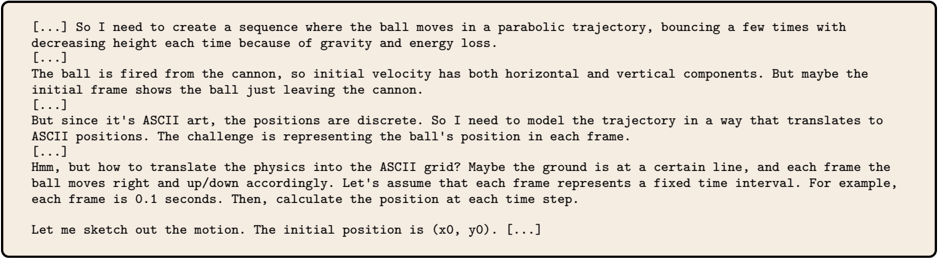
The image contains a block of text outlining the thought process for creating an ASCII art animation of a bouncing ball. The text details the challenges of translating physics (parabolic trajectory, gravity, energy loss) into discrete ASCII positions and proposes a solution involving fixed time intervals and calculating position at each step.
### Content Details
The text can be transcribed as follows:
“[…] So I need to create a sequence where the ball moves in a parabolic trajectory, bouncing a few times with decreasing height each time because of gravity and energy loss. [….]
The ball is fired from the cannon, so initial velocity has both horizontal and vertical components. But maybe the initial frame shows the ball just leaving the cannon. [….]
But since it’s ASCII art, the positions are discrete. So I need to model the trajectory in a way that translates to ASCII positions. The challenge is representing the ball’s position in each frame. [….]
Hmm, but how to translate the physics into the ASCII grid? Maybe the ground is at a certain line, and each frame the ball moves right and up/down accordingly. Let’s assume that each frame represents a fixed time interval. For example, each frame is 0.1 seconds. Then, calculate the position at each time step.
Let me sketch out the motion. The initial position is (x0, y0). [….]”
### Key Observations
The text is a stream of consciousness, indicating a problem-solving approach. It highlights the core issues:
* **Parabolic Motion:** The desired movement of the ball.
* **Discretization:** The need to represent continuous motion in a discrete ASCII grid.
* **Time Steps:** The proposal to use fixed time intervals for calculation.
* **Initial Conditions:** The mention of initial position (x0, y0) and velocity.
### Interpretation
The text represents the initial planning stages of a programming or art project. The author is grappling with the complexities of simulating physics within the limitations of ASCII art. The focus on discrete positions and fixed time intervals suggests an intention to use numerical methods to approximate the ball's trajectory. The mention of gravity and energy loss indicates an awareness of the factors influencing the ball's motion. The ellipses "[….]" suggest that this is an excerpt from a larger document or conversation, and that the author is actively thinking through the problem and potentially exploring different ideas. The final sentence indicates a shift towards a more concrete approach – sketching out the motion to visualize the problem. This is a typical iterative process in problem-solving, moving from abstract concepts to visual representations.