## Text Block: Technical Problem-Solving Notes on ASCII Physics Simulation
### Overview
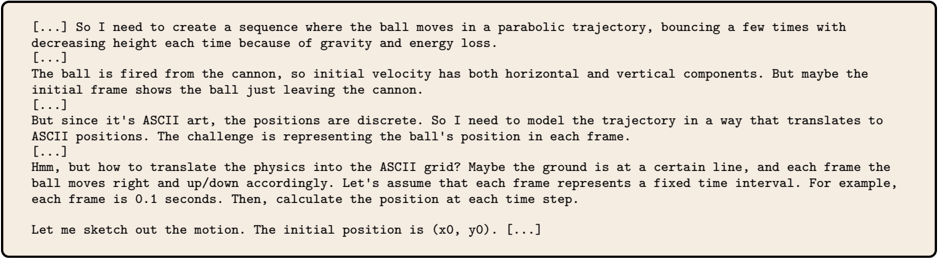
The image displays a block of text, likely from a technical document, design note, or code comment. The text outlines the conceptual process and challenges of simulating a bouncing ball's physics for representation in ASCII art. It is presented on a light beige background in a monospaced font.
### Content Details (Full Transcription)
The text is in English. The following is a precise transcription, preserving the ellipses `[...]` which indicate omitted or placeholder content.
```
[...] So I need to create a sequence where the ball moves in a parabolic trajectory, bouncing a few times with decreasing height each time because of gravity and energy loss.
[...]
The ball is fired from the cannon, so initial velocity has both horizontal and vertical components. But maybe the initial frame shows the ball just leaving the cannon.
[...]
But since it's ASCII art, the positions are discrete. So I need to model the trajectory in a way that translates to ASCII positions. The challenge is representing the ball's position in each frame.
[...]
Hmm, but how to translate the physics into the ASCII grid? Maybe the ground is at a certain line, and each frame the ball moves right and up/down accordingly. Let's assume that each frame represents a fixed time interval. For example, each frame is 0.1 seconds. Then, calculate the position at each time step.
Let me sketch out the motion. The initial position is (x0, y0). [...]
```
### Key Observations
1. **Problem Domain:** The text is a problem-solving narrative focused on translating continuous physics (projectile motion with damping) into a discrete, grid-based medium (ASCII art).
2. **Key Challenges Identified:**
* **Discretization:** Converting continuous parabolic motion into discrete ASCII grid positions.
* **Frame-Based Animation:** Modeling the trajectory as a sequence of frames, each representing a fixed time step (e.g., 0.1 seconds).
* **Physics Implementation:** Incorporating gravity (causing downward acceleration) and energy loss (causing decreasing bounce height).
3. **Assumptions & Parameters:** The author establishes working assumptions: the cannon provides initial horizontal and vertical velocity, and the ground is defined as a specific line in the ASCII grid.
4. **Process:** The text follows a logical flow: defining the goal → identifying constraints (ASCII) → posing the core translation problem → proposing a frame/time-step model → beginning to sketch the mathematical model with initial conditions `(x0, y0)`.
### Interpretation
This text captures the "thinking-aloud" phase of a technical or creative project. It reveals the analytical process of breaking down a complex natural phenomenon (a bouncing ball) into a set of rules and calculations suitable for a constrained digital representation.
* **Underlying Goal:** The author is likely designing an animation, a game, or a visualization for a terminal or text-based environment.
* **Methodology:** The approach is systematic and computational. It moves from a high-level description of motion to the identification of a core technical hurdle (discrete positioning) and then to the formulation of a solvable model using time-based steps and coordinate geometry.
* **Implied Next Steps:** The text cuts off just as the author begins to "sketch out the motion." The logical continuation would involve writing the equations for position as a function of time, incorporating the bounce condition (when `y` equals the ground line), and applying a coefficient of restitution to model energy loss on each bounce. The final step would be mapping these calculated `(x, y)` coordinates to specific rows and columns in a text grid.