## Text Block: Parabolic Trajectory Modeling in ASCII Art
### Overview
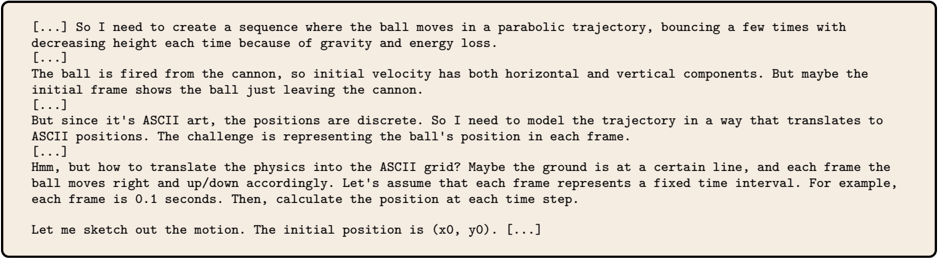
The image contains a block of text discussing the challenge of modeling a ball's parabolic trajectory (with bouncing and energy loss) in ASCII art. The text outlines a physics-based approach to translate continuous motion into discrete grid positions, considering frame intervals and gravitational effects.
### Components/Axes
- **No visual axes, legends, or numerical scales** are present. The content is purely textual.
- **Key terms**: "parabolic trajectory," "ASCII positions," "gravity," "energy loss," "frame interval," "initial velocity," "horizontal/vertical components."
### Detailed Analysis
1. **Problem Statement**:
- A ball is fired from a cannon with horizontal and vertical velocity components.
- The goal is to model its motion in ASCII art, where positions are discrete.
- Each frame represents a fixed time interval (e.g., 0.1 seconds).
2. **Physics Translation**:
- The ball’s trajectory must account for gravity and energy loss, causing decreasing bounce heights.
- Initial position is given as `(x₀, y₀)`.
- Positions are calculated at each time step (frame) to map to the ASCII grid.
3. **Challenges**:
- Discrete ASCII positions vs. continuous physics equations.
- Determining how to align the ball’s motion (right/up/down) with grid cells.
### Key Observations
- The text emphasizes the need to reconcile physics equations (e.g., projectile motion) with the constraints of ASCII art’s grid-based representation.
- No numerical data points or visual trends are provided; the focus is on conceptual steps for implementation.
### Interpretation
The text outlines a method to simulate projectile motion in a low-resolution, grid-based medium (ASCII art). By breaking motion into discrete time steps (frames), the author suggests calculating positions iteratively while accounting for energy dissipation. This approach highlights the tension between continuous physical laws and discrete computational representations, a common challenge in game development or procedural animation. The lack of numerical examples implies the text is a conceptual framework rather than a ready-to-implement solution.