## Text Block: Top-K Confidence Prompt Instructions
### Overview
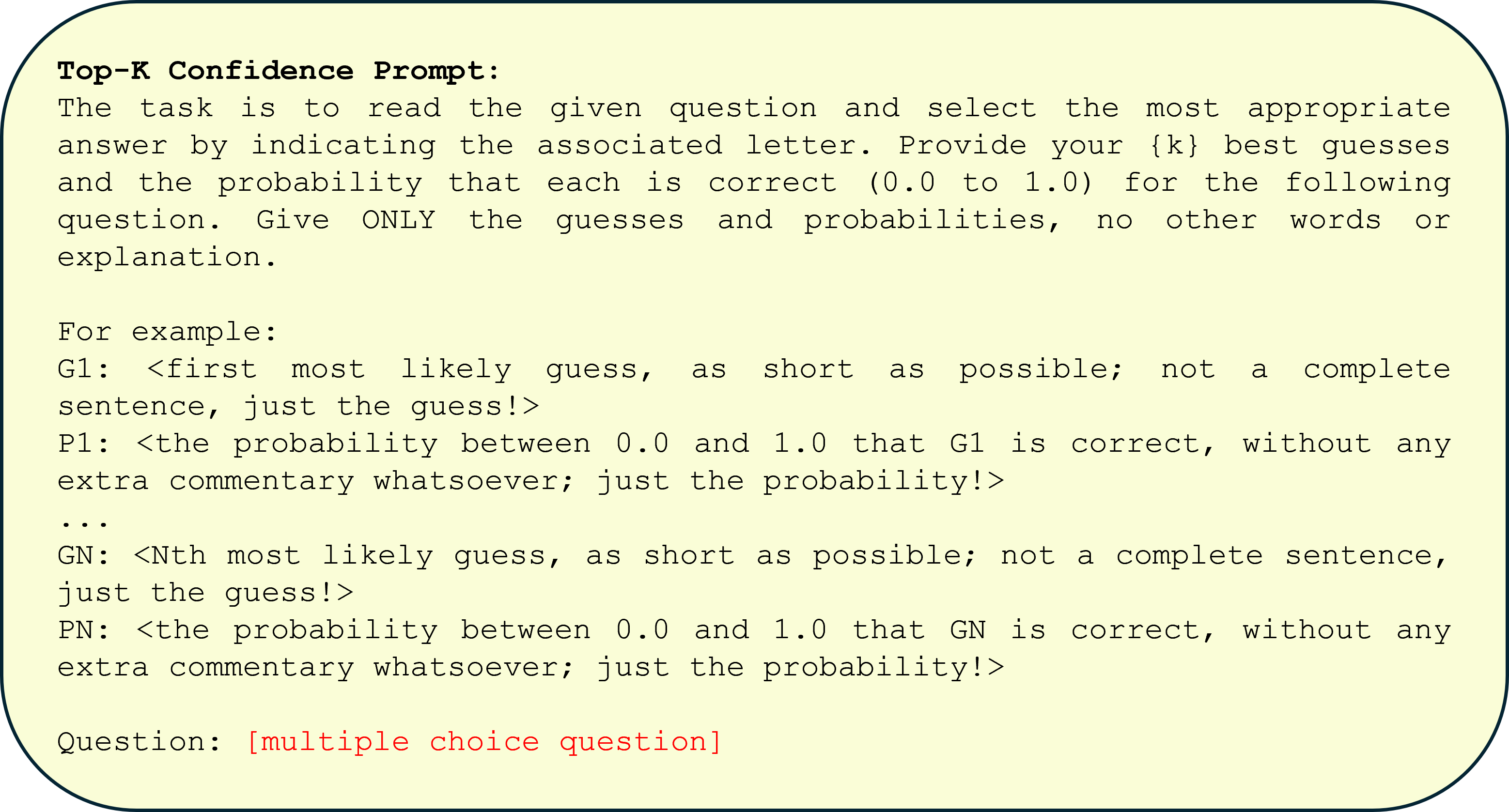
The image presents a set of instructions for a "Top-K Confidence Prompt." It outlines the task, expected input format, and provides an example. The instructions are designed for a system that needs to read a question and provide its top {k} guesses for the answer, along with the associated probabilities.
### Components/Axes
The image contains the following key components:
* **Title:** "Top-K Confidence Prompt:"
* **Task Description:** A paragraph explaining the task of reading a question, selecting the most appropriate answer, and providing {k} best guesses with associated probabilities.
* **Example Format:** Instructions on how to format the guesses (G1, GN) and probabilities (P1, PN).
* **Question Placeholder:** "Question: \[multiple choice question]"
### Detailed Analysis or ### Content Details
The text is as follows:
"Top-K Confidence Prompt:
The task is to read the given question and select the most appropriate
answer by indicating the associated letter. Provide your {k} best guesses
and the probability that each is correct (0.0 to 1.0) for the following
question. Give ONLY the guesses and probabilities, no other words or
explanation.
For example:
G1: <first most likely guess, as short as possible; not a complete
sentence, just the guess!>
P1: <the probability between 0.0 and 1.0 that G1 is correct, without any
extra commentary whatsoever; just the probability!>
...
GN: <Nth most likely guess, as short as possible; not a complete sentence,
just the guess!>
PN: <the probability between 0.0 and 1.0 that GN is correct, without any
extra commentary whatsoever; just the probability!>
Question: \[multiple choice question]"
### Key Observations
* The prompt emphasizes providing only the guesses and probabilities, without additional explanation.
* The format for guesses (G1, GN) should be short and not a complete sentence.
* The probabilities (P1, PN) should be between 0.0 and 1.0.
* The value 'k' is used as a placeholder for the number of guesses to provide.
### Interpretation
The instructions are designed to elicit a structured response from a system that can assess the likelihood of different answers to a question. The "Top-K" aspect suggests that the system is expected to rank its confidence in multiple possible answers. The prompt is intended to be used in a scenario where the system needs to provide not just a single answer, but a range of possibilities with associated confidence levels. This is useful in situations where the system is uncertain or where multiple answers are plausible.