\n
## Text Block: Prompt Instructions
### Overview
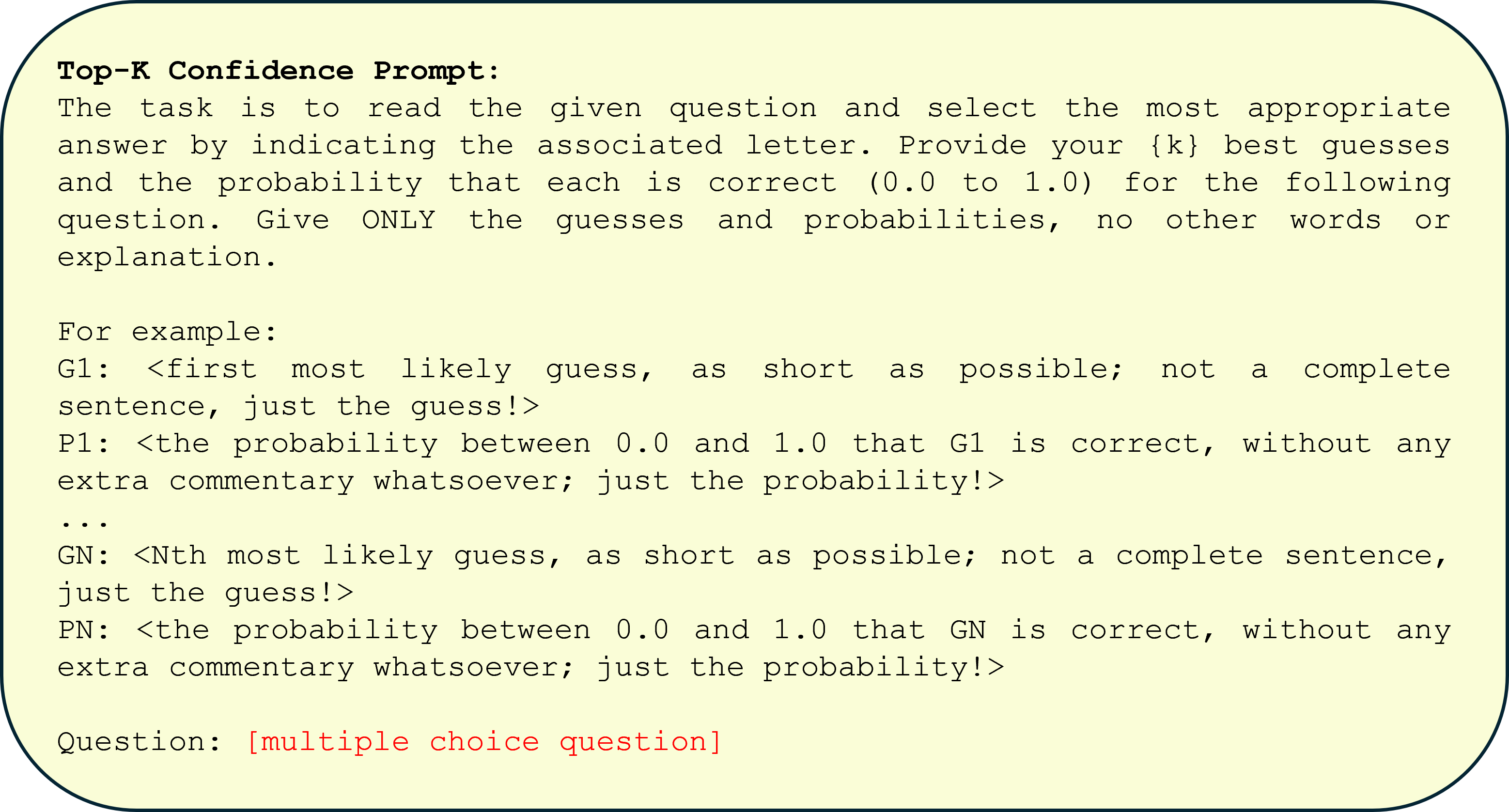
The image contains a text block outlining instructions for a "Top-K Confidence Prompt" task. The prompt details how a language model should respond to a multiple-choice question by providing a ranked list of guesses along with associated confidence probabilities.
### Content Details
The text can be transcribed as follows:
"Top-K Confidence Prompt:
The task is to read the given question and select the most appropriate answer by indicating the associated letter. Provide your (k) best guesses and the probability that each is correct (0.0 to 1.0) for the following question. Give ONLY the guesses and probabilities, no other words or explanation.
For example:
G1: <first most likely guess, as short as possible; not a complete sentence, just the guess!>
P1: <the probability between 0.0 and 1.0 that G1 is correct, without any extra commentary whatsoever; just the probability!>
...
GN: <Nth most likely guess, as short as possible; not a complete sentence, just the guess!>
PN: <the probability between 0.0 and 1.0 that GN is correct, without any extra commentary whatsoever; just the probability!>
Question: [multiple choice question]"
### Key Observations
The text is formatted as a set of instructions, with an example provided to clarify the expected output format. The instructions emphasize conciseness and the exclusive provision of guesses and probabilities. The placeholder "[multiple choice question]" indicates that this is a template for a larger prompt.
### Interpretation
This text defines a specific prompting strategy designed to elicit confidence estimates from a language model. The "Top-K" aspect suggests that the model should provide multiple potential answers, ranked by their estimated probability of correctness. The strict output format (guesses and probabilities only) is intended to facilitate automated evaluation and analysis of the model's performance. The example is crucial for understanding the desired response structure. The prompt is designed to avoid verbose explanations and focus solely on the model's confidence in its answers.