## Screenshot: Top-K Confidence Prompt
### Overview
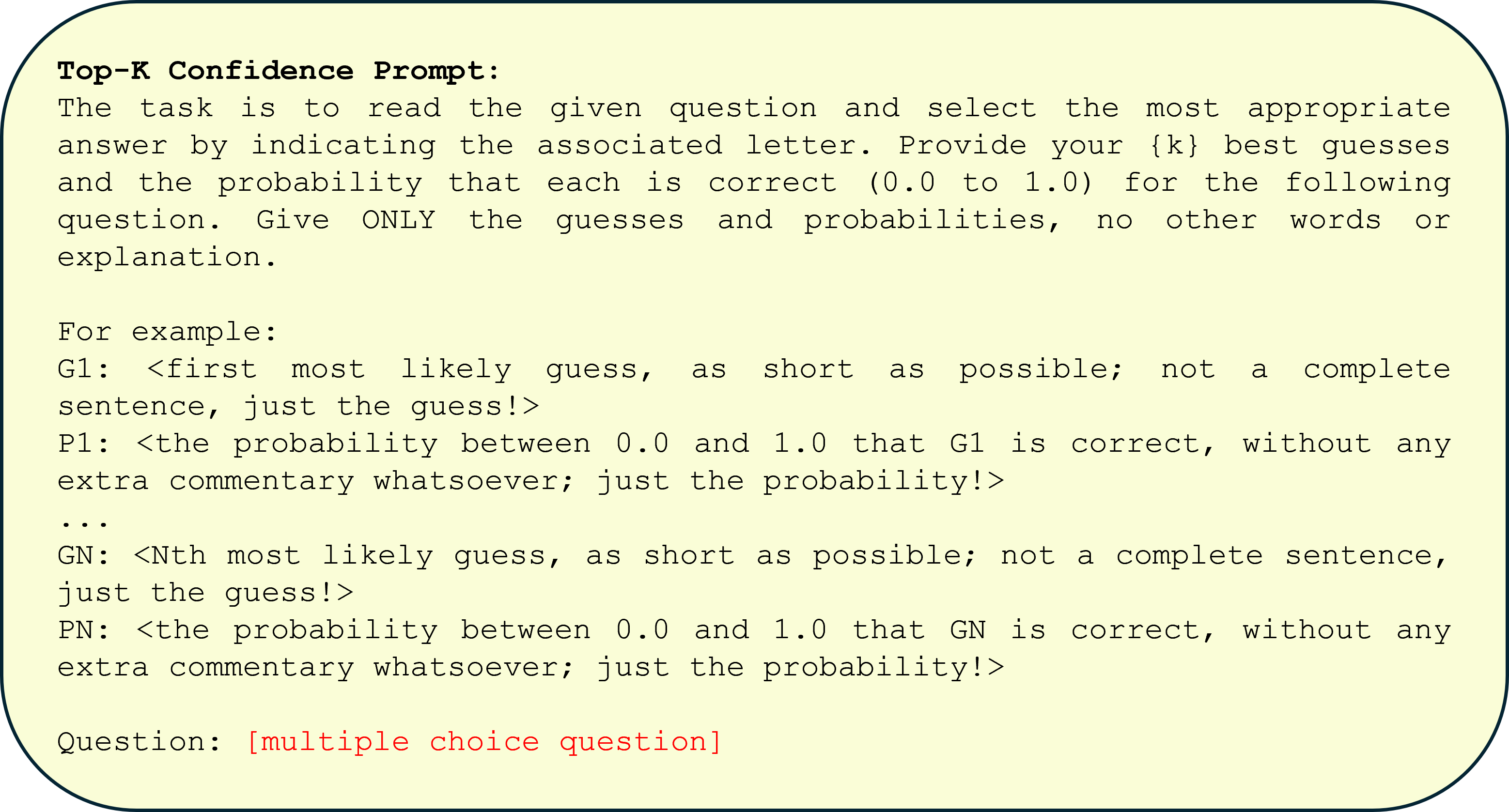
The image displays a technical prompt for a task involving selecting the top-K most likely answers to a multiple-choice question, along with their associated probabilities. The prompt includes formatting guidelines, an example, and a placeholder for the actual question.
### Components/Axes
- **Title**: "Top-K Confidence Prompt:" (bold, top-left)
- **Task Description**: Instructions to select the most appropriate answer by indicating associated letters and providing probabilities (0.0–1.0) for the top-K guesses.
- **Example Section**:
- **G1**: Placeholder for the first most likely guess (e.g., "first most likely guess, as short as possible; not a complete sentence, just the guess!").
- **P1**: Placeholder for the probability of G1 being correct (e.g., "the probability between 0.0 and 1.0 that G1 is correct, without any extra commentary whatsoever; just the probability!").
- **GN**: Placeholder for the Nth most likely guess (e.g., "Nth most likely guess, as short as possible; not a complete sentence, just the guess!").
- **PN**: Placeholder for the probability of GN being correct (e.g., "the probability between 0.0 and 1.0 that GN is correct, without any extra commentary whatsoever; just the probability!").
- **Question Placeholder**: "[multiple choice question]" (red text, bottom of the prompt).
### Detailed Analysis
- **Formatting Rules**:
- Only guesses and probabilities are to be provided; no additional words or explanations.
- Guesses (G1, GN) must be concise, avoiding complete sentences.
- Probabilities (P1, PN) must be numerical values between 0.0 and 1.0, with no commentary.
- **Example Structure**:
- Each guess (G1, GN) is labeled with a letter and a brief instruction.
- Each probability (P1, PN) is labeled with a letter and a numerical range instruction.
- **Placeholder**: The question is denoted as "[multiple choice question]" in red, indicating where the actual question would be inserted.
### Key Observations
- The prompt emphasizes brevity and precision in both guesses and probabilities.
- The example uses placeholders (e.g., "Nth most likely guess") to illustrate the required format.
- The red text for the question placeholder suggests it is a variable input for the task.
### Interpretation
This prompt is designed for a system or user to generate top-K guesses for a multiple-choice question, prioritizing confidence scores (probabilities) for each guess. The structure ensures clarity and consistency in responses, avoiding ambiguity. The example demonstrates how to format answers without extraneous text, which is critical for automated processing or evaluation. The use of placeholders (e.g., "Nth") indicates scalability for varying values of K. The red question placeholder highlights the need for customization based on the specific query being addressed.