## Histogram: Comparison of Geometric Quantum Theory and Quantum Mechanics Probability Distributions
### Overview
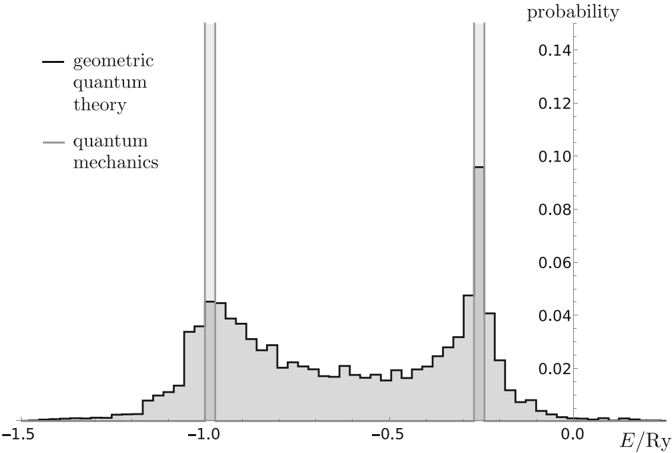
The image is a histogram comparing the probability distributions of two theoretical frameworks: geometric quantum theory (solid black line) and quantum mechanics (dashed line). The x-axis represents energy in Rydberg units (E/Ry), ranging from -1.5 to 0.0, while the y-axis represents probability, ranging from 0 to 0.14. The distributions show distinct peaks and spreads, indicating differences in energy state probabilities between the two theories.
### Components/Axes
- **X-axis (E/Ry)**: Energy in Rydberg units, labeled with approximate markers at -1.5, -1.0, -0.5, and 0.0.
- **Y-axis (Probability)**: Probability values, labeled with approximate markers at 0.02, 0.04, 0.06, 0.08, 0.10, 0.12, and 0.14.
- **Legend**:
- Solid black line: "geometric quantum theory"
- Dashed line: "quantum mechanics"
- **Placement**: The legend is positioned in the top-left corner of the chart.
### Detailed Analysis
- **Geometric Quantum Theory (Solid Line)**:
- Peaks at approximately **E/Ry = -1.0** (probability ~0.10) and **E/Ry = 0.0** (probability ~0.08).
- A secondary peak near **E/Ry = -0.5** (probability ~0.06).
- The distribution is more concentrated at the extremes (closer to -1.5 and 0.0) compared to quantum mechanics.
- **Quantum Mechanics (Dashed Line)**:
- A prominent peak at **E/Ry = -0.5** (probability ~0.08).
- A smaller peak near **E/Ry = -1.0** (probability ~0.06).
- The distribution is broader, with lower probabilities at the extremes (e.g., ~0.02 at E/Ry = -1.5 and ~0.04 at E/Ry = 0.0).
### Key Observations
1. **Peak Differences**:
- Geometric quantum theory exhibits higher probability at **E/Ry = -1.0** and **0.0**, while quantum mechanics peaks at **E/Ry = -0.5**.
2. **Spread**:
- Geometric quantum theory shows a narrower distribution at the extremes, whereas quantum mechanics has a more uniform spread across the range.
3. **Probability Magnitude**:
- The maximum probability for geometric quantum theory (~0.10) is slightly higher than that of quantum mechanics (~0.08).
### Interpretation
The histogram suggests that geometric quantum theory and quantum mechanics predict different energy state probabilities. The geometric theory's higher probability at **E/Ry = -1.0** and **0.0** may indicate stronger or more localized energy states in this framework, while quantum mechanics' broader distribution could reflect a more delocalized or probabilistic nature of energy states. The peak at **E/Ry = -0.5** in quantum mechanics might correspond to a stable or resonant energy level in that theory. These differences highlight potential divergences in how the two theories model quantum systems, possibly due to variations in assumptions about spatial geometry or probabilistic behavior.