## Diagram: Neural Network Block for Output Computation
### Overview
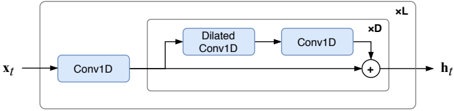
The diagram illustrates a computational block in a neural network architecture, showing the flow of data from input `x_t` to output `h_t`. It includes two parallel convolutional pathways (dilated and standard) combined via element-wise addition.
### Components/Axes
- **Input**: `x_t` (time-step input)
- **Blocks**:
- `Conv1D`: Standard 1D convolutional layer.
- `Dilated Conv1D`: Dilated 1D convolutional layer (skips input values to capture broader context).
- **Operations**:
- `×L`: Multiplication by a learnable scalar `L`.
- `×D`: Multiplication by a learnable scalar `D`.
- `+`: Element-wise addition of the two pathways.
- **Output**: `h_t` (final output at time step `t`).
### Detailed Analysis
1. **Input Pathway**:
- `x_t` is first processed by a `Conv1D` layer.
2. **Parallel Pathways**:
- The output of `Conv1D` splits into two branches:
- **Dilated Path**: Processed by `Dilated Conv1D`, then scaled by `×L`.
- **Standard Path**: Processed by `Conv1D`, then scaled by `×D`.
3. **Combined Output**:
- The scaled outputs of both pathways are summed to produce `h_t`.
### Key Observations
- The architecture uses **dilation** to increase receptive field without adding layers.
- Learnable scalars `L` and `D` allow adaptive weighting of the two pathways.
- No numerical values or trends are present; the diagram focuses on structural relationships.
### Interpretation
This block likely serves as a **gating mechanism** (e.g., in an LSTM or attention network), where dilated and standard convolutions capture different temporal scales. The element-wise addition suggests a fusion of features at multiple resolutions. The absence of explicit activation functions (e.g., ReLU) implies they may be omitted for simplicity or assumed in the `Conv1D` blocks.
**Note**: No numerical data, trends, or outliers are present in this diagram. It is purely architectural.