## Diagram: Hierarchical Flow of Acronyms
### Overview
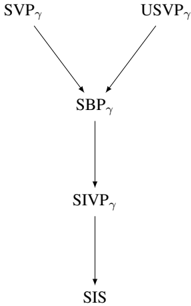
The image displays a simple, top-down hierarchical flow diagram consisting of five text labels (acronyms) connected by directional arrows. The diagram illustrates a process or relationship where two initial components converge into a single path, which then proceeds through two further stages. The visual style is minimal, using black text and arrows on a plain white background.
### Components/Axes
The diagram contains the following textual components, listed with their approximate spatial positions:
1. **Top-Left:** `SVPγ`
2. **Top-Right:** `USVPγ`
3. **Center (below the top two):** `SBPγ`
4. **Center (below SBPγ):** `SIVPγ`
5. **Bottom-Center:** `SIS`
**Arrows (Flow Direction):**
* An arrow points from `SVPγ` (top-left) down and to the right, terminating at `SBPγ`.
* An arrow points from `USVPγ` (top-right) down and to the left, terminating at `SBPγ`.
* A vertical arrow points from `SBPγ` straight down to `SIVPγ`.
* A vertical arrow points from `SIVPγ` straight down to `SIS`.
### Detailed Analysis
The structure defines a clear, linear flow after an initial convergence:
1. **Convergence Stage:** Two distinct elements, `SVPγ` and `USVPγ`, both feed into a common element, `SBPγ`. This suggests `SBPγ` is a synthesis, combination, or result derived from the first two.
2. **Sequential Processing Stage:** The output of `SBPγ` flows directly into `SIVPγ`.
3. **Final Output Stage:** The output of `SIVPγ` flows directly into the final element, `SIS`.
The consistent use of the Greek letter gamma (γ) as a subscript on the first four acronyms (`SVPγ`, `USVPγ`, `SBPγ`, `SIVPγ`) indicates they belong to a related family or version of processes/models. The final element, `SIS`, lacks this subscript, suggesting it may be a distinct, higher-level, or resultant system.
### Key Observations
* **Hierarchical and Linear Flow:** The diagram is strictly hierarchical and unidirectional, with no feedback loops or branches after the initial convergence.
* **Symmetry in Convergence:** The top two elements are positioned symmetrically, emphasizing their parallel role as inputs to `SBPγ`.
* **Notation Consistency:** The γ subscript is applied uniformly to the first four terms, creating a clear visual and conceptual grouping.
* **Minimalist Design:** The diagram contains no decorative elements, colors, or legends. All information is conveyed through the text labels and arrow directions.
### Interpretation
This diagram most likely represents a **technical or scientific workflow, model architecture, or data processing pipeline**. The acronyms are domain-specific, but their structure suggests a logical progression:
* **`SVPγ` and `USVPγ`** could represent two different sensing, processing, or validation modules (e.g., "Sensor Validation Process" and "Uncalibrated Sensor Validation Process").
* **`SBPγ`** likely stands for a "Sensor Fusion," "State Belief," or "System Block" process that integrates the outputs from the two preceding modules.
* **`SIVPγ`** might be a subsequent "System Integration," "State Inference," or "Signal Interpretation" validation process.
* **`SIS`** is the final output, potentially a "System Integrity Status," "Safety Instrumented System," or "Situation Awareness" score.
The flow implies that raw or pre-processed data from two sources (`SVPγ`, `USVPγ`) is fused or assessed (`SBPγ`), then further interpreted or validated (`SIVPγ`), before culminating in a final system state or decision (`SIS`). The absence of the γ subscript on `SIS` may indicate it is the ultimate, version-agnostic output of the entire pipeline. Without additional context, the exact meaning of the acronyms remains speculative, but the structural relationship between them is explicitly defined by the diagram.