## Diagram: Neuro-Symbolic Probabilistic AI System Overview
### Overview
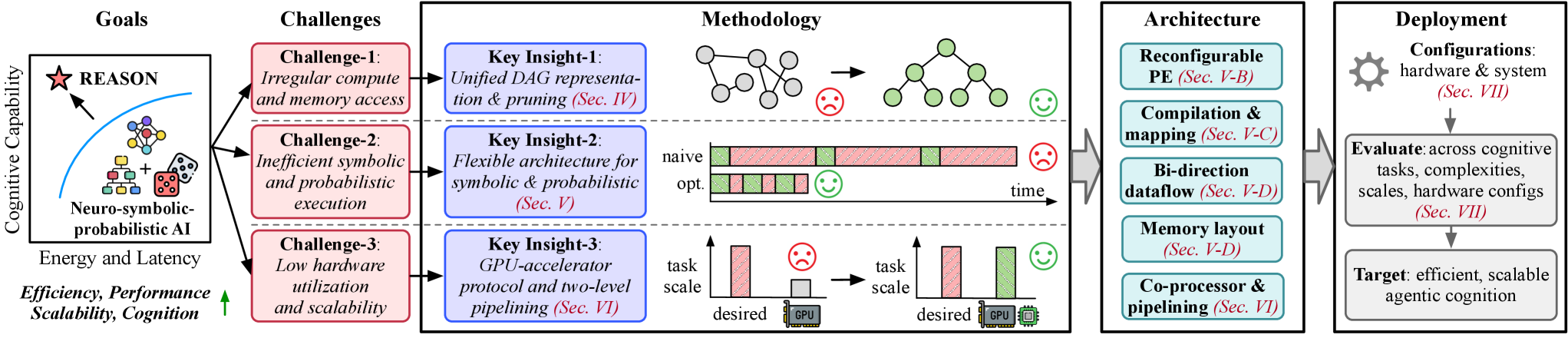
This diagram illustrates a system overview for Neuro-Symbolic Probabilistic AI, outlining the goals, challenges, methodology, architecture, and deployment stages. It uses a flow-based representation with boxes representing stages and icons representing key insights or components. The diagram is organized horizontally, moving from left to right, representing a progression from goals to deployment.
### Components/Axes
The diagram is divided into five main columns:
1. **Goals:** Focuses on the desired capabilities of the system.
2. **Challenges:** Identifies the key obstacles to achieving those goals.
3. **Methodology:** Describes the approach used to overcome the challenges.
4. **Architecture:** Details the system's structural components.
5. **Deployment:** Outlines the steps for implementing and evaluating the system.
The left-most column has a vertical axis labeled "Cognitive Capability" with two levels: "REASON" (top) and "Neuro-symbolic probabilistic AI" (center), and "Energy and Latency, Efficiency, Performance, Scalability, Cognition" (bottom).
The diagram also includes references to sections (e.g., "Sec. IV", "Sec. V") within a larger document, indicating where more detailed information can be found.
### Detailed Analysis or Content Details
**Goals (Leftmost Column):**
* Top: A star icon labeled "REASON".
* Middle: A collection of icons representing various elements (balls, cubes, gears, etc.) labeled "Neuro-symbolic probabilistic AI".
* Bottom: A green upward-pointing arrow labeled "Energy and Latency, Efficiency, Performance, Scalability, Cognition".
**Challenges (Second Column):**
* **Challenge-1:** "Irregular compute and memory access".
* **Challenge-2:** "Inefficient symbolic and probabilistic execution".
* **Challenge-3:** "Low hardware utilization and scalability".
**Methodology (Third Column):**
* **Key Insight-1:** "Unified DAG representation & pruning (Sec. IV)". Depicted as a network of interconnected circles with a smiling face icon.
* **Key Insight-2:** "Flexible architecture for naive symbolic & probabilistic opt. (Sec. V)". Depicted as a network of interconnected circles with a smiling face icon. An arrow labeled "time" points from left to right.
* **Key Insight-3:** "GPU-accelerator protocol and two-level pipelining (Sec. VI)". Depicted as two sets of interconnected circles with a smiling face icon, each labeled "task" and "desired GPU".
**Architecture (Fourth Column):**
* **Reconfigurable PE (Sec. V-B):** Represented by a gear icon.
* **Compilation & mapping (Sec. V-C):** Represented by a downward-pointing arrow.
* **Bi-direction dataflow (Sec. V-D):** Represented by a bidirectional arrow.
* **Memory layout (Sec. V-D):** Represented by a rectangular block.
* **Co-processor & pipelining (Sec. VI):** Represented by a rectangular block.
**Deployment (Rightmost Column):**
* "Configurations hardware & system (Sec. VII)". Represented by a gear icon.
* "Evaluate across cognitive tasks, complexities, scales, hardware configs (Sec. VII)". Represented by a downward-pointing arrow.
* "Target: efficient, scalable agentic cognition".
### Key Observations
The diagram emphasizes a progression from high-level goals to concrete deployment steps. The "Key Insights" in the Methodology column appear to be solutions to the identified "Challenges". The use of smiling face icons within the Methodology section suggests a positive or successful approach to each insight. The references to sections (e.g., Sec. IV, Sec. V) indicate a larger document providing more detailed information. The diagram is visually structured to show a clear flow of information and dependencies.
### Interpretation
This diagram presents a high-level overview of a neuro-symbolic probabilistic AI system. It highlights the core challenges in building such a system – irregular compute, inefficient execution, and hardware limitations – and proposes a methodology based on unified DAG representation, flexible architecture, and GPU acceleration to address these challenges. The architecture focuses on reconfigurable processing elements, efficient dataflow, and memory layout. The ultimate goal is to achieve efficient, scalable, and agentic cognition.
The diagram suggests a system that aims to combine the strengths of both neuro-symbolic and probabilistic approaches to AI. The emphasis on GPU acceleration indicates a focus on performance and scalability. The references to specific sections within a larger document suggest a detailed technical report or paper. The smiling face icons within the methodology section could be interpreted as a visual cue to indicate the effectiveness or promise of each key insight. The overall diagram conveys a sense of a well-planned and structured approach to building a complex AI system.