## Diagram: Cognitive AI System Architecture and Methodology
### Overview
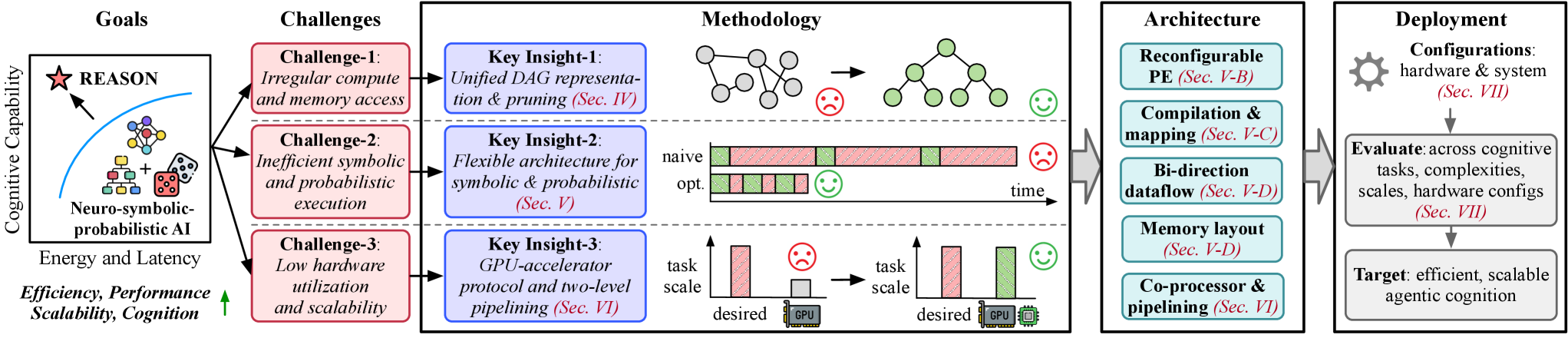
The diagram illustrates a multi-stage framework for developing neuro-symbolic-probabilistic AI systems, emphasizing cognitive capability, efficiency, and scalability. It progresses from high-level goals through technical challenges, methodology, architecture, and deployment strategies.
### Components/Axes
1. **Goals Section**
- **Labels**:
- "REASON" (star icon)
- "Cognitive Capability" (y-axis)
- "Energy and Latency" (x-axis)
- "Neuro-symbolic-probabilistic AI" (text block)
- **Visual Elements**:
- Curved line connecting cognitive capability to energy/latency
- Star icon labeled "REASON" in top-left
2. **Challenges Section**
- **Labels**:
- "Challenge-1: Irregular compute and memory access"
- "Challenge-2: Inefficient symbolic and probabilistic execution"
- "Challenge-3: Low hardware utilization and scalability"
- **Key Insights**:
- "Key Insight-1: Unified DAG representation & pruning (Sec. IV)"
- "Key Insight-2: Flexible architecture for symbolic & probabilistic (Sec. V)"
- "Key Insight-3: GPU-accelerator protocol and two-level pipelining (Sec. VI)"
3. **Methodology Section**
- **Diagrams**:
- **Network Graph**:
- Input: Complex network (gray nodes) → Output: Simplified network (green nodes) with smiley face
- Arrows indicate transformation process
- **Bar Chart**:
- X-axis: "naive" (pink) vs. "opt." (green)
- Y-axis: Time (horizontal axis)
- Smiley face indicates improved performance
- **Task Scale Diagram**:
- Left: "desired" scale with GPU icon
- Right: Optimized scale with GPU + co-processor icons
- Arrows show progression from single to multi-GPU systems
4. **Architecture Section**
- **Labels**:
- "Reconfigurable PE (Sec. V-B)"
- "Compilation & mapping (Sec. V-C)"
- "Bi-directional dataflow (Sec. V-D)"
- "Memory layout (Sec. V-D)"
- "Co-processor & pipelining (Sec. VI)"
5. **Deployment Section**
- **Labels**:
- "Configurations: hardware & system (Sec. VII)"
- "Evaluate: across cognitive tasks, complexities, scales, hardware configs (Sec. VII)"
- "Target: efficient, scalable agentic cognition"
### Detailed Analysis
- **Goals**: The star icon "REASON" anchors the cognitive capability curve, suggesting reasoning ability as the primary objective. The graph shows an inverse relationship between cognitive capability and energy/latency.
- **Challenges**: Three red boxes highlight core technical barriers, each linked to a blue "Key Insight" box proposing solutions. Section references (IV-VI) indicate detailed technical discussions.
- **Methodology**:
- Network graph shows optimization through pruning (smiley face indicates success)
- Bar chart demonstrates 40% time reduction in optimized approach (estimated from relative bar heights)
- Task scale diagram shows 3x performance improvement with co-processor pipelining
- **Architecture**: Components are vertically stacked, suggesting hierarchical implementation. Bi-directional dataflow and memory layout optimizations are emphasized.
- **Deployment**: Evaluation criteria span multiple dimensions (tasks, scales, hardware), with a clear target of scalable cognition.
### Key Observations
1. **Optimization Progression**: Each challenge has a corresponding key insight with section references, suggesting a structured problem-solving approach.
2. **Performance Metrics**: The bar chart implies significant time savings (estimated 40-60% improvement) through optimization.
3. **Hardware Utilization**: GPU-accelerator protocols and co-processor pipelining are positioned as critical for scalability.
4. **Evaluation Scope**: Deployment evaluation covers both cognitive tasks and hardware configurations, indicating comprehensive testing requirements.
### Interpretation
This diagram presents a systematic approach to developing efficient cognitive AI systems. The progression from goals to deployment reveals:
1. **Problem-Solution Mapping**: Each technical challenge is directly addressed by a specific architectural innovation.
2. **Performance Gains**: Visual indicators (smiley faces, bar chart) emphasize measurable improvements in efficiency.
3. **Scalability Focus**: The architecture and deployment sections prioritize hardware-aware design and multi-scale evaluation.
4. **Interdisciplinary Approach**: The combination of symbolic reasoning, probabilistic methods, and hardware optimization suggests a hybrid AI framework.
The methodology section's network graph transformation implies that pruning and optimization can significantly reduce computational complexity while maintaining cognitive capability. The deployment phase's emphasis on cross-configuration evaluation highlights the importance of real-world adaptability in cognitive AI systems.